Audit Report of the New York City Department of Education’s Oversight of Its Contracted Bus Services
Audit Impact
Summary of Findings
The audit found that the New York City Department of Education (DOE) does not adequately oversee vendors that provide school bus transportation and technology, nor does it hold them accountable for poor performance by implementing corrective action plans, issuing violations or assessing penalties as warranted. DOE does not proactively or systematically use readily available global positioning system (GPS) or complaint data to oversee school bus vendors, enforce contract terms, identify trends and problematic vendors or routes, or improve performance. DOE primarily relies on investigations of individual complaints to oversee vendors and assess their performance but lacks formal policies and procedures for reviewing and resolving them. Further, based on an in-depth review of sampled problematic routes, DOE did not adequately or promptly investigate individual complaints or take effective corrective action to resolve them.
In addition, DOE did not investigate vendor reports of problematic routes and did not ensure that GPS devices were installed and operational on all school buses, or that practice runs were conducted for all routes before the first day of school.
As a result, students missed school, support services, and free school meals, adversely impacting their academic performance and progress, and students and their families were repeatedly inconvenienced by unreliable bus service. Based on vendors’ self-reported delays and complaint data for School Year 2023–24 (SY2023–24), special education students were disproportionately impacted by unreliable bus service.
The audit also found that DOE did not adequately oversee or hold Via Transportation, Inc. accountable for implementing technology that would improve school bus routes and let parents/guardians know when their children board and exit buses. This technology was expected to be implemented in December 2021 but to date, this has not happened.
Intended Benefits
This audit assessed whether DOE adequately and equitably provided school bus service to students requiring transportation to and from school. The audit identified a need for improvement in DOE’s oversight of its vendors providing school bus transportation and technology, and makes recommendations to DOE for proactively using available GPS and complaint data to analyze performance trends and identify problematic vendors and bus routes; strengthening vendor accountability by incorporating minimum monthly performance metrics and a tiered penalty structure in new bus contracts; and for improving processes and administrative oversight.
Introduction
Background
DOE’s Office of Pupil Transportation (OPT) is responsible for coordinating transportation services for public, charter, and nonpublic schools and programs in New York City and surrounding areas up to 50 miles outside of the City. During School Year 2023–2024 (SY2023–24), there were 912,064 students enrolled in traditional public schools and 145,997 students enrolled in charter schools.
School Bus Transportation Requirements
Transportation services available to students vary depending on their needs and eligibility, which is based on grade level, distance between home and school, and accommodations due to disability, housing status, or safety assessment.
- Grade Level and Distance: New York State Education Law requires school districts to provide transportation to students in grades K–8 who live more than two miles from the school they attend and to students in grades 9–12 who live more than three miles from their school.
- Students with Disabilities: The federal Individuals with Disabilities Education Act (IDEA) requires schools to provide students with disabilities with free appropriate public education that emphasizes special education and related services. This includes transportation that is designed to meet their unique needs and prepare them for further education, employment, and independent living. Further, New York State Education Law requires school districts to provide suitable transportation to and from special classes or programs, up to 50 miles to and from a nonpublic school that a student with a disability attends. The New York State Education Department Commissioner may approve placement exceeding 50 miles if no appropriate non-residential special service or program is available within 50 miles and the school districts are required to provide transportation.
- Students in Temporary Housing: The federal McKinney-Vento Homeless Assistance Act, the Every Student Succeeds Act of 2015, and New York State Education Law require school districts to provide transportation to students who are experiencing homelessness to help them stay in school. Students are entitled to transportation to and from the school where they were last permanently housed or attended, up to 50 miles each way. The McKinney-Vento Act’s definition of homeless children and youths includes individuals who are sharing housing with others due to loss of housing, economic hardship, or similar reasons, individuals living in shelters or public spaces, and migratory children.[1]
School Bus Transportation Services
DOE provides Stop-to-School (STS) bus service for certain students in grades K–6. This service picks up and drops off one or more students at designated bus stops. Students who meet grade and distance eligibility requirements are provided with this service if it is available at their school and if a bus stop exists or can be added to accommodate the student. The standard yellow school bus is the only vehicle used for general education routes that serve eligible students who do not require specialized transportation.
For students in grades Pre-K–12 who have Individualized Education Programs (IEP), DOE provides Curb-to-School (CTS) bus service if the students’ IEP recommends this service and to other students with disabilities who cannot take public transportation.[2] CTS service is also offered to certain children enrolled in New York City Department of Health and Mental Hygiene Early Intervention Programs. CTS service uses a variety of different vehicles that are equipped to meet students’ transportation accommodations as required in IEPs, picking up and dropping off students at the safest location near their homes. Vehicles include standard buses, non-wheelchair accessible vehicles, vehicles equipped with hydraulic lifts or ramps to accommodate students who use wheelchairs, and ambulance transportation service.
Specialized transportation may be recommended for students whose documented needs affect their ability to travel to or from school. These needs can relate to:
- Mobility, which may include non-ambulatory students who use wheelchairs;
- Behavior, which may include students who are fearful in noisy environments, self-abusive, or run away;
- Cognitive, which may include students who face challenges that impact their ability to learn;
- Communication, which may include students who are nonverbal, hard of hearing, or have limited understanding of questions or directions;
- Physical, which may include students who need assistive devices to walk, go up and down stairs, or remain in a sitting position; and
- Medical, which may include students who have seizures, require oxygen equipment, or use an inhaler.
Students who are not eligible or assigned to school bus transportation service but meet distance eligibility requirements are provided with OMNY cards to use on public transportation to get to and from school.
School Bus Routes
According to DOE, one of OPT’s main functions is to plan efficient and fiscally responsible school bus routes. OPT is responsible for creating routes at the beginning of the school year for students in grades K–12, conveying them to vendors, and overseeing those vendors to ensure safe and reliable transportation service. School bus routes are created based on school locations and start and end times, ride time guidelines, and traffic patterns, among other factors, and according to DOE are designed to maximize vehicle capacity and improve efficiency.
In addition, CTS routes are created based on students’ addresses and ambulatory status and take into consideration additional loading, securing, and unloading time for students using specialized vehicles and equipment, such as wheelchairs, car seats, and medical equipment. A single school bus may serve multiple schools.
School bus vendors that provide CTS service to pre-school and early intervention students are responsible for creating their own routes.
School Bus Transportation Contract Terms and Performance Goals
DOE contracts with school bus vendors to provide safe and reliable transportation services to eligible students. Pursuant to DOE’s school bus contracts and Contractor’s Manual, vendors must adhere to all duties and responsibilities related to transportation services.[3] These responsibilities include (but are not limited to) picking up and dropping off students at their specified residences or school bus stops; ensuring students arrive at school no more than 30 minutes before and no less than five minutes before the scheduled session start time, and picking up students at schools no more than 30 minutes after the end of the session time; transporting students as routed and/or authorized by OPT; and reporting delays. Vendors that do not comply with the transportation service standards and expectations set forth in their contracts are subject to liquidated damages with varying monetary penalties, ranging from $30 to $1,200 based on the violation. (See Appendix I for a full list of Vendor Violations and Penalties.)
For students receiving CTS service, DOE’s performance goals for the time to complete a route are generally between 60 and 90 minutes for routes that travel within the same borough (intra-borough), and generally between 90 and 105 minutes for routes that travel between boroughs (interborough). If a student’s IEP specifies limited travel time as a medical necessity, the student must be assigned to a route that is shorter in duration or includes fewer stops.
DOE officials stated the department does not apply ride time goals to STS routes because they are shorter (no longer than five miles), do not travel between boroughs, and there are generally no travel time concerns.
School Bus Ridership and Costs
In SY2023 –24, DOE provided STS bus service to approximately 68,742 students and CTS bus service to approximately 56,446 students.[4] In this same period, DOE’s total budget was $39.4 billion, with $1.7 billion dedicated to transportation services. DOE’s actual costs for special education and general education buses were about $1.2 billion and $465 million respectively.[5] This amounts to $21,719 per student for CTS service and $6,761 per student for STS service, as shown in Table 1 below.
Table 1: CTS and STS Transportation Costs for SY2023-24
| Curb-to-School Bus Service | Stop-to-School Bus Service | |
| Cost of Bus Service | $1,225,950,828 | $464,780,315 |
| Number of Students who Received School Bus Service | 56,446 | 68,742 |
| Estimated Cost per Student | $21,719 | $6,761 |
City Council Hearing on School Bus Service Held in 2018
In October 2018, the New York City Council Committee on Education held a hearing on student transportation in response to reports from parents and students of “interminable delays and repeated no shows,” resulting in missed classroom time, upended schedules, and caretakers waiting for hours with no information relayed by DOE about bus locations. The Committee stated that OPT has a history of mismanagement and a lack of transparency, because the only data available for bus delays and no-shows is self-reported, and accountability by vendors that may be subject to fines and penalties for poor performance.[6]
In addition, the Committee stated that OPT was increasingly failing to provide students with safe, secure, and reliable school bus service. The Committee reported that in September 2018, DOE received nearly 130,000 complaints, which represented an increase of 20,000 (18.2%) from the same period in the prior year. Many of the complaints related to no-show school buses, significant delays, and drivers getting lost on routes. The Committee reported that the rate of delays at the start of the school year increased each year because DOE did not provide drivers with route information early enough for them to familiarize themselves with their routes and map out timing.
During the hearing, parents, City Council Members, advocates, and attorneys described ongoing mismanagement in school bus transportation. Their testimonies expressed deep frustration and concern with school bus transportation, including chronic issues with buses not showing up or arriving very late, extended travel times (in some cases, more than two or three hours in each direction), and a lack of communication and information about bus routes and students’ whereabouts. They also stated that OPT failed to respond to repeated service complaints and requests for assistance, and to resolve issues.
Testimony also addressed the impact on students—in particular, on special education students who missed classroom instruction time, related services, and field trips. During the hearing, one special education attorney testified about a student who was “denied the opportunity to go to first period and second period every day because the bus was late every day or because it took too long to get there and so the child was in crisis by the time that they got there. They had soiled themselves and needed to spend the first 30 minutes or 45 minutes of the day being changed and reregulated so that they were available for instruction.” In addition, parents of students with autism and attention-deficit/hyperactivity disorder (ADHD) testified about the danger of waiting for long periods near busy traffic, complaining that the emotional distress impacted their child’s ability to participate in school.
In addition, there was testimony about how these transportation failures not only disrupt students’ education but also place undue stress on families that are already navigating complex support needs. Advocates described “parents feeling overwhelmed by bus problems and how to resolve them.” Many people testified about parents being forced to take time off or arriving late to work because they had to stay home with their child or take their child to school themselves, causing them to lose wages, incur significant transportation costs, and forgo vacations.
New York City Administrative Code Amendments of 2019
To address school bus transportation issues, the New York City Council introduced a package of bills—the Student Transportation Oversight Package (STOP)—aimed at increasing oversight and efficiency. In January 2019, the City Council voted to approve this package and enact a series of local laws to amend the New York City Administrative Code. Among other things, these laws required DOE to:
- Report the duration of school bus routes and scheduled and actual arrival and departure times for each transportation site, as recorded by GPS trackers (Local Law 26 of 2019);
- Distribute a school bus ridership guide to parents and guardians, which includes information about transportation eligibility and responses to common questions about transportation services (Local Law 27 of 2019);
- Report the total number of calls received about school bus transportation services by complaint type and disaggregate this data by vendor (Local Law 31 of 2019);
- Equip school buses with communication and GPS tracking devices that operate at all times to determine the location and direction of the buses in real time; make the real-time GPS data available electronically to DOE and authorized parents and guardians of students; and maintain electronic records of the GPS tracking in a database (Local Law 32 of 2019);
- Report the criteria used to design school bus routes, goals for the time it should take a school bus to complete a route, and performance of practice runs of routes (known as dry runs) prior to the first day of school (Local Law 33 of 2019); and
- Report on school bus vendors providing transportation services, including the number of routes assigned to vendors, the number of students transported disaggregated by special education and general education, total number of school bus routes, number of transportation sites, number of delays, and number of times a bus fails to arrive at transportation site, among other things (Local Law 34 of 2019).
DOE is generally required to submit biannual reports to the City Council and post them on its website.
DOE’s NYC Student Transportation Modernization Plan
In response to these legislative changes, DOE amended school bus contracts and issued Chancellor’s Regulation A-802, which required GPS equipment installation, training, and dry runs of bus routes.
In addition, DOE initiated the NYC Student Transportation Modernization Plan, which included efforts to upgrade school bus routing technology to make it more efficient, update vehicle tracking and management systems, record when and where a student boards and exits a bus (known as student badging), and provide real-time information to DOE staff, schools, and parents/guardians.
In September 2019, DOE entered a five-year contract with Via Transportation, Inc valued at $38.8 million to implement this technology.[7] In 2024, DOE executed a two-year renewal for this contract valued at $12.9 million. The combined value of Via Transportation’s contracts is $51.7 million.
Objectives
The objectives of this audit were to determine whether DOE has proper operational controls over its contracted school bus service providers to ensure that school bus services are adequately provided to New York City school children and comply with applicable laws, regulations, and contractual requirements.
Discussion of Audit Results with DOE
The matters covered in this report were discussed with DOE officials during and at the conclusion of this audit. An Exit Conference Summary was sent to DOE on October 17, 2025, and discussed with DOE officials at an exit conference held on October 31, 2025. On November 14, 2025, we submitted a Draft Report to DOE with a request for written comments. We received a written response from DOE on December 1, 2025. In its response, DOE stated that the department agreed with eight recommendations and partially agreed with two recommendations. DOE did not explicitly agree or disagree with the remaining two recommendations, stating only that the department would take them under advisement.
DOE stated that improving school bus service is a top priority and the department is focused on shifting from a reactive to a proactive approach. In addition, DOE stated that the themes of the report’s recommendations—analyzing data/trends, strengthened accountability, and better oversight—will contribute to a better future for school busing in New York City.
DOE’s written response has been fully considered and, where relevant, changes and comments have been added to the report. The full text of DOE’s response is included as an addendum to this report.
Detailed Findings
The audit found that DOE does not adequately oversee its vendors, including those providing school bus services, and Via Transportation, which was contracted to modernize school bus technology. DOE does not effectively hold vendors accountable for their performance despite recent legislative actions requiring it do so, and the adequacy of transportation has not substantially improved. Students continue to miss school, support services, and free school meals, and students and their families are still impacted by disruptions to learning. Because of this, students still experience adverse impacts on academic performance and progress and are inconvenienced by unreliable bus service. Despite the significant investment in new technology, parents/guardians are still unable to see when their child boards and exits a school bus.
The audit found that DOE does not adequately hold vendors accountable for poor performance. It does not implement corrective action plans, issue violations or assess penalties as warranted, and does not consistently evaluate vendor performance.
The audit also found that DOE does not proactively or systematically use readily available data to oversee school bus vendors, to enforce contract terms, to identify trends and problematic vendors or routes, or to improve performance. Although school buses have been equipped with GPS devices since January 2020, DOE does not use available GPS data to determine whether and to what extent vendors comply with key contract performance terms regarding service. Most notably, DOE does not routinely compare scheduled and actual pick-up and drop-off times to determine whether vendors provided timely service, nor does it calculate ride times to determine whether they exceeded DOE guidelines.
DOE primarily relies on investigations of individual complaints to oversee vendors and assess their performance but lacks formal policies and procedures for reviewing and resolving them. Based on an in-depth review of 160 sampled trips for 10 consistently problematic routes, DOE did not adequately or promptly investigate individual complaints or take effective corrective action to resolve them. The auditors found that DOE Transportation Specialists generally did not follow DOE’s informal procedures for investigating complaints by reviewing GPS data, instead closing investigations after communicating with vendors. When DOE did investigate and modify routes, the changes were not effective and students continued to arrive to school late—in some cases, up to two-and-a-half hours after school started. Travel times often exceeded DOE goals for CTS bus routes (which serve students with IEPs) and likely exceeded IEP ride time limits for certain students.
DOE also did not investigate vendor reports of problematic routes (known as “problem runs”) and did not ensure that GPS devices were installed and operational on all school buses, or that dry runs were conducted for all routes before the first day of school.
DOE did not report scheduled and actual pick-up and drop-off times to the City Council as required. Therefore, the audit team could not systematically assess the extent to which school bus vendors complied with performance standards or compare CTS and STS bus service performance. However, based on the audit team’s review of DOE vendors’ self-reported delays and complaint data for SY2023–24, it appears that students with IEPs were disproportionately impacted by unreliable bus service. The vast majority of vendor-reported delays and complaints—both in the aggregate and relative to the number of routes—pertained to CTS bus service.
The audit also found that DOE did not adequately oversee or hold Via Transportation accountable for implementing dynamic routing and route optimization, student badging, or turn-by-turn navigation technology. This technology was expected to be implemented in December 2021; to date, this has not happened. According to DOE, Via Transportation has indicated that there were development challenges and that they are identifying new tentative dates for completion. However, DOE recently issued a new Request for Proposals, ostensibly seeking a new vendor (or vendors) to implement this same technology. In the meantime, DOE continues to rely on unsupported legacy systems to create and modify bus routes, and parents/guardians still do not have access to real-time location of students.
In its formal written response, DOE stated that school bus service has substantially improved since the City Council hearing on school bus service was held in 2018. In support of this assertion, DOE reported that the department received 387,380 complaints in SY2018-19, and 154,376 complaints in SY2023-24. DOE stated that this represents a 60.1% reduction in overall complaints since SY2018-19.
However, in its response, DOE stated that in SY2018-19, parents experiencing school bus service issues had only one option to seek assistance—calling the OPT Customer Service line—and that DOE now functions under a school support model where parents can seek assistance directly from “transportation coordinators” at the school level. Since not all types of complaints were reported to OPT in SY2023-24, it is not accurate or reasonable for DOE to attribute the significant decrease in the number of complaints reported to OPT solely to improved school bus service.
The DOE Transportation Guide for Families directs them to contact either their child’s school, school bus vendor, or OPT. Families are directed to contact their child’s school when their child’s school bus is repeatedly late or repeatedly does not show up or when having problems with their child’s current bus, among other things. In addition, the guide directs families to contact school bus vendors when their child’s bus is late or did not arrive that day. Families are only directed to contact OPT when they want to submit a complaint against a school bus vendor, report a safety concern or accident, or request help with an emergency involving a bus.
DOE Does Not Leverage Available Data to Assess Performance, Identify Problematic Trends, or Hold Vendors Accountable
Following the City Council hearing in 2018, a slate of laws and modernization efforts were implemented with the express purpose of improving DOE’s monitoring capabilities to support greater accountability by school transportation providers. However, despite the introduction of new and costly technologies that provide access to data, DOE has made little use of that data to improve performance monitoring, identify performance trends, or proactively identify problems and solve them.
The auditors found that DOE does not proactively use GPS data to determine whether school bus vendors comply with contract performance standards requiring timely pick-up and drop-off times before and after school, or to enforce IEP and DOE guidelines for travel times. DOE does not systematically analyze community complaints reported by parents/guardians, school staff, and others, nor does it analyze vendor-reported delay data to monitor and assess performance on specific routes or individual vendors.
This kind of data-driven monitoring would have allowed DOE to comprehensively assess school bus vendors’ compliance with key contract performance terms; identify vendors that consistently failed to comply with contract performance standards, IEP mandates, and DOE operational guidelines; issue violations and assess monetary penalties; and take actions to improve vendor performance and ensure timely and reliable service for students.
DOE officials stated that when they “see performance trends and receive feedback that a company is under-performing,” they have corrective action meetings with vendors, request that vendors develop corrective action plans, and monitor them until performance improves. However, DOE did not provide any evidence to show that it analyzed complaint, GPS, or vendor self-reported delay data. Furthermore, although the number of service complaints dramatically increased in SY2023–24 and certain school bus vendors had much higher rates of complaints and delays, DOE did not conduct corrective action meetings or require any school bus vendors to implement corrective action plans to improve their performance. This includes vendors such as Empire State Bus Corp and Van Trans LLC (which were among the vendors with both the highest complaint and delay rates), and Jofaz Transportation Inc. (which was among the vendors with the highest complaint rates and that failed to perform dry runs for more than half of its routes).
In its formal written response, DOE stated that the department provided evidence that it conducted corrective action meetings. However, DOE did not conduct such meetings in SY2023-24; this was confirmed by DOE officials via email, both during the audit and after the exit conference.
GPS Data
Regarding STS bus service, DOE maintains that it cannot use GPS data to routinely monitor vendors’ performance because devices are linked only to a vehicle number—not the bus route number. However, at the beginning of each school year, DOE collects the vehicle numbers associated with each STS route and vendors are required to report any vehicle changes. Therefore, DOE should be able to link GPS data to routes and proactively monitor vendors’ performance.
Regarding CTS bus service (which serves students with IEPs), DOE stated that routing systems record the route sequence of pick-up and drop-off locations but “do not capture scheduled pick-up times [which are] estimated by school bus companies and communicated to parents directly.” However, DOE could easily obtain this information from vendors and should do so to comply with legally mandated reporting requirements.
Local Law 26 of 2019 amended the Administrative Code to require DOE to biannually report to the City Council scheduled and actual school bus performance, including arrival times at the first and last transportation site of all school bus routes for each day. This requirement has been in effect since April 2020.
Community Reported Complaints
The DOE Transportation Guide for Families instructs parents/guardians to contact OPT when they want to submit a complaint against a bus company or report a school bus safety concern, accident, or other emergency. The guide contains a link to DOE’s Support Hub and OPT’s Customer Service Line and provides guidance on whether to contact the school or vendor, based on the nature of each complaint.[8]
The number of complaints reported to OPT increased by nearly 82% over the three-year period between 2021 and 2024. In SY2021-22, OPT received 84,849 complaints. This increased by 38,185 complaints to reach 123,034 during SY2022-23. The number of complaints rose by a further 31,342 in SY2023-24; the total number of complaints reached 154,376, as shown in Table 2 below.
Despite the significant increase in the number of complaints and legislative requirements, DOE did not systematically analyze this data to identify problematic vendors or trends driving increases. In addition, DOE did not analyze complaint data to prioritize investigations of individual complaints.
Table 2: School Bus Complaints (SYs 2021–22 through 2023–24)
| School Year | 2021–22 | 2022–23 | 2023–24 |
| Number of Complaints Reported | 84,849 | 123,034 | 154,376 |
The auditors subsequently conducted analysis, by complaint category and by vendor, with the results below.
Complaints by Category
The audit team performed a trend analysis of the top 10 complaint categories for SYs 2021–22 through 2023–24. The analysis found that all but one of these categories increased over this time, and in some categories, far exceeding the overall rate of increase of 82% shown in Table 2 above.[9] As shown in Table 3 below, five categories exceeded the overall rate of increase, ranging from 89% to over 365% over this three-year period.
Complaints regarding disconnected calls to OPT’s Customer Service Line increased by 365.9%. Complaints about Special Education Vendors rose by almost 224% and about Special Education Pick-Up or Drop-Off by 55%. Late arrivals at school in the morning and afternoon rose by 143% and complaints for no pickup before or after school session together rose by almost 90%.
The raw numbers—which represent the number of pupils and families potentially impacted—are also staggering. In SY2023–24, OPT received over 16,000 complaints related to Special Education transportation; over 15,000 calls related to late pickup and/or late arrival at school; over 14,000 no pick-ups before or after school session; and over 5,000 complaints concerning lack of response or disconnected calls.
DOE provided no evidence that it had taken note of these increases or identified their causes. It could not point to a strategy or action taken to prevent further increases—or drive decreases—in the future.
Table 3: Trend Analysis for the Largest Complaint Categories (SYs 2021–22 through 2023–24)
| Complaint Category | 2021–22 | 2022–23 | 2023–24 | Increase/Decrease from SY2021–22 to SY2023–24 | |
|---|---|---|---|---|---|
| # | % | ||||
| Caller Disconnected/No Response | 1,121 | 2,742 | 5,223 | +4,102 | +365.9% |
| Special Education Vendor/Route Information[10] | 1,469 | 3,468 | 4,755 | +3,286 | +223.7% |
| No Pick-Up After Session Time | 3,528 | 7,095 | 9,417 | +5,889 | +166.9% |
| Late Arrival at School in AM/PM | 2,966 | 6,579 | 7,206 | +4,240 | +143% |
| No Pick-Up Before Session Time | 2,771 | 6,689 | 5,244 | +2,473 | +89.2% |
| Special Education Pickup or Drop-off Inquiry | 7,643 | 12,428 | 11,889 | +4,246 | +55.6% |
| Student Misconduct | 16,127 | 20,205 | 22,981 | +6,854 | +42.5% |
| Late Pickup/Drop Off in the AM/PM | 7,524 | 8,849 | 8,505 | +981 | +13% |
| General Education Pickup or Drop-off Inquiry | 3,765 | 4,363 | 4,179 | +414 | +11% |
| Unprofessional Behavior | 4,807 | 4,600 | 3,363 | -1,444 | -30.0% |
Vendors with the Highest Number of Complaints
For SY2023–24, the audit team analyzed vendor complaints relative to the average number of routes assigned to the vendor. The analysis revealed that certain vendors had significantly more complaints per route than others. Complaint ratios for school bus vendors ranged from 1.32 to 29.45.[11]
Table 4 below shows the five school bus vendors with the highest number of complaints relative to their routes: Van Trans LLC, Empire State Bus Corp, L & M Bus Corp, Y & M Transit Corp, and Jofaz Transportation Inc. These vendors had ratios ranging from 21.81 to 29.45. Complaints primarily related to no/late service, pick-up or drop-off inquiries, or Via Transportation application issues. As previously stated, DOE did not provide the audit team with evidence to show that it analyzed complaint data and did not conduct corrective action meetings or require any school bus vendors to implement corrective action plans to improve their performance.
Table 4: Vendors with the Highest Complaint Ratios for SY2023–24
| School Bus Vendor | Total Number of Complaints | Average Routes | Complaint Ratio |
| Van Trans LLC | 3,298 | 112 | 29.45 |
| Empire State Bus Corp | 758 | 30 | 25.27 |
| L&M Bus Corp | 3,991 | 159 | 25.10 |
| Y & M Transit Corp | 3,861 | 162 | 23.83 |
| Jofaz Transportation Inc. | 4,602 | 211 | 21.81 |
Vendor-Reported Delays
School bus vendors are contractually required to self-report delays in OPT’s Bus Breakdown and Delay system in real time, recording the route, whether the bus was traveling to school, from school, or to or from a field trip, and estimated length and reason for the delay, which may include delays due to heavy traffic, problem runs, or other reasons.[12] However, the auditors found that DOE does not systematically analyze this data set to identify problematic vendors or hold vendors accountable.
For SY2023–24, the audit team analyzed vendor-reported delays relative to the average number of routes assigned to each vendor. The analysis showed that certain vendors had significantly more delays per route than others. Delay ratios for school bus vendors ranged from 0.12 to 49.47. Table 5 below lists the five vendors with the highest number of delays relative to the number of their assigned routes: Empire State Bus Corp, Empire Charter Service Inc, Allied Transit Corp, Van Trans LLC, and Leesel Transportation Corp. These vendors had complaint ratios ranging from 23.16 to 49.47. Van Trans and Empire State Bus Corp were also listed among the top five vendors with the highest complaint ratios, as shown in Table 4 above.
As previously stated, DOE did not provide the audit team with evidence to show that it analyzed GPS or self-reported data and did not conduct corrective action meetings or require any school bus vendors to implement corrective action plans to improve their performance.
Table 5: Vendors with the Highest Delay Ratios for SY2023–24
| School Bus Vendor | Total Number of Delays | Number of Assigned Routes | Delay Route Ratio |
| Empire State Bus Corp. | 1,484 | 30 | 49.47 |
| Empire Charter Service Inc | 3,049 | 67 | 45.51 |
| Allied Transit Corp | 2,922 | 103 | 28.37 |
| Van Trans LLC | 2,916 | 112 | 26.04 |
| Leesel Transportation Corp | 9,842 | 425 | 23.16 |
DOE officials stated that they had challenges building a data team and acknowledged the need to improve school bus transportation service. DOE officials stated that they are working to shift from a complaint-driven, reactive approach to a proactive, systemic monitoring approach. To that end, DOE officials stated that they are working to link vehicle information to bus routes and working with Via Transportation to develop an on-time performance report. In addition, DOE officials stated that they are analyzing which vendors and routes have the most complaints and focusing on the most significant issues.
DOE officials also stated that in comparison to number of reported complaints for September 2018 alone (130,000) to the number of complaints received for the entire SY2023–24 (154,376), the number of complaints received is trending in the right direction.
In addition, DOE officials stated that disconnected calls are not due to DOE not responding to calls but may include instances where the call was either disrupted due to technical glitches or abandoned by the caller.
During the exit conference and on November 3, 2025, the audit team requested monitoring reports that were implemented or are in the process of being developed by DOE. On November 14, 2025, DOE provided only a screenshot of its Executive Dashboard which DOE states is an interactive dashboard that can be filtered by date, routes, schools, boroughs, and districts, among other categories, that allows them to identify and proactively address trends in bus complaints, climate issues, and vendor violations.
Additionally, DOE provided a screenshot of the VIA transportation on-time report, which is still in development. DOE stated that this report will provide the department with capabilities to proactively assess vendor performance rather than rely on parental complaints and vendor-reported delays.
Special Education Students Disproportionately Impacted by Unreliable Bus Service
The Individuals with Disabilities Education Act (IDEA) requires schools to provide students with disabilities with free appropriate public education that emphasizes special education, as well as related services designed to meet their unique needs. Related services include transportation.
DOE did not report scheduled and actual pick-up and drop-off times to the City Council as required and did not systematically assess vendor compliance or compare CTS and STS bus service performance. In the absence of this more detailed data set, the audit team relied on vendors’ self-reported delays and complaint data for SY2023–24 to conduct a comparison and conclude from this review that students with IEPs were disproportionately impacted by unreliable bus service and therefore may not have received equal access to education.
The vast majority of vendor-reported delays and complaints—both in the aggregate and relative to the number of routes—pertained to CTS buses, which serve students with IEPs.
CTS Routes Had Double the Number of Delays Per Route
For SY2023–24, school bus vendors reported 83,573 delays. The audit team disaggregated this data based on route type and compared the number of delays reported for CTS and STS bus service provided to K–12 students relative to the number of routes operated.[13] [14]
School bus vendors operated 5,487 CTS bus routes, for which they reported 63,052 delays. On average, this amounts to approximately 11.5 delays per route. During the same period, vendors operated 1,971 STS routes, for which they reported 11,057 delays. On average, this amounts to 5.6 delays per route. This means that students with IEPs were two times more likely to be impacted by delays, as detailed in Table 6 below.
Table 6: Comparison of Delays in Bus Service Provided to K–12 Students During SY2023–24
| Service Type | # of Delays | # of Routes[15] | Average # of Delays per Route |
| CTS | 63,052 | 5,487 | 11.5 |
| STS | 11,057 | 1,971 | 5.6 |
In its formal written response, DOE stated that while the raw number of delays may appear high, they should be viewed within the context of the total number of trips. DOE stated that within this context, there is a relatively low percentage of delays.
However, as previously stated, DOE did not report scheduled or actual pick-up and drop-off times to the City Council as required. Therefore, the audit team could not determine the actual number of delays based on GPS data. Furthermore, the team’s review was limited to vendors’ self-reported delays, which may not capture all delays. Vendors have little incentive to self-report delays, as vendors may be subject to fines and penalties for such delays.
As detailed later in this report, the audit team analyzed both GPS and Trip Card data on a sample basis. This showed that one school bus vendor consistently arrived late on a route, but the vendor reported only one delay for the entire SY2023–24.
In addition, DOE stated that the disparities in delays between CTS and STS bus service are largely due to the fundamental differences between these services. This issue is discussed below.
CTS Routes Also Had Higher Rates of Excessive Delays
Students with IEPs were also impacted by excessive delays at a much higher rate than other students. Only 3% of STS delays lasted more than one hour, compared to 24.2% of CTS delays, as detailed in Chart 1 below.
Of the 63,052 CTS delays reported, 6,711 (10.6%) were less than 15 minutes, 25,151 (39.9%) were between 16 and 30 minutes, 9,692 (15.4%) were between 31 and 45 minutes, 6,239 (9.9%) were between 46 and 60 minutes, and 15,259 (24.2%) were between 61 and 90 minutes, as detailed in Chart 1 below.
During this period, 2,061 (18.6%) of the 11,057 delays reported for STS bus routes were less than 15 minutes, 4,170 (37.7%) were between 16 and 30 minutes, 3,328 (30.1%) were between 31 and 45 minutes, 1,168 (10.6%) were between 46 and 60 minutes, and 329 (3.0%) were between 61 and 90 minutes, as detailed in Chart 1 below.
Chart 1: Comparison of Length of Delays for CTS and STS Bus Service Provided to K–12 Students During SY2023–24
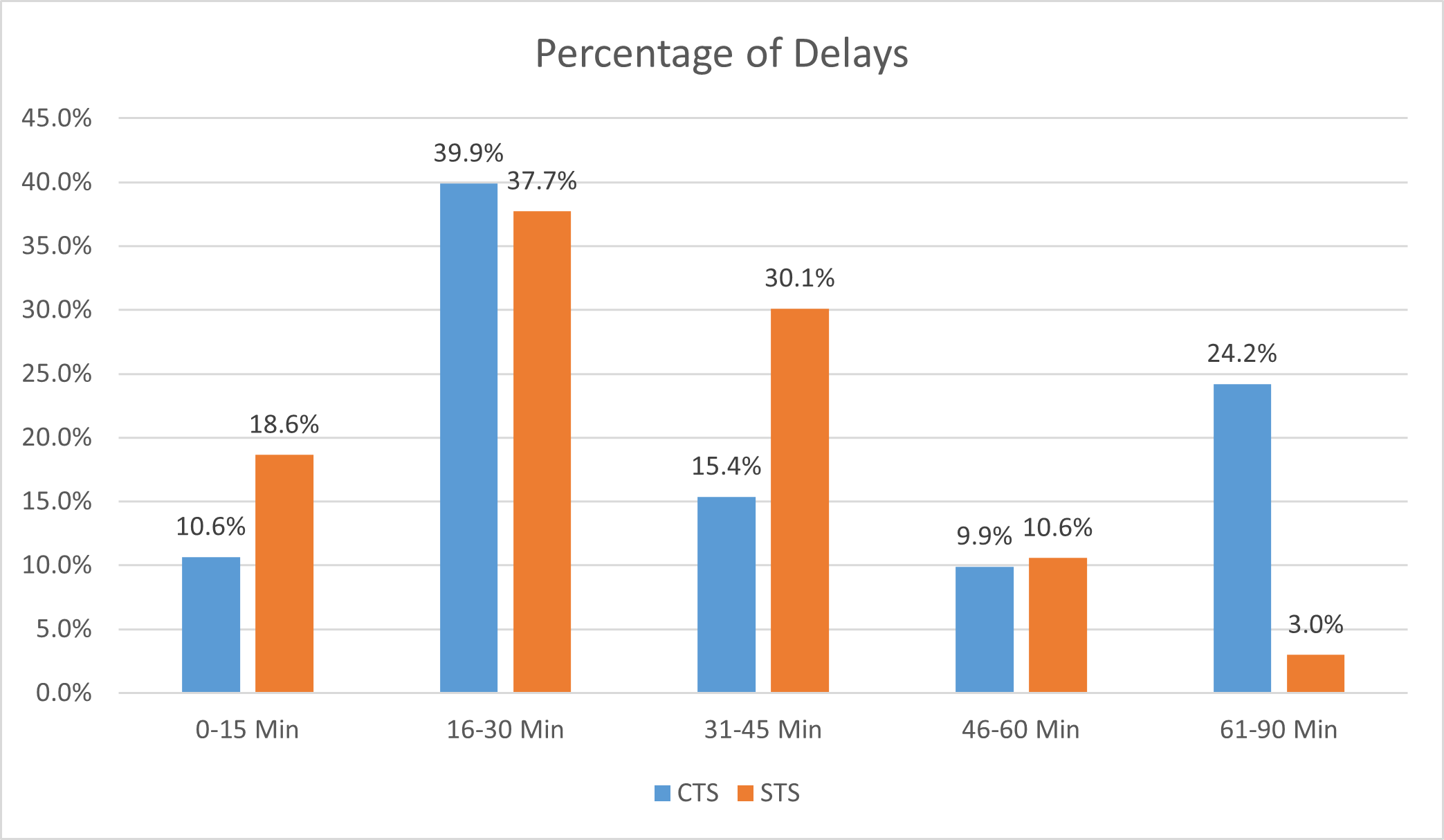
Chart 1 shows the number of delays by duration and bus route type, side by side. CTS routes had far fewer short delays and far more delays exceeding 60 minutes than STS routes. Although for both CTS and STS routes, the most common delays lasted between 16 and 30 minutes, delays lasting up to 15 minutes show a variance between CTS and STS routes of 8%, and for delays lasting an hour or more, a variance between the two of approximately 21%.
DOE failed to report several data points to the City Council, including the number of CTS bus routes scheduled to take less than one hour, between one and two hours, and more than two hours; the average scheduled length of CTS bus routes by district; and actual travel times. However, when students with IEPs are impacted by excessive delays of 61 to 90 minutes, their total ride times are likely to exceed DOE guidelines and IEP travel time limitations, if applicable. For students receiving CTS service, DOE’s performance goals for travel time are between 60 and 90 minutes for routes that travel within the same borough, and between 90 and 105 minutes for routes that travel between boroughs.
CTS Routes Accounted for 99% of Problem Runs
If a vendor believes that a route is too long or has too many stops, or if there is inadequate time between schools, they must immediately report it is as a “problem run.” Of the 83,573 school bus delays reported in SY2023–24, 8,524 delays were due to problem runs. Nearly all delays (8,496) pertained to CTS bus service, as detailed in Table 7 below. Problem runs accounted for 7.3% of all CTS routes, in contrast to about 1% of all STS routes.
Table 7: Problem Runs Reported for Bus Service Provided to K–12 Students During SY2023–24
| Service Type | # of Delays Reported Due to Problem Runs | # of Routes Reported as Problem Runs | Total # of Routes | % of Routes Reported as Problem Runs |
| CTS | 8,496 | 400 | 5,487 | 7.3% |
| STS | 28 | 26 | 1,971 | 1.3% |
The disproportionate number and length of delays attributable to problem runs suggest that OPT does not design routes in an efficient manner and does not allow adequate time for traffic patterns, students’ ambulatory status, and additional loading, securement, and unloading time for students using specialized vehicles and equipment. DOE uses unsupported legacy software to create and modify CTS routes, which may be the cause of these inefficient route designs. This issue is discussed in further detail below.
As highlighted in parents’ testimonies during the September 2024 City Council hearing, these delays not only increase ride times and cause students to arrive late, but also disrupt their academic progress, daily routines, and emotional well-being.[16] For students with special needs, the impact is even more severe. These students often depend on structured routines and consistency to manage their conditions, and prolonged bus rides can aggravate medical issues, especially when ride times exceed what is permitted in their IEPs.
Late arrivals can also cause students with IEPs to miss critical instruction and limit their ability to participate meaningfully in classroom activities, hindering progress towards their IEP goals. This can heighten anxiety and exacerbate behavioral challenges, which may set a negative tone for the rest of the school day. Over time, repeated delays may widen achievement gaps and undermine the stability these students need to succeed in the classroom. This raises serious concerns about equity, safety, and student well-being.
Majority of Bus Service Complaints Related to CTS Routes
For SY2023–24, DOE received 154,376 complaints regarding bus service. The audit team disaggregated complaints based on route type and compared the number of complaints for CTS and STS bus service relative to the average number of assigned routes. Based on this analysis, CTS bus service was the subject of more complaints, both in the aggregate and relative to the number of routes.
For SY2023–24, 99,851 complaints were reported for CTS bus routes, which served approximately 56,446 K–12 students with IEPs on 5,487 routes. This amounts to approximately 18.19 complaints per route. During that same period, 18,609 complaints were reported for STS routes, which served approximately 68,742 K–12 students on 1,971 routes. This amounts to only 9.44 complaints per route.
CTS bus routes were also disproportionately the subject of complaints for no/late service. In SY2023–24, there were 25,793 no/late service complaints related to CTS services, while STS routes accumulated just 4,636 similar complaints. This is discussed in more detail below.
DOE officials stated that performance goals for CTS routes are not statutory requirements but rather general guidelines and that the department’s travel time goals have recently been revised. Under DOE’s new goals, interborough CTS routes can take up to two hours. DOE’s travel time goal for intra-borough CTS routes increased from generally 60–90 minutes to 75–90 minutes, meaning the shortest expected travel time increased by 15 minutes but the longest travel time remained the same. Regarding interborough CTS routes, DOE’s goal increased from generally 90–105 minutes to 105–120 minutes, meaning both the shortest and longest expected travel times increased by 15 minutes.
In addition, DOE stated that CTS routes are delayed more often and have higher rates of excessive delays compared to STS routes because of inherent differences in how transportation services are provided and the populations served.
DOE officials stated that CTS routes travel longer distances, up to 67 miles, with many routes traveling across boroughs and some traveling outside of New York City to schools that provide specialized services, whereas STS routes generally travel within a school district and do not exceed five miles. CTS routes also have more stops because they travel to each student’s home and may be delayed on side streets, while STS routes pick up multiple students at stops located on main streets. For these reasons, CTS routes are more likely to be delayed in traffic and particularly on morning routes which operate during rush hour.
Furthermore, DOE stated that while STS routes generally roll over each school year, CTS routes must be newly created due to changes in ridership based on students’ IEPs (new transportation mandates or changes to transportation mandates) and students moving or changing schools due to promotion to middle school or high school or other reasons. Therefore, CTS routes are more likely to be reported as problem runs.
DOE stated that since CTS routes are impacted by delays more often, they receive more complaints.
In its response, DOE stated that CTS routes are prone to delays and rather than investigate problematic routes, redesign routes, or implement technology that would improve routes, DOE increased the department’s ride time goals for CTS routes when parents, guardians, and school personnel are already complaining that students ride on buses too long. DOE is responsible for creating bus routes for K-12 students. If DOE believes that routes are too long or serve too many students, DOE should redesign routes to minimize travel times or start routes earlier to ensure that students receive timely and reliable bus service and do not miss school.
Two purposes of the federal Individuals with Disabilities Education Act (IDEA) are to ensure that students with disabilities have available to them a free appropriate education that emphasizes special education and related services designed to meet their unique needs and prepare them for further education, employment, and independent living and to ensure that the rights of students with disabilities and their parents are protected.
DOE’s Transportation Rights states that students and their families have the right to “dependable and timely school bus service” and “the shortest and safest bus route to minimize travel times to and from school” and that students with disabilities “have the same transportation and bus rights” as their peers and the right to a “consistent and on-time pickup schedule.” Students with disabilities who do not receive dependable and timely bus service and who do not consistently receive a full school day of instructional time and services due to transportation issues may be deprived of their rights.
On November 3, 2025, the audit team requested that DOE provide information regarding CTS and STS routes including the average number of stops served and the minimum, average, and maximum length of routes, as well as the number of CTS routes that travel outside of the City.
In addition, the audit team requested supporting documentation for DOE’s revised travel time goals for CTS routes and their effective date.
On November 14, 2025, DOE provided the audit team with a table listing the average number of stops per route and the minimum, average, and maximum distance per trip. However, DOE did not provide the audit team with the number of CTS routes that travel outside of the City or supporting documentation for revised CTS travel time goals and effective date.
For SY2023-24, DOE indicated that the average number of stops for STS and CTS routes was similar, with 12.1 stops for STS service and 11.8 stops for CTS service. However, the average distance per trip and maximum distance per trip for STS and CTS bus service varied. For STS routes, the average distance per trip was 5.4 miles and the maximum distance was 19.6 miles. For CTS routes, the average distance per trip was 12.8 miles and the maximum distance was 45.2 miles. DOE stated that the longer a school bus travels, “the greater likelihood of encountering unavoidable chronic rush hour traffic and the more likely that unfortunate delays will take place.” However, as previously stated, DOE reported to the City Council that it creates school bus routes based on school locations and start and end times, ride time guidelines, and traffic patterns and congestion. The results, as shown in the audit, suggest that DOE’s methodology needs improvement.
DOE Did Not Adequately or Promptly Investigate Complaints of No/Late Service
According to DOE officials, complaints of no/late service are routed to OPT Transportation Specialists, who review GPS data for the date of the complaint, as well as the preceding and following days, to determine whether complaints are substantiated and, if so, whether they are isolated or ongoing service issues. DOE indicated that it determines if a service issue is ongoing based on OPT’s review of the GPS data but does not review or consider prior complaints and violations issued to vendors. If OPT considers the issues to be ongoing, DOE will modify the route by removing students or changing route start times.
For SY2023–24, the audit team identified the 10 school bus routes that received the most complaints for no/late service. All were CTS routes serving students with IEPs, as detailed in Table 8 below. School bus vendors reported that five of those 10 routes were “problem runs” on multiple occasions.
For each of the 10 routes, the audit team reviewed complaint and vendor-reported delay data for SY2023–24, and GPS data or Trip Cards for 160 trips, to determine whether OPT Transportation Specialists investigated complaints and took timely and appropriate action to resolve issues.[17] Although parents/guardians and school personnel consistently reported service issues for these 10 routes, DOE failed to resolve them. As a result, students missed classroom instruction time, related services, and meals.
Based on a review of DOE complaint data, some parents reported that their children were late to school every day, missing classes and negatively impacting their grades. One parent whose child was assigned to route K099 reported to OPT in February 2024 that her son “is the only student from his school on this route,” and “he is late every day.” Furthermore, this parent reported that her son’s first period teacher told her that “over 50% of the grade is based on participation.” This route served between 20 and 31 students attending schools at five different locations. Based on GPS data and Trip Cards, this bus consistently arrived late to each of the schools.
Another parent, whose child was assigned to route K161, reported to OPT on February 7, 2024, that the bus has been late and the “issue has been going on for a month.” They stated that the bus was late to pick up the student on February 6 and 7, 2024, forcing the parent to take their child to school themselves. In addition, the student was also picked up more than two hours late after school. This route served between 13 and 39 students attending schools at seven different locations. Based on sampled GPS data for February 6 and Trip Card data for February 7, the bus consistently arrived late to each of the schools.
Table 8: Bus Routes with the Most No/Late Service Complaints in SY2023–24
| Route # | Service Type | School Bus Vendor | # of No/Late Service Complaints | # of Vendor-Reported Delays | # of Delays Due to Problem Run | Date First Reported as a Problem Run |
| K527 | CTS, Intra-borough | NYC School Bus Umbrella Services | 150 | 20 | N/A | N/A |
| L120 | CTS, Inter-borough | NYC School Bus Umbrella Services | 134 | 16 | N/A | N/A |
| K521 | CTS, Intra-borough | NYC School Bus Umbrella Services | 129 | 1 | N/A | N/A |
| K099 | CTS, Intra-borough | Pride Transportation | 129 | 36 | 5 | 01/04/24 |
| L602 | CTS, Inter-borough | NYC School Bus Umbrella Services | 103 | 2 | N/A | N/A |
| X070 | CTS, Intra-borough | Pioneer Transportation | 89 | 59 | 2 | 09/11/23 |
| M107 | CTS, Inter-borough | All American School Bus Corp | 87 | 71 | 7 | 10/04/23 |
| M121 | CTS, Inter-borough | Boro Transit, Inc. | 86 | 125 | 2 | 10/24/23 |
| K161 | CTS, Intra-borough | Pride Transportation | 85 | 96 | 10 | 09/26/23 |
| K433 | CTS, Intra-borough | Boro Transit Inc. | 77 | 33 | N/A | N/A |
Based on DOE records for these routes, Transportation Specialists generally did not always follow DOE’s informal procedures, which call for reviewing GPS data when investigating no/late service complaints. (DOE does not have formal written policies and procedures for prioritizing, investigating, or resolving complaints or problem runs. This issue is discussed in further detail below.) Instead, Transportation Specialists generally reported that they resolved complaints by communicating with vendors, who often stated that reported issues were due to weather, traffic, or new/substitute drivers unfamiliar with the routes. Transportation Specialists then recorded these reasons and closed complaints, without further investigation.
In addition, when Transportation Specialists reviewed GPS data, substantiated ongoing service issues, and modified routes, DOE did not take timely or effective corrective action to ensure that service issues were successfully resolved. Table 9 below details the number of trips reviewed for each route, the number of students assigned to the route and impacted by no/late service, the maximum number of sites routes served, the number of modifications made to the route, and the range of lateness after those modifications were made.
DOE made between one and five modifications to each of the 10 problematic routes during the school year. However, the data shows they were not effective. Although modifications mitigated delays in some cases, buses continued to arrive late to one or more sites serviced each day. After modifications, delays ranged from four minutes to 2 hours and 20 minutes. This suggests that DOE did not proactively follow up to ensure that modifications made by OPT staff to routes were effective at resolving service issues and ensuring that students arrived to school on time.
Below are two examples, for routes M107 and K521, which detail DOE’s failure to take prompt and effective action to resolve service issues and illustrate the impact on students and their parents/guardians.
Table 9: Modifications to School Bus Routes with the Most No/Late Service Complaints During SY2023–24
| Route # | # of Trips Reviewed | Number of Students Assigned to each Route (per month) | Maximum Number of Sites/Locations per the Route | Number of Modifications Made to the Route | Range of Lateness (minutes-hours) after Route Was Modified |
| K099 | 17 | 20–31 | 5 | 5 | 0:05–0:50 |
| K161 | 10 | 13–39 | 7 | 1 | 0:12–0:23 |
| K433 | 18 | 7–11 | 5 | 3 | 0:04–1:28 |
| K521 | 23 | 18–29 | 5 | 4 | 0:25–2:00 |
| K527 | 12 | 11–19 | 5 | 2 | 0:05–0:38 |
| L120 | 13 | 10–16 | 8 | 4 | 0:05–1:07 |
| L602 | 19 | 12–17 | 5 | 5 | 0:04–0:44 |
| X070 | 16 | 18–35 | 3 | 2 | 0:05–0:48 |
| M107 | 16 | 3 | 1 | 2 | 0:05–1:36 |
| M121 | 16 | 2–3 | 1 | 3 | 0:25–2:20 |
M107: CTS Interborough Route Attending International Academy of Hope (iHOPE) in Manhattan
During SY2023-24, DOE received 87 complaints related to no/late service for route M107. This was an interborough route that served one to three students with IEPs who attended iHOPE, a specialized private school educating students with traumatic brain injury (TBI) and multiple disabilities.
School administrators submitted complaints to OPT almost daily in September and October 2023, with the first complaint submitted on the second day of school, September 8, 2023. On that same day, the vendor reported that “from the last stop, it takes [them] an hour to get to the school.” Further, the vendor reported to DOE that this route was a problem run seven times between October 4 and 16, 2023.
On November 9, 2023, DOE noted that this “route will be tracked to determine if [delays are] in fact due to traffic or other reasons.” By this time, DOE had received 44 complaints about this route, most of which pertained to late school arrivals. Based on GPS data and Trip Cards for sampled dates in September and November 2023, this bus arrived between 45 minutes and 1 hour and 25 minutes late. Ultimately, the department did not modify this route.
Effective November 2023, iHOPE changed its school start time from 8:00 am to 8:15 am. However, GPS data and Trip Cards for sampled dates in December 2023 and February 2024, showed that the bus still arrived 30 minutes to 1 hour and 36 minutes late. If trends continue, students will continue to arrive late, despite the delayed start time.
DOE continued to receive no/late service complaints about route M107 from school personnel, parents, and guardians. In response, in February 2024, approximately five months after the start of the school year, DOE modified this route to start the route 15 minutes earlier. The team requested GPS data and Trip Cards for three dates after this modification. GPS data was not available for any of the three days, and Trips Cards were provided for two of the three days. Based on these Trip Cards, the bus driver reported that the bus arrived five minutes late. Arrival time does not account for the time needed to get students from the bus to the classroom, and to get them ready to begin classes. This meant that the actual impact of the reported delay was later than the arrival time.
As previously mentioned, this route serves iHOPE students who have TBIs and multiple disabilities. DOE was aware at the beginning of the school year that this route was a problem run, as reported by school administrators and the vendor, and did not take timely or effective corrective action to resolve the transportation issues plaguing this route.
These issues appeared to persist in SY2024-25. At a City Council hearing held on September 30, 2024, an iHOPE Director stated that this school serves the most medically fragile students, primarily with brain injuries who are non-ambulatory and non-verbal. All of the school’s 130 students rely on OPT transportation. At the beginning of the school year, students were not provided with bus routes or accommodations (including travel nurses).
The Director stated that “some parents are unable to transport the students themselves due to them not having accessible vehicles, leaving the students to miss classes altogether.” As of the date of her testimony, the Director stated that “68 [students] had collectively accumulated over 400 absences, since the start of the school year – all of which were related to transportation issues.” As a result, students with severe disabilities missed weeks of school and mandated therapeutic services.
In addition, the Director stated that “students have daily seizures. They have high maintenance medical needs. They have scheduled medications that must be administered at a certain time of the day, and they’re missing these interventions due to the busing delays.”
Furthermore, the Director stated that these students are attending private school because they cannot be served by public schools, and “families rely on DOE-funded tuition reimbursements.” Due to high rates of transportation related absences, parents are at risk of losing their tuition reimbursement.[18]
DOE officials stated that this route is indicative of the challenges the department has with transporting students who are traveling long distances from outer boroughs to Manhattan during rush hour. With regard to transportation issues reported for SY2024–25, DOE officials stated that OPT did not receive transportation needs information for iHOPE students before the start of the school year, as it should have. This information should have been provided by the Committee on Special Education. DOE officials stated that once OPT became aware of the situation at the beginning of the school year, they worked as quickly as possible to rectify the issues.
During the exit conference and on November 3, 2025, the audit team requested that DOE provide documentation to show that OPT did not receive transportation needs information for iHOPE students before the beginning of SY2024–25. On November 14, 2025, DOE provided documentation which indicates that OPT received transportation needs information for 16 iHOPE students on August 22, 2024, two weeks before the first day of school, September 5, 2024. Routes were not created for these students until September 9, 2024.
K521: CTS Intra-borough Route in Brooklyn
During SY2023–24, DOE received 129 complaints related to no/late service for route K521. This was an intra-borough route serving 18 to 29 special education students attending five schools at four different sites in Brooklyn. The first complaints were received on September 13, 2023; however, based on DOE complaint system records, Transportation Specialists did not indicate they would review the GPS data for this route until more than a month later, on October 18, 2023. By this time, DOE had received 34 complaints about this route, most of which pertained to late school arrivals.
Based on GPS data and Trip Cards for October 18 to 20, 2023, this bus arrived late at all five schools each morning, with delays ranging from 15 to 40 minutes. After reviewing this complaint, DOE removed one student from this route and placed them on a different route, effective October 24, 2023. However, this modification was not effective; GPS data and Trip Cards for October 30 to November 1, 2023, showed that the bus still arrived late to all five schools each morning, with delays ranging between five and 50 minutes.
DOE continued to regularly receive no/late service complaints about route K521 from school personnel, parents, and guardians. In response, DOE made four additional modifications: one in November 2023, one in December 2023, and two in January 2024. DOE removed more students from this route and started the route earlier, but none of those modifications were effective. Based on the audit team’s review of GPS data and Trip Cards after all modifications were implemented and made effective in January 2024, this bus continued to arrive 26 to 28 minutes late.
Although GPS and Trip Card data shows that this bus consistently arrived late, the vendor running the route, NYC School Bus Umbrella Services, reported only one delay for SY2023–24.
DOE was aware that this route received numerous complaints for no/late service and made four modifications to the route throughout the school year; nevertheless, DOE did not implement or take effective corrective action to resolve the transportation issues and did not monitor them until performance improved.
DOE Did Not Provide Evidence That Reports of Problem Runs Were Investigated
As noted above, vendors are required to report certain runs as problem runs to OPT staff, ostensibly for research and resolution, and possible changes to improve runs. STS bus routes may be adjusted by vendors with OPT’s approval. CTS bus routes, which serve students with IEPs, must be modified by OPT staff.
OPT Transportation Specialists are responsible for reviewing and addressing vendor-reported problem runs. DOE officials stated that Transportation Specialists first review related complaints or emails regarding the route and then review GPS data for morning and afternoon service on multiple days. They stated that they check whether bus drivers are adhering to the route start time, sequence, and directions, and that based on their reviews, Transportation Specialists then determine cause—specifically they try to determine whether the route is a problem run that requires adjustments (such as removing students or changing route start times), or if the driver was not performing the route correctly and requires guidance. After the changes take effect, they state that they monitor the route, communicate with vendors, and issue violations, as warranted.
The Contractor’s Manual states that OPT “will attempt to resolve all problems as quickly as possible.” According to DOE officials, this process usually takes about a week but may take two weeks or more in September.
During SY2023–24, vendors reported 83,573 delays. Of the 10 school bus routes with the highest number of self-reported delays, nine were reported as problem runs. On July 2, 2025, the audit team asked DOE whether Transportation Specialists investigated and modified those nine routes and if so, to provide supporting documentation detailing how and when routes were modified. To date, DOE has not responded to this request.
DOE Did Not Ensure All Dry Runs Were Performed Before the First Day of School
School bus transportation contracts and Chancellor’s Regulation A-802 state that vendors must ensure that drivers and attendants make at least one practice run of their assigned morning and afternoon bus routes prior to the start of school. This is known as a “dry run,” and it must be performed before the first day of school, as close to the scheduled times as possible. The contracts further state that vendors may be assessed liquidated damages of $460 for every instance that they fail to require a driver to perform a dry run.
Local Law 33 of 2019 required DOE to submit biannual reports to City Council and post on its website a summary of school bus vendor contract requirements related to dry runs, a list of vendors who complied with those requirements, a list of vendors who were assessed liquidated damages for failure to comply, and a list of vendors who did not fall within either of those categories, along with an explanation.
However, DOE did not monitor, enforce, or report on dry run compliance, as required.
For SY2023-24, DOE failed to monitor and report on dry run requirements for any of the 16 school bus vendors that provided CTS bus service to pre-school aged students.[19] These 16 vendors provided bus service to approximately 11,209 pre-school aged students.
Additionally, based on DOE’s Dry Run Completion Report posted on its website, 19 vendors that provided bus service to school-aged students failed to comply with dry run requirements. One school bus vendor, Third Avenue Transit, Inc, did not perform dry runs for any of its 24 CTS bus routes (12 morning routes and 12 afternoon routes).
In addition, 18 vendors did not complete dry runs for all of their assigned routes, as required. These vendors did not perform dry runs for between 1% and 55% of their routes, as detailed in Table 10 below.
Table 10: Vendors that Failed to Perform Dry Runs During SY2023–24
| School Bus Vendor | Average # of Routes | % of Dry Runs | |
|---|---|---|---|
| Total | Performed | Not Performed | |
| Third Avenue Transit, Inc | 24 | 0% | 100% |
| Jofaz Transportation Inc | 423 | 45% | 55% |
| Y & M Transit Corp | 324 | 59% | 41% |
| G.V.C. Ltd | 198 | 81% | 19% |
| Children’s Trans Inc. | 18 | 89% | 11% |
| Quality Transportation Corp | 415 | 94% | 6% |
| Pride Transportation | 958 | 94% | 6% |
| First Steps Trans Inc. | 50 | 97% | 3% |
| B & F Skilled Inc. | 52 | 97% | 3% |
| NYC School Bus Umbrella Services | 1,408 | 98% | 2% |
| Bobby’s Bus Co. Inc | 239 | 98% | 2% |
| Van Trans LLC | 218 | 99% | 1% |
| SNT Bus Inc | 720 | 99% | 1% |
| L & M Bus Corp | 318 | 99% | 1% |
| Leesel Transportation Corp | 850 | 99% | 1% |
| Allied Transit Corp. | 206 | 99% | 1% |
| Grandpa’s Bus Co, Inc. | 449 | 99% | 1% |
| Consolidated Bus Transit, Inc | 308 | 99% | 1% |
| All American School Bus Corp | 595 | 99% | 1% |
DOE’s Dry Run Completion Report (posted on its website) did not include a summary of school bus vendor contract requirements related to dry runs, a list of vendors that were assessed liquidated damages for failing to comply with those requirements, or a list of vendors that were not assessed liquidated damages along with an explanation. Therefore, the audit team requested this information from DOE.
In response, DOE stated that it did not assess liquidated damages for any of the above-mentioned 19 vendors. DOE stated that multiple labor negotiations were occurring between school bus vendors and employee unions during the summer and fall of 2023, and DOE did not issue liquidated damages “for some procedural items where ongoing negotiations were the root of their issue.”
Dry runs are not a procedural item. Rather, they are practice runs that are conducted to familiarize drivers with assigned routes, identify potential issues with the route, and, ultimately, to ensure timely pick-up and drop-off. Vendors that do not complete dry runs in full—or at all—cannot identify and inform DOE of routing issues prior to servicing students. For SY2023–24, the audit team estimated that, at minimum, DOE failed to assess liquidated damages of $268,691.
Since DOE did not monitor or hold vendors accountable by assessing liquidated damages, DOE did not ensure that routes could be performed within DOE operational guidelines or IEP-mandated ride times, or that students were provided with timely and reliable bus service.
During the exit conference, DOE officials acknowledged that the department needs to improve its monitoring of the performance of dry runs for CTS bus service provided to pre-school aged students. DOE officials stated that they will ensure dry runs are completed for these routes once Via Transportation GPS tracking devices are installed on pre-school aged buses.
DOE did not address issues related to enforcement of dry run requirements for vendors that provide bus service to school-aged students.
DOE Did Not Enforce Via Transportation Contract Terms to Ensure That Routing, Student Tracking, and Navigation Technology Were Implemented
Via Transportation’s contract required the implementation of dynamic routing, route optimization, and student ridership tracking, among other things.[20] Via Transportation’s initial and renewal contracts have a combined maximum value of $51.7 million.
Via Transportation’s routing technology was intended to allow DOE to edit and immediately optimize routes in real-time, based on road and traffic conditions. Additionally, it would efficiently transport CTS and STS students together and incorporate relevant student data and routing constraints in routing assignments (such as student travel times, or space for medical equipment, among other things). According to Via Transportation’s project phase timeline, routing technology was scheduled to be implemented in December 2021. However, to date, it has not been implemented.
DOE officials stated that the implementation of routing and student tracking functionality was delayed by COVID-19 supply chain issues and remote learning in schools, funding issues, and scope changes due to data limitations, among other things. In September 2024, DOE stated that Via Transportation would implement the routing technology by September 2025 and student tracking by September 2026. However, DOE did not provide the auditors with contract amendments to show that revisions to the scope of the contract and timeline were documented or authorized.
More recently in July 2025, the audit team asked DOE to provide an update on the implementation of routing and student tracking functionality and whether there has been any change in scope or completion date. DOE stated that Via Transportation is facing development issues, which have further impacted the expected delivery of these features, and DOE is currently reviewing the issues to try and identify next steps and set new tentative dates.
Furthermore, while DOE previously maintained that Via Transportation would implement all functionality by September 2026, DOE issued a Request for Proposals (RFP) in March 2025 for a new transportation management system, ostensibly seeking a new vendor (or vendors) to provide this same technology. According to the RFP, DOE intends to procure an integrated solution to accurately track, update, and report for three core functions: near real-time tracking via GPS devices, near real-time notifications for bus location, student pick-ups and drop-offs, route changes, vehicle delays, and adaptive/dynamic vehicle routing. This suggests that DOE was looking for a different vendor instead of using Via Transportation, with whom a contract was already in place.
In the meantime, DOE continues to rely on two different systems to create and edit routes for CTS and STS bus service and communicate them to vendors. While DOE uses Edulog, a customizable, configurable commercial off-the-shelf software to create STS routes, DOE uses an internally built legacy system for CTS routes. This legacy system was built in 1994 and relies on outdated MapInfo and FoxPro software that has not been supported since January 2015. The use of unsupported software can cause decreased system performance and productivity, compatibility issues, and poses significant security risks.
Since DOE did not hold Via Transportation accountable for implementing technology it was contracted and paid to do, DOE continues to rely on outdated and inefficient routing technology. This technology very likely contributes to school bus delays, and parents/guardians still lack information on the whereabouts of school buses and their children.
During the exit conference and on November 3, 2025, the audit team requested updated implementation dates for routing and student badge-in/out functionality and the status of the most recent RFP. On November 14, 2025, DOE officials informed the audit team that the ridership tracking pilot will be launched in December 2025 and expanded in March 2026. However, DOE still does not have an updated timeframe for the implementation of route optimization. Additionally, DOE officials stated that they do not have any updates on the status of the RFP since the next steps in the process are being handled outside of OPT. While DOE’s Division of Contracts and Purchasing issued the RFP, the transportation management system is being procured for OPT. Therefore, OPT or the Office of the Auditor General should have been able to obtain this information and provide it to the audit team.
DOE Did Not Enforce GPS Tracking Requirements
Real-Time Tracking Not Installed on All Buses
Although DOE installed tracking devices (both GEOTAB and Via Transportation) that provide real-time tracking on buses that transport school-aged students, it failed to enforce those same tracking requirements for the 16 school bus vendors that provided bus service to Pre-K students. These school buses are equipped only with GEOTAB devices; they are not equipped with tracking devices capable of real-time reporting of school bus locations to parents/guardians.
During SY2023–24, the 16 vendors provided bus service to approximately 11,209 Pre-K students. On August 7, 2025, the audit team asked DOE officials to explain why the agency had not enforced this requirement for Pre-K bus service, and whether and when Via Transportation would install such tracking devices on Pre-K buses. During the exit conference, DOE officials stated that they will be installing Via Transportation GPS tracking devices on Pre-K buses but did not provide a timeline for when these devices will be installed.
K–12 Bus Route Start Times Not Consistently Logged by Drivers
While tracking devices were installed on school buses that provide service to school-aged children by January 2024, DOE failed to enforce log-in requirements and assess liquidated damages. During SY2024–25, drivers did not consistently log-in at the start of their routes. DOE calculates and reports on log-in rates of school bus drivers for both CTS and STS bus service across all vendors. For 200,556 instances in which drivers did not log-in, vendors’ subscription rates did not meet DOE’s commercially reasonable standard (i.e., log-in rates were less than 90%); therefore, DOE could have assessed liquidated damages totaling $44.3 million.[21] However, DOE assessed damages in only 7,556 (5.5%) of 200,556 violations, totaling $1.7 million. This means that DOE was entitled to assess almost $42.6 million in damages but failed to do so.
DOE stated that it tracked log-in rates, provided vendors with reports detailing driver log-in rates daily, and discussed results with vendors. However, for September through October 2024, vendors’ average monthly log-in rates ranged from 54.1% to 100%. DOE informed vendors that it would start assessing monetary penalties if log-in rates were less than 90%, effective November 2024.
Table 11: Drivers’ Monthly Log-in Rates for September 2024 through May 2025
| Month | Min. Log-in Rate | Max. Log-in Rate | Avg. Log-in Rate |
| Sep-24 | 54.05% | 99.91% | 76.48% |
| Oct-24 | 65.81% | 100.03% | 84.22% |
| Nov-24 | 69.19% | 99.93% | 87.49% |
| Dec-24 | 74.90% | 100% | 89.01% |
| Jan-25 | 79.04% | 99.61% | 89.71% |
| Feb-25 | 79.11% | 99.69% | 93.04% |
| Mar-25 | 77.25% | 99.58% | 93.23% |
| Apr-25 | 80.84% | 99.93% | 93.57% |
| May-25 | 82.28% | 100% | 94.32% |
As part of its formal response, DOE provided the audit team with an Excel spreadsheet detailing the number of violations and dollar amount of liquidated damages assessed for each school bus vendor for failing to log into the Via Transportation app during Fiscal Year 2025. For this period, DOE reported that the department assessed liquidated damages totaling approximately $3.5 million. However, DOE did not provide vendor subscription rates for the entire period or proof that liquidated damages were collected. Therefore, the audit team could not compare the figure DOE claims it assessed to the total amount it could have assessed.
DOE Did Not Establish Adequate Administrative Procedures
Comptroller’s Directive 1 states that “[i]nternal control activities are [. . .] an integral part of an agency’s planning, implementing, review and accountability for stewardship of its resources.” The Directive further states that sound internal controls include performing ongoing monitoring during normal operations and at various organizational levels, and that monitoring should be performed continually and be ingrained within the agency’s operations.
However, DOE did not systematically monitor or analyze complaint or vendor-reported delays data to identify problematic vendors. DOE officials stated that it monitors performance trends for complaints, among other things, and has corrective action meetings with vendors when they are under-performing. However, DOE did not provide auditors with documentation to show that it analyzed trends over time, developed benchmarks, and discussed results of analysis with vendors.
DOE’s failure to identify these issues were in part due to the lack of comprehensive and uniform policies and procedures on addressing problematic vendors, and oversight and enforcement of vendor contract terms.
DOE Lacks Written Policies and Procedures for Reviewing and Resolving Complaints
Comptroller’s Directive 1 states that “[i]nternal control activities [are] the policies, procedures, techniques, and mechanisms used to enforce management’s direction.” The Directive also states that internal controls should be documented in management’s administrative policies or operating manuals.
However, DOE does not have written policies and procedures related to reviewing or resolving complaints. The audit team requested such internal policies and procedures on several occasions; however, DOE was unable to provide any standards that address how OPT staff are required to handle complaints, or the timeframe in which complaints are expected to be resolved.
DOE officials provided the audit team with one document that itemized the priority levels for each complaint type and a workflow diagram that showed how a complaint moves through the process at a very high level. However, these documents did not offer adequate guidance on a number of aspects of the complaint review process, such as the timeframe in which complaints are to be reviewed and resolved, the details that should be included in the resolution field, the types of documentation considered acceptable for resolving a complaint, or whether and how vendors should be monitored on an ongoing basis.
Based on the audit team’s review of complaints, the manner in which complaints were handled and resolutions documented lacked uniformity and consistency. For example, GPS tracking for no/late service complaints may or may not be checked, and the vehicle number serving the route (which is needed to perform GPS tracking) may or may not be obtained and documented.
Directive 1 also states that “[n]o one individual should control all key aspects of a transaction or event” and that “[k]ey duties and responsibilities need to be divided or segregated among different staff members to reduce the risk of error.” However, the auditors learned that complaints are processed without secondary supervisory oversight.
When asked whether secondary supervisor reviews are conducted to ensure resolved and closed complaints are valid, DOE stated that staff are responsible for actively managing their complaint queues and that supervisors are involved in the resolution process every step of the way, depending on a staff member’s experience level. However, DOE officials could not provide the audit team with internal guidance on how supervisors should monitor staff resolving complaints, or how frequently supervisors should be reviewing complaint resolutions. In addition, the auditors did not observe a supervisory review field in the complaint system to indicate that reviews are, in fact, conducted and approved.
As a result of DOE’s failure to establish written policies and procedures, the agency has limited assurance that its goals and requirements are properly communicated and systematically followed. The development of standard policies and procedures is needed to ensure that staff are supervised and complaints are processed in a consistent and appropriate manner.
At the exit conference, DOE officials stated that it is difficult to assess a timeframe in which complaints should be reviewed because some complaints may be easily resolved while others may require further investigation to be conducted.
DOE Failed to Assign Contract Managers to Oversee Bus Vendor Contracts
DOE’s Procurement Policy and Procedures states that each contract must have an assigned contract manager responsible for administering the contract. Their duties include conducting quality assurance, inspections, and testing; monitoring contractor performance; and maintaining a comprehensive file of all records, correspondence and decisions related to the contract. However, DOE does not assign contract managers to oversee vendor performance.
The audit team asked DOE whether it assigns specific contract managers to oversee vendor performance and whether those contract managers conducted routine meetings with vendors to discuss contractor performance. DOE only stated that it “performs corrective action meetings as required with respect to GPS compliance and overall performance.” DOE further stated that when it observes vendors underperforming based on performance trends (such as complaints, violations, driver recruitment, and GPS compliance), it will continue monitoring until the vendor improves.
Without assigned contract managers performing routine oversight (such as quality assurance checks, performance evaluations, and timely corrective actions), DOE lacks a systematic way to detect, address, and prevent vendor underperformance. Additionally, the absence of formal performance tracking and documentation weakens DOE’s ability to enforce contract terms or hold vendors accountable for repeated failures.
DOE officials stated that while they do not assign contract managers for each contract, the department has several units responsible for monitoring vendor performance, including, but not limited to, contract directors, the Transit Services and the Fleet Management Units. However, this is contrary to DOE’s own procurement policy. Furthermore, these units do not routinely or systematically monitor vendor performance or contract compliance, or otherwise hold poor performers accountable, as detailed throughout the report.
Recommendations
To address the abovementioned findings, the auditors propose that DOE should:
Analyze Trends and Diagnose Causes
- Assign contract managers to vendors contracts to proactively conduct routine reviews and assessments of complaint data and vendor-reported delays to identify problematic routes and vendors that are performing poorly, discuss issues with vendors, implement corrective action plans, monitor progress until performance improves, and assess liquidated damages if vendors do not improve timely.
DOE Response: DOE agreed with this recommendation. - Review and use prior complaints made regarding transportation issues as part of its investigation process to identify trends in vendor’s poor performance
DOE Response: DOE agreed with this recommendation. - Consistently maintain vehicle numbers that service school bus routes and use them to systematically perform a GPS review for all complaints related to no/late service.
DOE Response: DOE agreed with this recommendation. - Routinely compare planned route start and end times to actual times for students to determine whether vendors comply with key contract performance standards and IEPs, and issue violations and penalties as appropriate.
DOE Response: DOE agreed with this recommendation.
Strengthen Vendor Accountability
- Consider implementing enhanced minimum performance standards for timely and reliable service and adding minimum performance standards related to ride times and complaints in its new school bus vendor contracts. This should include:
- Setting minimum monthly performance metrics for on-time performance, no service, and ride times based on GPS data, and complaints relative to the number of routes, scheduled trips, or completed trips;
DOE Response: DOE partially agreed with this recommendation. DOE stated that it is currently working on different methods to develop and implement performance standards for timely and reliable service outside of the contract, but DOE did not agree to implement performance standards for ride times. DOE stated that it is not practical to include objective performance standards for ride times because they are a product of several factors, including distance traveled, traffic, and “road closures/reengineering.” DOE stated that neither the department nor school bus vendors have control over these issues.
Auditor Comment: DOE is responsible for ensuring that students are provided with transportation services as set forth in their IEPs, which may include limits on ride times. DOE is responsible for creating routes and modifying them as needed and therefore must have a degree of control over ride times, particularly as it is DOE which establishes each route, including the total distance traveled in each case.
DOE’s response suggests they have no objective targets in mind when routes are established. This is highly problematic from the standpoint of holding vendors accountable for performance. Furthermore, as noted in this report, DOE does not use real-time GPS data as it should to monitor ride times to effectively mitigate problems once identified. In addition, although DOE reported to City Council that the department considers traffic patterns and congestion when creating routes, DOE’s response suggests that it does not use GPS data to identify traffic patterns or inform route planning. As also noted, vendors did not perform dry runs before the start of the school year as required. This was another missed opportunity to identify and address problems prior to the start of the school year.
The auditors reiterate the need for DOE to establish objective minimum performance standards for ride times and numbers of complaints. These standards should be incorporated in new school bus vendor contracts, so they are readily enforceable. - Establishing a structure that incentivizes good performance and provides greater accountability for poor performance and escalation including a tiered scale of penalties based on monthly performance metrics and increased penalties for repeated violations;
DOE Response: DOE agreed with this recommendation - Assessing liquidated damages for noncompliance based on GPS data; and
DOE Response: DOE agreed with this recommendation - Taking routes away from the poorest performers or terminating their contracts.
DOE Response: DOE agreed with this recommendation
- Setting minimum monthly performance metrics for on-time performance, no service, and ride times based on GPS data, and complaints relative to the number of routes, scheduled trips, or completed trips;
- Collect CTS route information, including pick-up and drop-off times, from the vendor at the beginning of each school year and not solely depend on the vendor to maintain this information.
DOE Response: DOE agreed with this recommendation. - Fully enforce the terms of school bus contracts and assess penalties when GPS devices are not operational when buses are in service.
DOE Response: DOE agreed with this recommendation stating that it is current practice.
Auditor Comment: Although DOE assessed some liquidated damages when GPS devices were not used when buses were in service, DOE did not fully assess all liquidated damages and is entitled to substantially more. Therefore, DOE should ensure that it is enforcing the terms of its school bus contracts and assessing all liquidated damages it is entitled to. - Ensure that it is recovering any monies distributed to Via Transportation for required work that was not performed.
DOE Response: DOE did not agree or disagree with this recommendation, stating that it will take this recommendation under advisement and that it expects Via to fully comply with the terms of the contract.
Auditor Comment: Given that Via Transportation is already between four and five years late in delivering required work, they have not fully complied with material terms of the contract, and it is unclear whether they have the capacity to do so. Via Transportation was supposed to implement routing technology in December 2021 but to date, this has not happened. DOE has not provided an updated implementation date. In addition, Via Transportation was supposed to implement student tracking technology in August 2020. DOE reported that this technology will be piloted in December 2025 and expanded in March 2026. Given that Via Transportation has not provided key deliverables, we reiterate that DOE should ensure that it recoups money from Via Transportation for required work that was not performed.
Improve Process and Administrative Oversight
- Establish comprehensive policies and procedures that provide guidance on (1) the methods and tools staff should use and consider when reviewing complaints, and (2) requiring supervisory review before resolving complaints.
DOE Response: DOE agreed with this recommendation - Provide vendors with reports detailing planned and actual route start and end times, discuss those reports with vendors, and document those discussions.
DOE Response: DOE partially agreed with this recommendation, stating that it engages in dialogue and provides vendors with updated reports/route sheets as needed. DOE also stated that documenting every conversation is not operationally feasible but did agree that actions taken to resolve issues should be documented.
Auditor Comment: Section 4-02 of DOE’s Procurement Policy and Procedures requires Contract Managers to monitor and evaluate vendor performance and maintain a file containing records, correspondence, and determinations pertaining to contract administration. DOE stated that it provides school bus vendors with updated reports/route sheets and engages in dialogue with those vendors. Therefore, DOE should document and maintain a record of those discussions. - Formally document and maintain a record of all performance discussions with vendors.
DOE Response: DOE agreed with this recommendation. - Formally document amendments made to Via Transportation’s new delivery dates and work plan and submit that amendment for registration.
DOE Response: DOE did not agree or disagree with this recommendation, stating that it will take the recommendation under advisement. Additionally, DOE stated that the Via Transportation contract expires in August 2026 and that it is committed to including explicit reference to any deliverables in future extensions.
Auditor Comment: Section 4-08 of DOE’s Procurement Policy and Procedures states that all changes to existing contracts must be reflected in a contract amendment which, once authorized, will become part of the original contract. Contract changes may include specification changes to account for design errors or omissions and changes in contract amount due to authorized additional or omitted work, among other things. Therefore, we reiterate that DOE should formally document amendments made to Via Transportation’s contract and submit them for registration.
Recommendations Follow-up
Follow-up will be conducted periodically to determine the implementation status of each recommendation contained in this report. Agency reported status updates are included in the Audit Recommendations Tracker available here: https://comptroller.nyc.gov/services/for-the-public/audit/audit-recommendations-tracker/
Scope and Methodology
We conducted this performance audit in accordance with Generally Accepted Government Auditing Standards (GAGAS). GAGAS requires that we plan and perform the audit to obtain sufficient, appropriate evidence to provide a reasonable basis for our findings and conclusions based on our audit objectives. We believe that the evidence obtained provides a reasonable basis for our findings and conclusions within the context of our audit objective(s). This audit was conducted in accordance with the audit responsibilities of the City Comptroller as set forth in Chapter 5, §93, of the New York City Charter.
The scope of this audit was July 2022 through July 2025.
To obtain an understanding of DOE’s internal controls governing its Office of Pupil Transportation (OPT), the audit team reviewed and, where applicable, used the following criteria:
- Chancellor’s Regulation A-801, Pupil Transportation
- Chancellor’s Regulation A-802, GPS Equipment Installation & Training and Dry Runs of Bus Routes
- DOE’s Contractor’s Manual
- DOE’s vendor contracts
- DOE’s Procurement Policy and Procedures Manual
- DOE’s Contractor System Guide Help Manual, OPT Call Recording System Overview
- Office of Pupil Transportation (OPT) Procedures to Request OPT Service
- Local Laws
- 26 of 2019, Report the duration of school bus routes
- 27 of 2019, Creation and distribution of a school bus ridership guide
- 31 of 2019, Report on complaints and investigations relating to school bus transportation services
- 32 of 2019, Placement of communication and tracking devices on school buses
- 33 of 2019, Report policies and goals relating to the provision of school bus transportation services
- 34 of 2019, Report on school bus transportation services
- Individuals with Disabilities Education Act, § 300.34(C) (16
- NYC Administrative Code Title 19, Transportation – Chapter 6 School Bus Service
- NYC Charter – Chapter 26, Office of Pupil Transportation Reports
- Comptroller’s Directive 1, Principles of Internal Control
- Mayor’s Management Report for Fiscal Year 2024
- New York City’s Open Data
To gain an understanding of the roles and responsibilities of OPT, the audit team met with key officials that are involved with the operations of student transportation services and the resolution of complaints pertaining to those services. Specifically, auditors interviewed the Executive Director of Control Operations and the Deputy Senior Executive Director, Office of Pupil Transport; Fleet Vehicle Safety Director; Deputy Chief of Fleet Operations; Regional Director for Transit Services; Executive Director of Communications & Engagement involved with the Via Transportation GPS application; and an Education Analyst responsible for adjudicating violations issued to vendors.
To determine school bus ridership and costs per student for SY2023-24, the auditors obtained the City Council biannual reports to determine the student ridership total and obtained the transportation costs from DOE’s FY 24 modified and adopted Budget in the Financial Management System (FMS). To determine the average Pre-K student ridership, the auditors totaled the number of pre-school students assigned to each vendor and divided the sum for each vendor by the total Pre-K bus routes assigned to each respective vendor as published in the bi-annual report.
To ascertain the scope of the various types of incidents/complaints received and subsequently resolved by OPT, auditors requested and were provided with an Excel spreadsheet from OPT’s Call Recording and Service NOW systems for the period July 1, 2021 through June 30, 2024, totaling 362,259 complaint records. The dataset was comprised of incidents/complaints submitted by parents, the school, bus vendors, and informational requests. The dataset included 84,849 complaints submitted for SY2021-22 (July 1, 2021 through June 30, 2022), 123,034 complaints submitted for SY2022-23 (July 1, 2022 through June 30, 2023), and 154,376 complaints submitted for SY2023-24 (July 1, 2023 through June 30, 2024). SY2023-24 was the basis of the sample selection used for the auditors’ test review. The audit team used all complaint data to review trends.
To determine reliability and completeness of the data and ensure it could be used for the audit tests, auditors reviewed SY2022-23 information for four data fields: incident number, date of complaint, violation number, and violation fine amount. Additionally, auditors reviewed the file to see whether there were any gaps and duplicates in the data. Auditors decided that the data would be considered accepted and reliable if the error rate for the primary fields and the gaps and duplicates error rate did not exceed five percent. For the period reviewed, auditors found there was a 4% and 5% error rate, respectively. Thus, it was determined that the data was usable for testing purposes.
To determine the three-year trend in the complaint categories, the auditors totaled the complaints by category and vendor for SYs 2021-22 to 2023-24 and determined the 10 largest complaint categories for those three years. To determine vendor complaint ratios for SY2023-24, the auditors compared the total number of complaints for each vendor from the complaint data with the total number of routes assigned to each vendor published in the biannual report for SY2023-24. Additionally, using the bi-annual reports, the audit team disaggregated complaints based on route type and compared the number of complaints for CTS and STS bus service relative to their average monthly ridership.
To learn the layout and features of the Via Transportation GPS system installed on the school buses for tracking and monitoring, auditors reviewed a brief online video on DOE’s website and were provided with a walkthrough of the system. During the walkthrough, OPT officials navigated the system and shared several screens that captured various pieces of information pertaining to Via Transportation’s GPS application, including the School Operations Console (SOC) and the NYC School Bus and Driver applications.
To evaluate whether drivers frequently subscribed to the Via Transportation app at the start of their bus route, auditors requested the driver subscription reports for the period September 5, 2024 to May 2, 2025, and conducted a trend analysis of the rate in which drivers consistently logged into the app at the start of their route in the mornings for school drop off and evenings for pick up from school. The functionality of the NYC School Bus application is dependent on the drivers subscribing to their route, thereby allowing parents to track their child’s bus location in real-time and receive alerts as the bus is approaching the pick-up or drop-off location.
To establish the extent to which Via Transportation delivered on their contract agreement, the audit team reviewed the contract, contract amendments, and work plans and received responses from DOE on project deliverables. To determine the total liquidated damages that DOE did not assess for vendors who failed to subscribe to bus routes in the Via Transportation app, the auditors totaled the number of times over the seven-month period that vendors failed to meet the 90% threshold for logging into the app in the morning and afternoon and multiplied this total by the applicable fine of $230.
To determine whether comprehensive investigative reviews were completed for complaints submitted to OPT and appropriately resolved, the auditors met with the Regional Director for Transit Services via MS Teams and reviewed a sample of 57 complaints related to the top 10 bus routes that received the most complaints during SY2023-24. The complaint types covered in the sample included: (1) Bus Did Not Arrive at School in AM/PM, (2) Late Arrival at School in AM/PM, (3) Late Pickup/Drop Off in AM/PM, (4) No Pickup After Session Time, (5) No Pickup Before Session Time, (6) Ongoing Late Pickup/Drop Off in the AM/PM, and (7) Ongoing No Pickup. The auditors also did an in-depth review of 160 sampled trips, dates preceding and following the initial complaint date, for these 10 routes.
For SY2023-24, auditors reviewed each of the complaint tickets on DOE’s Call Recording System and reviewed the details pertaining to the complaint and the notations made to the resolution tab explaining how and when the complaint was resolved. For complaints submitted by a parent warranting a route adjustment for the student in question, the OPT staff was able to retrieve the transaction history to demonstrate when the change was made to the route. A change typically includes the student being removed from the route and assigned to a new route. For instances where the school submitted the complaint and a route change was necessary to address the issue, DOE could not obtain the transaction history record to demonstrate.
Additionally, auditors reviewed the GPS and Trip Card data for the 160 sampled trips to determine the arrival and drop off times at each school along the bus route. If the complaint pertained to late arrival at school in AM/PM, auditors reviewed the time the student was picked up from their home. If the complaint pertained to a late pick-up/drop off in the AM/PM or no pick-up before session time auditors reviewed the GPS data to see the time the buses were departing the depot each morning. In cases where the vendor reported a delay as the explanation for the late pick-up of a student or the late arrival to a school, auditors also retrieved the delay report to verify whether it was a reported delay. To calculate the range of students assigned to those 10 routes and the maximum number of school sites serviced for each bus route, the auditors collated student route information provided by DOE, which showed bus route number, student route number, student ID, date student started and left the route and school name, school address and school start time that the bus serviced.
To determine bus delays with service delivery, the auditors analyzed the self-reported delays by school bus vendors published in the bi-annual reports. To analyze vendor reported delays relative to the average number of routes assigned to each vendor for SY2023-24, the auditors compared vendor reported delays to the average number of assigned routes for each vendor as reported in the bi-annual report for that year and listed the five vendors with the highest ratio delays to routes.
To determine how school bus delays comparatively affected CTS and STS students for SY2023-24, the auditors disaggregated vendor-reported delays based on route type and compared the number of delays reported in the biannual reports for CTS and STS bus service provided to students relative to the number of routes operated. The audit team also divided the delays into 15-minute increasing intervals (from 0-15 minutes; 16-30 minutes; 31-45 minutes; 46-60 minutes; and 61-90 minutes) and compared the length of delays and percentage of delays between the CTS and STS routes. Additionally, the auditors compared the number of routes classified as problem runs in the bi-annual report for CTS and STS bus routes.
To assess whether dry runs were done by all contracted vendors, the audit team compared the list of bus vendors who performed dry runs published in the bi-annual reports with DOE’s list of bus vendors. To determine the amount of liquidated damages that were not assessed by DOE for school-aged vendors who did not compete 100% of dry runs, the auditors multiplied the percentage of dry runs that were not performed by the total average number of school-aged routes assigned to the 19 school-aged vendors listed on the website in DOE’s Dry run completion report and multiplied this result by $460.
To assess whether DOE accurately posted to its website the reports required by the NYC Administrative Code §21-993 and NYC Charter §19-609, auditors requested and received an Excel document with several files covering various reports that DOE is required to submit to the New York City Council biannually. Using each of the itemized regulations listed in both the NYC Administrative Code and the NYC Charter, auditors reviewed to ensure all required metrics were provided and were in fact posted to DOE’s website. It should be noted that the records provided by DOE did not include metrics on the type of training completed by the vendors, including training on the needs of students with disabilities and training description.
The results of the above tests, while not projectable to their respective populations, provided a reasonable basis for the auditors to evaluate and support audit findings and conclusions regarding DOE’s oversight of its contracted school bus services.
Appendix I
Vendor Violations and Penalties
| LD # | Violation | Amount |
| 1.1 | Failure to conform to and maintain the route, including (a) arriving at the start of school more than 30 or fewer than 5 minutes before the scheduled arrival time, (b) arriving more than 30 minutes after the scheduled pickup time at the end of school, (c) not adhering to schedule changes promulgated by OPT including those changes for only certain days, (d) departure from the school before receiving authorization to do so from the school, (e) not serving an authorized stop, (f) picking up pupils prior to the authorized start time, (g) failing to wait at the pickup or drop-off point until the scheduled pickup or drop-off time in the event the vehicle arrives early, or (h) altering the pickup sequence or other aspects of a bus route (with the exception of route changes by OPT for which the Contractor received less than 48 hours of prior notice) without notifying the Director, school, and par- ents/guardians of children on the route including not notifying schools and parents/guardians when routes change because of OPT rerouting, (i) failure to update OPT, in whatever reasonable form it requires, about actual bus routing, schedules, ridership and other conditions, or (j) failure to notify OPT if a student with disabilities has not ridden the bus for five consecutive days. There shall be an assessment of $230 for each run of the route
per day for violation of items (c), (h) and (i) in this section. |
$230 |
| 1.2 | Failure to provide service to a school for “regular” or “mid-day” service. | $460 |
| 1.3 | Exclusion of any rider from a run by the contractor, driver and/or attendant
(escort-matron). |
$230 |
| 1.4 | Each instance in which the driver embarks or disembarks a child inappropriately including, but not limited to, the following: (a) at a location not authorized by OPT; (b) when at a school at a specific place not authorized by school officials; (c) if the driver or attendant (escort-matron) does not follow the procedures for a child who does not disembark; (d) in the case of door-to-door service at an improper stop; or, (e) in the case of door-to-door service, without an authorized caregiver unless written permission for such discharge exists. | $460 |
| 1.5 | Failure to participate in emergency drills or lessons in transportation safety. | $115 |
| 2.1 | Failure to dispatch the kind of bus specified by OPT including, when need-
ed, spare vehicles. |
$460 |
| 2.2 | Failure to have the minimum number of spare vehicles as required by the
Contract. |
$230 |
| 2.3 | Failure to provide required attendant(s) (escort-matron(s)) on a vehicle transporting a student with a disability. | $460 |
| 2.4 | Failure to provide service for a field trip provided that the Contractor has received written notice at least one business day in advance. In the case of failure to provide field trip service, damages will be for each bus that shall have failed to provide service, and additional assessed damages shall include the out of pocket costs of schools in the event that they were required to forfeit admission tickets or other incurred costs. | $460 |
| 2.5 | Failure of the Contractor to require the driver to drive a new run assigned to him or her before being permitted to transport students on the run and/or provide verifiable documentation of same except (i) in instances in which a shape is assigned to cover an unscheduled absence such as for an illness; and (ii) where the Contractor has received less than three business days of
advance written notice of such new run. |
$460 |
| 3.1 | Failure to make prompt report of overcrowding (such as, but not limited to,
one or more standees) conditions on buses to OPT. |
$460 |
| 3.2 | Each instance in which the sign “This Bus Has Been Checked for Sleeping Children” has not been posted in the rear window of the vehicle as specified by OPT. | $230 |
| 4.1 | Each instance in which a bus crew fails to properly and promptly clean and disinfect any soiled equipment within a reasonably practicable period after it has been soiled or before exposing another passenger to such equipment
and/or accessories. |
$115 |
| 4.2 | Each time a driver or attendant (escort-matron) allows a pupil to enter or
leave the vehicle while it is in motion. |
$800 |
| 4.3 | Each time a driver or attendant (escort-matron) is found to use corporal
punishment on a child. |
$800 |
| 4.4 | Each time that a rider is left unattended on a vehicle except in an emergency. | $1,200 |
| 4.5 | Failure to shut off the motor, remove the ignition key, turn the wheels to
the curb, and/or set the brakes when the driver leaves his or her seat. |
$115 |
| 4.6 | Each unauthorized transfer of a child from one vehicle to another, either on
the trip to the site or on the homeward trip. |
$115 |
| 4.7 | Each violation of traffic laws. | $460 |
| 4.8 | Failure to follow the procedures for reporting and documenting the following: (a) accidents; (b) physical harm to passengers or pedestrians; (c) mis- conduct by students, bus staff, school staff or guardians or parents of stu- dents; and/or, (d) medical emergencies as set forth in the Contract, the Con- tractor’s Manual, or any federal, state and local laws, rules or regulations, provided however that OPT will provide notice to vendors of any changes in the applicable NYCDOE regulations. | $460 |
| 4.9 | Failure to follow procedures for the reporting of any delay due to a break- down or traffic difficulties as set forth in the Contract, the Contractor’s Manual, federal, state and local laws and regulations, with the provision that OPT will provide notice to vendors of any changes in NYCDOE regulations that might affect them. | $115 |
| 5.1 | Failure to maintain and equip vehicles in accordance with LEVEL A standards described in the Contract, Contractor’s Manual, the Office of Pupil Transportation School Age and Pre-K Bus Physical Inspection Standards, and other rules and regulations, including Part 720 of the New York State Department of Transportation Bus & Passenger Vehicle Regulations. | $460 |
| 5.15 | Missing or incomplete first aid kit. | $30 |
| 5.2 | Failure to maintain and equip vehicles in accordance with LEVEL B standards described in the Contract, Contractor’s Manual, the Office of Pupil Transportation School Age and Pre-K Bus Physical Inspection Standards, and other rules and regulations, including Part 720 of the New York State Department of Transportation Bus & Passenger Vehicle Regulations (except that a missing or incomplete first aid kit is covered by 5.15 above). | $230 |
| 5.3 | Each failure to provide sufficient seating of the required type for the existing passengers and for each instance of exceeding the posted capacity of the vehicle. | $230 |
| 5.4 | Failure to operate a program of preventive maintenance for all vehicles and to maintain acceptable records of such maintenance in accordance with applicable law and DOE regulations. | $460 |
| 5.5 | Each driver or attendant (escort-matron) on duty or awaiting an assignment to duty for whom LEVEL A requirements specified by Federal or State law or regulation and/or DOE contracts and/or regulations including, but not limited to, those for medical certification, fingerprinting, driving records, reference letters, applications for employment, and/or training, are not met. | $460 |
| 5.6 | Each driver or attendant (escort-matron) on duty or awaiting an assignment to duty for whom LEVEL B requirements specified by Federal or State law or regulation and/or DOE contracts and/or regulations including, but not
limited to, those for medical certification, fingerprinting, driving records, reference letters, applications for employment, and/or training, are not met. |
$230 |
| 5.7 | For each driver or attendant (escort-matron), each instance of a failure to administer a pre-employment, random, post-accident and/or reasonable suspicion alcohol and/or drug test according to applicable law, NYCDOE
regulation, and/or in response to a lawful request from the OPT Director, an OPT Inspector or a Chancellor’s Designee(s). |
$695 |
| 6.1 | Contractor’s failure to provide adequate communication with DOE and families as specified in the Contract, the Contractor’s Manual and other DOE directives including, but not limited to, (a) provision of fax, internet and telephone service, (b) staffing of sufficient English-speaking parent/guardian service staff to answer calls from 10 minutes before the first bus departs until the last bus returns, (c) provision of enough phone lines so that each of the Contractor’s garages and guardian/parent staff can be reached, (d) furnishing DOE with 24 hour emergency contact information, and/or (e) being available to DOE 24 hours per day, 365 days per year. | $460 |
| 6.2 | Failure to supply information and documentation as may be required by the Director in whatever reasonable form it is so required that pertains to the following: (a) the documentation of when buses arrive and depart from each stop on the route both in real time (e.g., “please call when the driver makes each stop”) and retrospect (e.g., “after the run please submit docu- mentation showing when the driver was at each stop”); (b) “trip cards” and other regular information collected in the performance of the bus route: (c) the number and names of children who embark and disembark at each stop if such information is requested by the Director in writing; (d) the tele- phone numbers, individuals authorized to accept children and other information commonly collected by bus staff about their passengers; (e) each vehicle’s capacity, registration, mechanical, body and identification markings; (f) the assignment of routes to garages, vehicles to routes and staff to routes; (g) contact information and names of staff at each Contractor facility; (h) details of untoward incidents (such as such as accidents, break- downs, delays, injuries, misconduct, emergencies, etc.) and investigations of these incidents; (i) insurance records and information submitted to insurance carriers and others in conjunction with DOE work; (j) vehicle maintenance records and records of the maintenance and use of any DOE purchased or required equipment; (k) personnel information about employees of the bus company including instances of disciplinary actions, drug and alcohol testing, and other information necessary to maintain certification with OPT and regulatory bodies; and/or, (l) financial information necessary to assist in OPT’s resolution of claims by unions and other entities and to as- certain the ability of the Contractor to continue to provide service. | $230 |
| 6.3 | With respect to any equipment and/or devices required by BOE for performance of the contract during the term of the contract, in order to provide standardized tools to enhance elements of service including, but not limited to, ridership reporting/tracking devices, routing applications etc.: Contractor’s failure to (a) implement or utilize any such equipment and/or devices on a commercially reasonable basis; (b) cooperate in the installation or maintenance of any such equipment and/or devices; (c) comply with related reporting or other related written directives; (d) or cooperate in any related training. | $230 |
Appendix II
Via Transportation Implementation Timeline
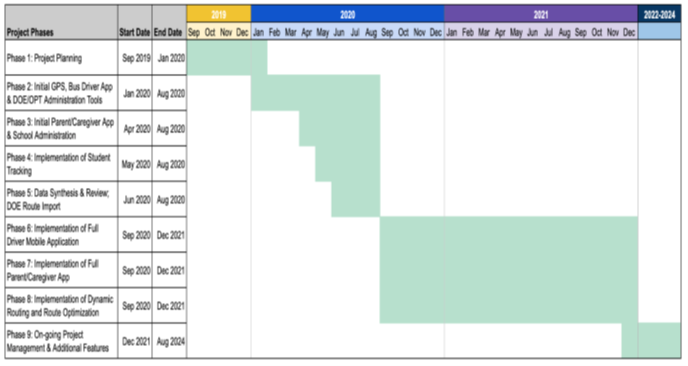
Endnotes
[1] Under the McKinney-Vento Act, a migratory child is defined as a child who moved from one school district to another within the past 36 months due to their parent/guardian moving to seek or obtain work as an agricultural worker or fisher.
[2] OPT provides CTS bus service to students with medical, health, or disability-related conditions or special circumstances, in accordance with the student’s IEP, which prevent them from being able to walk or utilize other forms of transportation to get to and from school. An IEP is a legal document that describes how a student will be provided with a free appropriate public education in the least restrictive environment appropriate to meet their needs. The IEP ensures that a student is provided with the appropriate learning opportunities, accommodations, adaptations, specialized services, and supports needed to progress towards achieving learning standards and meet the unique needs related to the disability.
[3] The Contractor’s Manual is the standard operating procedures provided by DOE to school bus vendors that details the duties and responsibilities of vendors when transporting students.
[4] Student ridership was determined based on the average number of students assigned to CTS and STS bus routes as reported by DOE in its Local Law 34 school bus transportation services bi-annual reports for August 2023 through June 2024.
[5] The cost for transportation services was determined based on DOE’s reported actual expenses in the Financial Management System (FMS) for budget codes special education (1106), general education (1108), and NYC School Bus Umbrella Services (1109) for Fiscal Year 2024.
[6] The New York City Council Committee on Education Oversight Hearing on DOE’s Office of Pupil Transportation, held on October 16, 2018. City Council testimony was included to help report readers understand why the audit was conducted and to provide broader context concerning school bus transportation and its impacts on the people DOE serves.
[7] The initial contract had a value of $36,206,526. In Fiscal Year 2023, the value of the contract was increased by $2,547,315 to $38,753,841. The contract was amended to include secure storage/charging stations and removal of existing GPS devices.
[8] In March 2024, DOE implemented the Support Hub – Service Now (SNOW) system to submit, store, review, and resolve complaints. This system replaced DOE’s former complaint system, the Call Recording System(CRS).
[9] Only one category—complaints related to Unprofessional Behavior—decreased in this period.
[10] The “Special Education Vendor/Route Information” complaint category is considered an informational inquiry; this complaint category is not investigated and is automatically closed by DOE.
[11] A “complaint ratio” is the number of complaints received in relation to the number of routes by vendor.
[12] Delay category types include mechanical problems, heavy traffic, weather conditions, problem run, flat tire, accident, and breakdowns.
[13] DOE does not maintain information on school bus routes that serve Pre-K students. Therefore, the audit team analyzed vendor-reported delays for school bus service provided to K–12 students. Of the 83,573 school bus delays reported during SY2023–24, 74,109 (88.7%) pertained to service provided to school-aged students.
[14] The audit team identified delays attributable to CTS and STS bus routes based on the route number. CTS and STS routes both have unique route identifiers: CTS routes that serve K–12 students have a unique four-character identifier, comprising one alpha character followed by three numeric characters; STS routes that serve certain K–6 students have a unique five-character identifier, comprising one alpha character followed by four numeric characters. CTS routes that serve Pre-K students with an IEP for busing and selected children in the Department of Health and Mental Hygiene’s Early Intervention Program do not have unique identifiers or naming conventions. Any value may be used.
[15] The audit team determined the number of routes vendors operated by obtaining the routes by service type in the City Council biannual reports from July 2023 to June 2024 and assessed the average routes operated for each vendor in SY2023-24.
[16] The New York City Council Committee on Education held hearings in 2018, 2019, 2022, and 2024 regarding OPT’s oversight of school transportation to allow parents and community representatives to provide testimony highlighting challenges faced in DOE’s transportation service. The 2024 hearing was not included in the Background section of this report because the hearing occurred after the audit was initiated in 2022.
The New York City Council Committee on Education Oversight Hearing on Upgrading School Transportation Services & Rebidding Contracts, held on September 30, 2024
[17] Trip cards are completed daily for each route and document the location and time of the first pick-up and arrival time at each school served. In addition, Trip Cards document afternoon pick-up time for each school and location and time of the last drop-off. Drivers and matrons, if applicable, sign cards to attest that information is true and accurate.
[18] Under the Individuals with Disabilities Education Act, children with special needs are entitled to a free appropriate public education in the least restrictive educational environment. If parents disagree with their child’s IEP developed by their public school district, they can enroll their child in a private school they believe better meets the needs of their child and can then seek reimbursement from the school district for tuition costs at the new school.
[19] Nine vendors provided school bus service to pre-school aged students only, while seven vendors provided service to both pre-school aged and school aged students.
[20] Dynamic routing and route optimization allows DOE to find, adjust, and provide the most efficient routes in real time.
[21] The audit team’s analysis was based on reports detailing vendors’ daily subscription rates and liquidated damages reported by DOE for the period November 4, 2024 through May 2, 2025.