Audit of the New York City Department of Environmental Protection’s Leak Detection Program
Audit Impact
Summary of Findings
The New York City Department of Environmental Protection’s (DEP) Leak Detection Program (the Program) is not functioning as a proactive, prevention-focused initiative as intended. Instead of progressing through the citywide system, DEP surveyed only a small portion of its planned coverage—just 27% of the 401 grids slated for inspection over a three-year period. Survey activity did not expand outward each year; DEP repeatedly revisited the same locations, leaving most of the water-distribution network uninspected.
Because inspection coverage remains limited, leak detection has continued to rely almost entirely on public complaints and visible emergencies rather than on the Program’s survey efforts. Of the 1,314 water main breaks repaired between FY23 and FY25, only 42 leaks—3%—were discovered through surveys, meaning that the Program is not meaningfully contributing to early leak identification. Consistent with this pattern, water main breaks increased by 54% in FY25, suggesting that the Program has not reduced break incidents or improved system reliability.
The audit also found that DEP does not use a structured, risk-based process for determining which grids to survey. Instead, DEP indicated survey selection depends heavily on institutional knowledge rather than on objective indicators such as pipe age, leak history, or infrastructure risk. Limited staffing during the scope period—one survey crew and one scan crew for the entire city—further restricted DEP’s ability to meet its own goals.
Finally, outdated technology hampers oversight and performance evaluation. DEP’s aging computer system cannot easily link survey findings to completed repairs, making it difficult to determine whether leaks identified in the field were addressed or whether survey activity contributes to outcomes.
Collectively, these issues—insufficient planning, inadequate resources, and limited data capabilities—have prevented DEP from carrying out a comprehensive, proactive leak-detection strategy and from achieving the preventive goals of the Leak Detection Program.
Intended Benefits
The audit assessed whether DEP’s Leak Detection Program is effectively identifying potential leaks before they lead to water main breaks, whether survey coverage is expanding in a systematic and risk-focused way, and whether the Program provides the preventive oversight needed to protect the City’s water infrastructure.
Introduction
Background
The New York City Department of Environmental Protection (DEP) is responsible for protecting public health and the environment by supplying clean drinking water, collecting and treating wastewater, mitigating storm and coastal flooding, and reducing air, noise, and hazardous materials pollution. DEP manages the City’s water supply, which provides more than one billion gallons of drinking water each day to more than half the population of New York State. The agency builds and maintains the City’s water-distribution network, fire hydrants, and storm and sanitary sewer systems, and is responsible for resolving emergencies, conducting preventive maintenance, and performing timely repairs to the water distribution system.
According to DEP, the capital commitment plan released by the Mayor de Blasio Administration on January 30, 2020, included increased investment in the City’s water delivery system. The plan was designed to strengthen the City’s water main infrastructure and expand inspection protocols aimed at preventing system failures. This investment was intended to reduce the frequency of water main breaks and to support modernization of DEP’s Leak Detection Program.
DEP’s Leak Detection Program
In July 2022, DEP implemented a Leak Detection Program to survey water mains as a preventive measure. The Program deploys field operations staff who use acoustic listening technology and specialized sensors to detect underground leaks before they develop into full water main breaks. Crews are dispatched daily to conduct systematic surveys and scans of water mains and associated infrastructure and equipment, such as valves, hydrants, fittings, and service connections throughout the City.
The purpose of the Leak Detection Unit is to identify small leaks before they escalate into water main breaks and cause loss, roadway deficiencies, and property damage, if left unaddressed. Early detection and repair are intended to prevent costly water main breaks that can cause roadway damage, flooding, and disruptions to public and private transportation. According to DEP, the Program enhances its ability to maintain the integrity of the City’s water distribution system through targeted monitoring and timely intervention.
DEP uses a computerized maintenance and management system known as Infor Public Sector (IPS) to generate and track customer service requests and corresponding work orders. The system is used to log incoming complaints (via NYC 311), allocate work orders to field crews, record maintenance and repair actions, and track their closure. DEP also uses IPS to document inspection results, assign follow-up activities, and maintain a centralized database of field operations and asset maintenance history across all boroughs.
As part of the Leak Detection Program, field crews conduct on-site assessments using sounding bars and acoustic monitoring equipment to identify potential leaks in underground water mains. When a survey is initiated, the crew creates a Leak Detection Survey Work Order (WLDSU) in the IPS system, entering the corresponding Map ID and the code “PROG” to designate it as a proactive leak detection survey. Each work order is closed with one of two outcomes: “Potential Leak(s) Detected” or “No Leak Found.”
If no evidence of leakage is detected, the crew proceeds to the next segment of the assigned map for continued surveying. If a potential leak is identified, a follow-up work order is generated for a second field crew to conduct a Leak Detection Scan using correlator equipment to precisely pinpoint the leak location. If the leak is confirmed, and if it is determined to be on City-owned infrastructure, the crew marks the site and creates a repair work order for the appropriate borough repair yard to perform corrective action.[1]
DEP categorizes leak identification as either proactive or reactive. Proactive leaks are those identified through scheduled leak detection surveys before the leak becomes visible or reported by the public. Reactive leaks, by contrast, are those discovered through 311 complaints, reports from other DEP field units, or emergency responses after the leak has already surfaced. The intent of the Leak Detection Program is to increase the proportion of proactive leak detections and reduce reliance on reactive repairs.
The Leak Detection Unit operates two shifts, Monday through Friday: a day shift from 7:00 a.m. to 3:30 p.m. and a night shift from 11:00 p.m. to 7:30 a.m. During the audit scope period, the unit consisted of one survey crew (one supervisor and three construction laborers) and one scan crew (one supervisor and three construction laborers).[2]
For survey planning, DEP divides the City’s water distribution system into survey grids—geographically defined sections that allow crews to systematically cover all water main segments. Each grid has a unique Map ID used in the IPS system to plan, record, and track survey activity and results across the five boroughs. DEP indicated that inspection parameters target surveying approximately 30% of the grids annually in the outer boroughs and in Manhattan above 96th Street, and 100% of the grids annually in Manhattan below 96th Street due to heightened consequences of potential leaks.
Since the July 1, 2022 implementation of the Leak Detection Program through the end of Fiscal Year 2025, DEP has repaired 1,314 water main breaks citywide. The Program initially began as a pilot initiative; however, at the time the audit commenced, DEP stated that it was no longer considered a pilot and has transitioned into a fully operational, ongoing program.[3]
Objective
The objective of this audit was to assess whether DEP’s Leak Detection Program effectively identifies and repairs leaks through proactive surveys and adequate tracking systems.
Discussion of Audit Results with DEP
The matters covered in this report were discussed with DEP officials during and at the conclusion of this audit. An Exit Conference Summary was sent to DEP on November 17, 2025, and discussed with DEP officials at an exit conference held on December 3, 2025. On December 8, 2025, we submitted a Draft Report to DEP with a request for written comments. We received a written response on December 19, 2025.
In its response, DEP did not specifically address each audit recommendation and instead stated generally that it agrees with many of the report’s recommendations.
DEP’s written response has been fully considered and, where relevant, changes and comments have been added to the report. The full text of DEP’s response is included as an addendum to this report.
Detailed Findings
The audit found that although the Program was designed to proactively identify leaks before they cause water main breaks, DEP’s coverage is limited. DEP surveyed only 27% of the grids in the four boroughs and Manhattan above 96th street that their internal policy called for surveying between FY23 and FY25, leaving 73% of those areas uninspected during the three-year cycle. Additionally, because survey activity did not expand into new areas—with the same grids frequently revisited—much of the City’s water system remains uninspected. Because survey coverage remains low, DEP’s repair work remains largely reactive. Most of the leaks DEP repaired during the scope period were identified outside of the survey process. Of 1,314 water main breaks repaired between FY23 and FY25, only 42 (3%) were found through proactive surveys. The rest were identified following 311 complaints, visible emergencies, and when uncovered by field operators performing other types of work. Repairs occurred mostly after leaks worsened.
It does not appear that the Program led to a reduction in water main breaks in FY25; over this period, water main breaks rose by 54% compared to FY24, indicating that the Program’s preventive impact has been minimal.
Based on the audit team’s review, DEP lacks a formal method for determining which grids to survey and instead relies on staff judgment, which is based on institutional knowledge of the system and its characteristics, rather than measurable indicators such as the age of the water main, pipe material, leak history, recent repair patterns, or proximity to critical infrastructure. With only one survey and one scan crew assigned citywide, the agency does not have the operational capacity to meet its own inspection goals, resulting in uneven coverage and missed targets.
An outdated computer system also makes program oversight cumbersome. DEP’s Infor Public Sector (IPS) system, implemented in the 1990s, does not readily or automatically link survey data to repairs, hindering the agency’s ability to track whether detected leaks have been repaired and its ability to evaluate overall performance. Together, these weaknesses—poor planning, limited resources, and obsolete data systems—have prevented DEP from achieving the Program’s goal of proactive, citywide leak detection and prevention.
Majority of the City’s Grids Not Surveyed
DEP established an operational goal that it has been unable to meet. The agency expected to survey approximately one-third of all grids in each borough every year, resulting in 100% coverage within each three-year cycle (FY23–FY25). In Manhattan, the expectation is higher: grids above 96th Street follow the one-third-per-year rule, while every grid below 96th Street must be surveyed annually (100%) due to the heightened consequences of potential leaks (e.g., asbestos-lined steam lines, heavy transportation disruptions, and a higher risk of property damage).
To comply with these goals, DEP is responsible for surveying all 401 grids across the four boroughs and Manhattan above 96th Street at least once every three years (approximately 134 grids per year) and surveying all 23 grids below 96th Street every year—resulting in a total annual expectation of about 157 grid surveys. However, audit testing found that DEP did not meet the three-year coverage goals, and that survey activity did not expand as needed across the five boroughs, with DEP often resurveying the same grid locations.
As shown in Table 1 below, DEP conducted a total of 141 surveys over a three-year period throughout the four outer boroughs and above 96th Street in Manhattan. This represents just 35% of the survey activity needed to achieve full coverage in these areas. In effect, DEP took a three-year period to complete almost one year’s worth of planned surveys. In addition, only 108 of the 141 grid surveys completed were of new grids—the majority of the 401 grids were not inspected even once during the three-year period. These results are reflected in Table 1 below.
Table 1: New and Repeat Survey Coverage (FY23–FY25)—4 Boroughs + Above 96th Street
| Fiscal Year | Total Grids Surveyed for 4 Boroughs + Above 96th Street | New Grids Surveyed | Repeat Grids Surveyed | % of Repeat Grids |
| FY 23 | 41 | 30 | 11 | 27% |
| FY 24 | 50 | 41 | 9 | 18% |
| FY 25 | 50 | 37 | 13 | 26% |
| Total FY23-FY25 | 141* | 108 | 33 | 23% |
*After the Exit Conference, DEP reported that it surveyed 151 total grids, including 43 repeat surveys, across the four boroughs and Manhattan above 96th Street. However, based on the data DEP provided, auditors calculated a total of 141 grids, with 33 repeats. DEP subsequently concurred with the auditors’ calculations and conclusion.
As shown in Table 1, during FYs 2023 through 2025, DEP surveyed only 108 of the 401 grids, leaving 293 grids (73%) uninspected during the three-year cycle. As also shown in the table, 33 (23%) of the 141 surveys conducted were surveys of grids that had been previously inspected, including one grid that was surveyed in all three years.
The distribution of DEP’s work under this Program did not provide uniform coverage. A deeper review reveals that grids in some boroughs received repeated surveys while grids in other boroughs had minimal surveys—or were not surveyed at all. Table 2 below shows how unevenly DEP’s survey efforts were spread and how this imbalance contributed to the agency’s inability to meet its three-year coverage goal.
Table 2: Three-Year Coverage by Borough
| Borough | Total # of Grids | # of Grids Surveyed (FY23–FY25) At Least Once | % Grids Surveyed Citywide Over a Three-Year Period |
| Manhattan – Above 96th Street | 27 | 22 | 81% |
| Bronx | 61 | 22 | 36% |
| Brooklyn | 101 | 33 | 33% |
| Queens | 146 | 31 | 21% |
| Staten Island | 66 | 0 | 0% |
| Total | 401 | 108 | 27% |
Because the Program is structured to achieve full coverage every three years, any cumulative result substantially below 100% represents a breakdown in the Program’s planned implementation. As shown in Table 2 above, the shortfall was consistent across boroughs. In three years, no borough received coverage consistent with DEP’s goals—and Staten Island received no surveys at all. This pattern indicates that large portions of the system remained unassessed during the cycle, undermining the preventive intent of the Program. According to DEP, this resulted from limitations related to staffing.
To better understand how DEP performed against its stricter goal for Manhattan below 96th Street (100% of grids surveyed annually), the audit separately analyzed survey activity in that area. Rather than providing the target annual inspection coverage for this high-risk section of Manhattan, DEP left multiple grids uninspected in both FY24 and FY25.
Table 3 (below) shows that DEP came closest to meeting the annual goal in FY23, surveying 22 of the 23 grids (96%). Coverage declined in the following years. In FY24, DEP surveyed only two grids, leaving 21 uninspected (91%), and although activity increased in FY25, DEP surveyed only 19 grids, leaving four uninspected (17%).
Table 3: Manhattan Below 96th Street: Survey Coverage (FY23–FY25)
| Fiscal Year | Total Grids to be Surveyed | Total Grids Surveyed | Total Grids Not Surveyed | |
| FY 23 | 23 | 22 (96%) | 1 (4%) | |
| FY 24 | 23 | 2 (9%) | 21 (91 %) | |
| FY 25 | 23 | 19 (83%) | 4 (17%) | |
| Total FY23-FY25 | 69 | 43 (62 %) | 26 (38%) | |
A closer review of which grids were missed each year shows that the gaps persisted across later cycles. The one grid not surveyed in FY23 was also not surveyed in FY24—this grid was not surveyed until FY25. Similarly, of the 21 grids not surveyed in FY 2024, 17 were surveyed in FY25; the remaining four were not surveyed in FY25.[4]
These shortfalls represent noncompliance with DEP’s operational goals and leave parts of this high-risk area unmonitored. Over the three-year period, DEP conducted 43 surveys but did not achieve full annual coverage in any of the three years, but the gaps in FY24 and FY25 were more significant.
DEP reported that the Program was still being rolled out during FY23 and FY24, with initial efforts concentrated heavily in Manhattan, and that FY25 saw an expansion into the Bronx and North Queens. DEP further explained that grid selection decisions are based primarily on staff’s institutional knowledge and field experience in identifying leak-prone zones. The agency added that without additional resources, it cannot expand the Program.
Water Main Breaks Increased Significantly in FY25
The goal of the Leak Detection Unit is to proactively survey water mains to detect leaks and reduce or avoid potential water main breaks. Despite the implementation of the Program, water main break trends between FY2021 and FY2025 suggest inconsistent impact.
As shown in Chart 1 below, the number of water main breaks decreased in the first year of the Program—from 459 to 403 in FY23—and further declined to 359 in FY24. However, there was a sharp increase by 54% in FY25. The number of water main breaks peaked in FY25 with 552 in total.
Chart 1: Number of Water Main Breaks on City Infrastructure during FYs 2021 to 2025
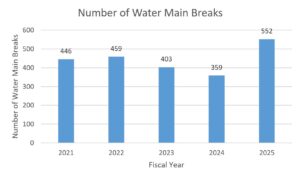
*DEP officials indicated that the number of water main breaks in 2024 was historically low.
The chart above shows that while water main breaks decreased during the first two years of the Leak Detection Program, they increased sharply in FY25.
Although DEP introduced the Leak Detection Program to identify and repair leaks before they escalate into water main breaks, DEP’s approach to leak management remains largely reactive, with most repairs made only after leaks are reported by the public or become visible emergencies.
Vast Majority of Water Main Breaks Identified Following Complaints, Emergencies or During Other Work
From FY23 through FY25, DEP completed 1,314 water main break repairs citywide. Of these, only 42 repairs (3%) originated from proactive detection efforts, while 1,272 repairs (97%) were initiated in response to public complaints, emergency conditions, or while other work was conducted. This imbalance is consistent with the limited survey coverage discussed in the first section of this report with DEP’s limited functionality to link survey results with repair outcomes (see further below).
To better understand how early detection varied across the City, the audit reviewed the number of leaks proactively identified through surveys, by borough. This is shown in Table 4 below.
Table 4: Proactively Identified Water Main Breaks, by Borough
| Borough | FY23 | FY24 | FY25 | Total |
| Bronx | 0 | 1 | 6 | 7 |
| Brooklyn | 0 | 5 | 0 | 5 |
| Manhattan | 11 | 6 | 5 | 22 |
| Queens | 1 | 0 | 7 | 8 |
| Total | 12 | 12 | 18 | 42 |
As indicated in the table above, Manhattan accounted for more than half (52%) of all proactively identified leaks citywide, consistent with its higher survey activity compared to other boroughs. DEP detected fewer than 10 leaks in Brooklyn, Queens, and the Bronx, and none were detected in Staten Island where no surveys were conducted. The limited scope of DEP’s survey activity is consistent with results above.
The vast majority of leaks that occurred during FYs 2023 through 2025 were repaired only after being reported through 311 complaints, visible emergencies, or when found by Field Operators conducting other work, as shown in Table 5 below.
Table 5: Reactively Identified Water Main Breaks, by Borough
| Borough | FY23 | FY24 | FY25 | Grand Total |
| Bronx | 61 | 55 | 75 | 191 |
| Brooklyn | 119 | 115 | 183 | 417 |
| Manhattan | 43 | 31 | 50 | 124 |
| Queens | 139 | 120 | 176 | 435 |
| Staten Island | 29 | 26 | 50 | 105 |
| Grand Total | 391 | 347 | 534 | 1,272 |
As indicated in Table 5 above, reactive repairs increased in all boroughs between FYs 2024 and 2025, particularly in Brooklyn and Queens, which together accounted for 67% of all reactive repairs.[5] These boroughs experienced frequent leaks but have had limited preventive survey coverage, as indicated earlier in the report. Without consistent survey activity or a mechanism to analyze where leaks occur, DEP is limited in its ability to target high-risk areas or plan future surveys effectively.
The data shows a clear relationship between survey coverage and proactive leak detection. Boroughs with more survey activity—especially Manhattan—had more leaks identified and proactively repaired, while those with little or no survey activity, such as Queens, had almost entirely reactive repairs, and in Staten Island, where no surveys occurred, all repairs were performed after leaks or water main breaks were reported. This pattern is consistent with the idea that more regular survey coverage and better planning support earlier leak detection.
In contrast, when detection depends mainly on public reporting, repairs tend to occur only after leaks worsen—leading to greater water loss, emergency excavations, and damage to roadways and adjacent infrastructure.[6] Leaks identified through proactive detection can help support earlier repairs and more efficient scheduling, which may reduce costs and minimize disruption to service and infrastructure.
Impediments to the Program
The magnitude and distribution of unsurveyed grids point to several areas needing improvement, as indicated in more detail below.
No Formal Criteria for Survey Planning
DEP does not have a structured, risk-based planning process to ensure that each borough meets the annual one-third coverage goals or, for Manhattan below 96th Street, the yearly 100% coverage goal.
DEP has not established written criteria for selecting grids based on documented risk factors—such as size and age of water mains, prior leak history, recent main breaks, recent construction or excavation activity, or proximity to critical underground infrastructure. In the absence of these written criteria, DEP lacks a standardized planning process to ensure borough-level compliance with Program goals or to systematically prioritize high-risk areas. As a result, grid selection is driven primarily by staff judgment, which is based on institutional knowledge of the system and its characteristics, as well as by staff availability, rather than by a documented, risk-based strategy to achieve consistent and complete citywide coverage.
This ad-hoc approach makes it difficult for DEP to anticipate workload needs, allocate crews efficiently, or ensure that resources are directed to areas with the greatest vulnerability. Without a more structured system, coverage gaps will continue to persist and limit the effectiveness of the Program.
Insufficient Staffing Prevents DEP from Meeting Survey Targets
DEP lacks the operational capacity necessary to achieve citywide compliance with its own targets.
In response to audit inquiries, DEP stated that the number of surveys conducted represented the maximum achievable with existing resources, indicating that staffing constraints were a limiting factor. This explanation is consistent with the Program’s limited staffing: one survey crew and one scan crew. DEP explained that in FYs 23, 24, and most of 25, the Program was essentially operating as a pilot, and that in May 2025 it was able to increase staffing for the Program by three positions.
However, during the audit scope period, with only one survey crew available and no structured schedule to guide coverage, DEP often returned to the same areas instead of moving through all of the grids that must be surveyed, and the survey work conducted remained concentrated in a small number of locations.
The results show that when survey coverage is provided, leaks are identified. However, the limited resources and the lack of a formal, risk-based deployment strategy hinder the Program’s effectiveness.
Outdated Computer System Undermines DEP’s Ability to Monitor Results
According to DEP, the agency’s work-order management platform—IPS—was implemented in the 1990s and is now considered outdated. The system does not have the functionality to readily or automatically trace the sequence of survey → scan → work order → repair across the Program. In its current form, IPS can record complaints and repairs, but it takes multiple steps to integrate data from leak detection surveys into tracking of repairs and can only be done for one survey at a time.
While IPS adequately manages public complaints via 311 and maintenance orders, it was not originally designed for proactive, data-driven asset management. DEP has acknowledged these gaps and indicated that it intends to modernize the system as part of a broader asset-management overhaul, adding that it is in the process of procuring a third-party advisor to assist with the transition.
Due to the limitations of DEP’s computer system, program-level performance monitoring—such as tracking how many leaks identified through surveys result in repairs, how many of those repairs are complete, or how many potential breaks were prevented—is cumbersome and cannot be done on an aggregate level. Management therefore lacks complete visibility into whether survey activity translates into measurable outcomes and whether the goals of the Program are achieved.
DEP officials agreed that the IPS system is cumbersome to use and acknowledged that a newer system would be beneficial to track the work of the Leak Detection Program.
Recommendations
To address the abovementioned findings, the auditors propose that DEP should implement the recommendations below. In its response, DEP did not provide responses to each recommendation and stated only that it agreed with many of them.
- Develop and implement a structured, risk-based survey planning process. This includes establishing written procedures for selecting survey grids using measurable risk indicators such as the age, size, and material of water mains; prior leak history; recent construction or excavation activity; and proximity to critical infrastructure.
- Regularly measure and report progress toward DEP’s operational goals—surveying 30% of each borough’s grids annually and achieving full coverage within three years—and use quarterly performance reviews to identify and address shortfalls.
- Create a formal process for scheduling and tracking survey coverage so that work is spread across all grids, avoids unnecessary repeats, and ensures every grid is inspected within the annual and three-year cycles.
- Conduct periodic reviews of proactive detection rates, repair times, and water main break trends to assess the effectiveness of the Leak Detection Program.
- Given the current staffing levels, consider reevaluating the feasibility of current survey goals based on available resources, reallocating personnel, increasing training, or adding shifts to meet operational goals. Consider seeking additional funding to expand the reach and impact of the Program.
- Ensure that its computer system—whether updated or new—allows for improved useability and direct traceability from survey to scan to repair, including the ability to link proactive detection results to follow-up actions and repair outcomes. The computer platform should include performance dashboards and reporting tools for program-level monitoring.
Recommendations Follow-up
Follow-up will be conducted periodically to determine the implementation status of each recommendation contained in this report. Agency reported status updates are included in the Audit Recommendations Tracker available here: https://comptroller.nyc.gov/services/for-the-public/audit/audit-recommendations-tracker/
Scope and Methodology
We conducted this performance audit in accordance with Generally Accepted Government Auditing Standards (GAGAS). GAGAS requires that we plan and perform the audit to obtain sufficient, appropriate evidence to provide a reasonable basis for our findings and conclusions based on our audit objectives. We believe that the evidence obtained provides a reasonable basis for our findings and conclusions within the context of our audit objective(s). This audit was conducted in accordance with the audit responsibilities of the City Comptroller as set forth in Chapter 5, §93, of the New York City Charter.
The scope of this audit was July 1, 2022 through June 30, 2025.
To obtain an understanding of the operations of the Leak Detection Program, auditors interviewed relevant DEP officials, including the following: Acting Chief Operating Officer and Assistant Commissioner of the Bureau of Water and Sewer Operations; Director of the Division of Field Operations–Maintenance and Repairs; Manhattan Borough Manager, Supervisor, and Survey/Scan team members; Director of Operations Analysis & Project Management; Director and Program Analyst in the Management Analysis unit; and BWSO Data Analyst.
In addition, auditors had a walkthrough of the IPS system and conducted field visits with DEP’s Leak Detection Unit to observe their process for identifying potential water main leaks in the water supply system.
In addition, auditors reviewed the following supporting documentation provided by DEP, including operational policies, internal reports, and correspondence describing program structure, staffing, and resource allocation:
- Leak Detection Standard Operating Procedure DCN FO-SOP-131-00-2020
- Leak Detection Program IPS Process
- Leak Repair Work Order Activity and Condition Codes
- Leak Detection Process Workflow
- Leak Detection Program Organizational Chart
- Leak Detection Data Capture – Survey (WLDSU)
- Leak Detection Data Capture Scan
Auditors obtained data on surveys, scans and repairs conducted from July 1, 2022 through June 30, 2025, as well as DEP’s map of the City with associated grids. Auditors assessed the reliability of the data by comparing the data to the maps/grids of the City, as well as to the water main repair data within the Mayor’s Management Report for those same three years.
The audit performed quantitative analysis to calculate compliance with annual and three-year survey goals, identify borough-level coverage gaps, and determine the share of leak repairs resulting from proactive detection versus reactive response.
To assess program performance, the audit reviewed DEP’s data for leak detection surveys, scan and repair work orders, and water main break records for the three-year period. The data was analyzed to determine (1) the number and percentage of grids surveyed annually and cumulatively by borough, (2) the number and source of leak repairs completed, and (3) trends in water main breaks citywide. DEP’s work-order and survey data were extracted from the Infor Public Sector (IPS) system, which tracks customer complaints, work orders, and field activity.
The audit also compared proactive survey results (leaks identified through scheduled leak detection surveys) with reactive repair data (repairs initiated through 311 complaints or emergency responses) and analyzed trends to assess whether proactive survey activity correlated with reductions in water main breaks within the five boroughs.
Auditors attempted to assess timelines for the entire cycle (survey to scan to repair) at the global level, but were unable to do so based on the way DEP maintains its information in the IPS system.
The combined results of the tests, analyses, and conclusions above, as well as the collection of information during interviews with DEP officials, provide sufficient and reliable evidence to support the audit’s findings and conclusions.
Endnotes
[1] If the identified leak is not on City infrastructure, DEP serves the property owner with a 3-day notice requiring the property owner to make the repair of the service line.
[2] According to DEP, as of May 2025, the Leak Detection Unit hired three additional staff. Staffing during Fiscal Year 2025 consisted of one supervisor and four laborers for the day shift, and one supervisor with five laborers for the night shift.
[3] In its response to the Draft Report, DEP indicated that the Program began as a pilot in FY23 and FY24 and neared the allocated headcount in FY25. This is indicated on page 12 of the report.
[4] The grid missed in FY23 was included among the 21 FY24 omissions.
[5] In its response to the Draft Report, DEP indicated that these increases correspond to the overall increase in water main breaks during this period.
[6] In its response to the Draft Report, DEP took exception to the statement that repairs tend to occur only after leaks worsen and states that this may be based on assumptions. However, the audit analysis shows that the vast majority of water main breaks repaired during the audit scope period were identified reactively, rather than through proactive surveys. The central purpose of the Leak Detection Unit is to identify small leaks before they escalate into water main breaks that can cause water loss, roadway damage, and adverse property conditions. When most repairs are triggered by public complaints or visible failures, leaks are generally being addressed after deterioration has occurred, which is inconsistent with the preventive intent of the Program.