Audit Report on the NYC Department of Veterans’ Services’ Coordination of Housing Assistance
Audit Impact
Summary of Findings
The New York City Department of Veterans’ Services (DVS) effectively helped 153 veterans secure housing in Fiscal Year 2025. It also provided the required aftercare services to veterans who received various rental assistance housing vouchers.
However, the audit identified several deficiencies and found several areas where improvement is needed. For example, in FY2025, DVS failed to respond to more than a quarter (27%) of veterans’ housing assistance requests within its five-business-day target. Moreover, the audit also found that DVS needs to improve staff oversight and training, especially in recordkeeping. The agency overstated the number of requests for assistance received and inaccurately reported the number of veterans it assisted in homelessness prevention and aftercare assistance for the fiscal year. The agency also offered inconsistent information regarding the frequency with which staff were expected to make aftercare service calls, indicating that internal policy and guidance to staff is not clear.
Finally, the audit found that as of December 1, 2025, DVS had not submitted the most recent annual report to the City Council detailing performance since 2023 and had also failed to submit the three most recent semi-annual reports to the Mayor and City Council regarding the operations of its veteran resource centers. DVS is mandated to compile and submit these reports within deadlines established in local laws. On December 15, 2025 (after its receipt of the auditors’ Draft Report), DVS submitted all outstanding required reports.
Intended Benefits
This audit identified the need for DVS to improve its oversight, training, and standard operating procedures for its housing assistance services. In addition, the audit identified the need for DVS to provide more complete and accurate information to the City on its services to veterans.
Introduction
Background
New York City is home to more than 129,000 veterans.[1] DVS was created in 2016 to connect veterans with various City services, such as healthcare, education, and housing, in coordination with federal, State, and City agencies, as well as regional private and non-profit partners. DVS’ goals include mitigating and preventing veteran homelessness and informing and connecting veterans and their families to services, benefits, and resources that are available to them.[2] This audit focused on DVS’ services as they relate to housing assistance.
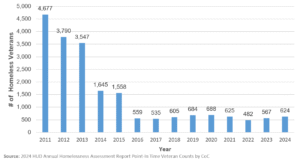
In recent years, the City has reduced its population of homeless veterans by nearly 90%, with the number decreasing from 4,677 in 2011 to 624 in 2024.[3] In December 2015, New York City became the largest city in the U.S. to be recognized by the federal government for ending chronic veteran homelessness. Chart 1 illustrates the decrease in the homeless veteran population in New York City between 2011 and 2024.
Chart 1: Number of Homeless Veterans in New York City from 2011 to 2024
DVS Programs and Services
DVS’ Housing and Support Services unit connects and refers veterans to housing resources, ensuring that they have permanent housing and access to the support services needed to find and maintain their homes.[4] According to DVS’ website, the agency uses the following approach to house formerly homeless veterans: (1) the Veteran Peer Coordinator program, (2) House-A-Veteran program, and (3) Aftercare Assistance.
- Through the Veteran Peer Coordinator program, DVS provides direct, peer-to-peer assistance to homeless and at-risk veterans in shelters. The program helps veterans identify apartments for which they are eligible, provides transportation to and from apartment viewings, assists veterans in accessing rental subsidies, and coordinates with interagency and housing partners to ensure that apartments meet necessary requirements so that they can be occupied.
- Through “House-A-Veteran,” DVS works to increase the supply of housing available to homeless veterans by finding and communicating with brokers, property owners, and managers who are looking to house homeless veterans. It offers an “Apartment Availability Referral Form” through its website that allows interested owners to provide information about their property, including the borough and number of bedrooms.
- Through Aftercare Assistance, DVS ensures that formerly homeless veterans remain housed. Aftercare Assistance services include regular check-in calls, referrals to community partners if the veteran seeks additional services, and providing veterans with necessary information about rent, utilities, and other expenses.
DVS works with the New York City Department of Homeless Services (DHS) by placing veteran housing coordinators from DVS’ Housing and Support Services unit at the Borden Avenue Veterans Residence in Queens, which is currently the City’s only DHS shelter reserved for homeless veterans.[5] DVS staff are at the shelter three days per week to help connect veterans to eligible housing resources and move out of the shelter.
DVS Intake
Veterans can request assistance from DVS through email, telephone, online through DVS’ website, or in-person at one of its veteran resource centers located throughout the City.[6] All requests (including housing assistance requests) are processed by DVS through VetConnectNYC, which is the sole application system used to enter and track client information and requests, and facilitate referrals to appropriate programs. According to DVS’ website, the agency’s Care Coordinators receive all requests made through VetConnectNYC and contacts (DVS refers to this as “processing”) them within three to five business days.
DVS conducts an intake process to gather basic information on the veteran, assist in determining eligibility, and ensure that applicants consent to receiving DVS’ assistance.[7]
Veteran Housing Resources and Vouchers
Following the intake process, DVS refers and connects veterans to various housing resources provided by its partners, including but not limited to:
- Housing and Urban Development-Veterans Affairs Supportive Housing (HUD-VASH) Program, which is provided by the U.S. Department of Housing and Urban Development (HUD) and the U.S. Department of Veterans Affairs (VA). HUD-VASH prioritizes the chronically homeless. HUD provides rental assistance vouchers for privately-owned housing to veterans who are eligible for VA health care and are experiencing homelessness. VA case managers connect these veterans to additional support services.
- Section 8 Housing Choice Voucher Program, which is provided by the New York City Housing Authority (NYCHA) or New York City Department of Housing Preservation and Development (HPD). Section 8 (also known as the Housing Choice Voucher program) is a rental subsidy that allows families to pay a reasonable amount of their income toward their rent.
- City Fighting Homelessness and Eviction Prevention Supplement (CityFHEPS) Program, which is provided by the New York City Department of Social Services (DSS). CityFHEPS is a rental assistance supplement to help formerly homeless individuals and families find and keep housing.
- Special One-Time Assistance (SOTA) Program, which is provided by DSS. SOTA helps facilitate the transition from shelter to permanent housing by providing rental assistance for one year.
DVS does not determine eligibility for the programs or whether the veteran will be approved for the program/voucher. Eligibility and approval are subject to the requirements of the agency managing the program.
According to DVS, 30 to 40% of veterans in New York City without permanent housing are not eligible for standard VA vouchers. There are several factors that can impact a veteran’s eligibility for standard VA vouchers, such as their eligibility for VA healthcare. Because of this, many ineligible veterans stay in City and nonprofit facilities for over a year on average. To create paths to permanent housing for these veterans, DVS collaborates with NYCHA and HPD to issue special purpose HUD-VASH vouchers, currently known as the HUD-VASH Collaborative Case Management (CCM) Voucher.[8] The CCM voucher provides rental assistance, with DVS coordinating community-based case management and supportive services to eligible veterans instead of the VA.
This audit focuses on DVS’ coordination of housing assistance services during FY2025 (July 1, 2024 through June 30, 2025).
Objective
The objective of this audit was to determine whether DVS is efficiently and effectively helping veterans find housing and avoid homelessness.
Discussion of Audit Results with DVS
The matters covered in this report were discussed with DVS officials during and at the conclusion of this audit. An Exit Conference Summary was sent to DVS on November 17, 2025, and discussed with DVS officials at an exit conference held on November 21, 2025. On December 1, 2025, we submitted a Draft Report to DVS with a request for written comments. We received a written response from DVS on December 15, 2025. In its response, DVS agreed with all six of the audit’s recommendations.
DVS’ written response has been fully considered and, where relevant, changes and comments have been added to the report.
The full text of the DVS response is included as an addendum to this report.
Detailed Findings
DVS helped veterans seek and obtain housing and avoid evictions and provided them with important aftercare services. The auditors’ review of DVS’ records found that the agency effectively helped 153 veterans secure housing in FY2025. The examination also revealed that DVS provided the required aftercare services to all veterans who secured housing through HUD-VASH Collaborative Case Management (CCM) housing vouchers. Although not required, DVS also provided aftercare services to veterans who used other housing vouchers.
However, the audit identified several deficiencies and areas where improvement is needed. For example, DVS failed to respond to more than a quarter (27%) of veterans’ housing assistance requests within five business days. The audit also found that DVS needs to improve staff oversight and training, especially in recordkeeping.
The auditors identified several discrepancies in DVS’ records resulting in the agency (1) overstating the number of requests for assistance received, and (2) inaccurately reporting the number of veterans the agency assisted in homelessness prevention (e.g., assistance with rental arrears) and aftercare assistance (e.g., financial counseling or landlord/tenant mediation). DVS also offered inconsistent information regarding the frequency with which staff were to make aftercare service calls.
Finally, the audit found that as of December 1, 2025, DVS had not submitted the most recent annual report to the City Council detailing performance since 2023 and had also failed to submit the three most recent semi-annual reports to the Mayor and City Council regarding the operations of its veteran resource centers. This lack of reporting contravenes requirements set forth in Local Law 44 of 2019 and Local Law 215 of 2018, respectively. On December 15, 2025, after receiving the Draft Report from the auditors, DVS submitted all outstanding required reports.
DVS Helped 153 Veterans Secure Housing in FY2025
The audit found that during FY2025, DVS assisted 153 veterans in securing permanent housing through its Veteran Peer Coordinator program. This represents a 21% increase from the 126 veterans DVS reported assisting during the prior fiscal year.[9]
Housing vouchers are one of the primary tools used to help veterans obtain housing.[10] A housing voucher allows people below a certain income level to receive rental assistance. According to DVS, most of its clients use vouchers that require the veteran to pay only 30% of their income towards rent, with the voucher covering the remainder. For example, if a veteran’s monthly income is only $1,000, they might pay $300 per month in rent, with the voucher covering the rest.
Generally, veterans first apply for a housing voucher. If they are eligible, they receive the voucher before they begin searching for housing. There are at least eight kinds of vouchers for which veterans may be eligible that can be used to help secure permanent housing.
DVS assisted 126 veterans in finding housing through vouchers, including HUD-VASH, Section 8, and CityFHEPS in FY2025. DVS also helped 27 veterans obtain housing through CCM vouchers.
DVS officials stated that the CCM voucher is generally issued as a last resort, when the veteran is found to be ineligible for other housing vouchers. CCM is a special type of HUD-VASH voucher that provides rental assistance, and DVS coordinates community-based case management and supportive services to eligible veterans (instead of the VA, which is the provider of case management services for standard HUD-VASH vouchers).
To receive the CCM voucher, a veteran’s case manager, housing coordinator, or other shelter/street homeless worker submits a CCM application to DVS. The agency then reviews it for initial eligibility based on three criteria: (1) the federal definition of homelessness;[11] (2) the veteran’s discharge status;[12] and (3) ineligibility for VA healthcare.[13] If eligible, DVS forwards the application to NYCHA for its CCM program review.
During FY2025, there were 37 CCM vouchers available and DVS helped 27 veterans receive one. Regarding the discrepancy between the number of available CCM vouchers and the number of vouchers used, DVS explained that it generally retains some CCM vouchers in case of dire circumstances, such as a veteran fleeing domestic violence, an elderly veteran, a veteran family with children, or a veteran who is experiencing chronic homelessness.
Aftercare Services Provided to Veterans
According to its Memoranda of Understanding (MOUs) with NYCHA and HPD, DVS staff are required to provide case management and supportive services to veterans who obtained housing through CCM vouchers to help them maintain permanent housing. DVS refers to these services as “aftercare.”
DVS stated that its aftercare includes coordinated support for veterans transitioning to stable housing, ongoing follow-up to keep them connected to key services during recovery, and regular check-ins to promote long-term stability.
The audit found that DVS provided aftercare services to veterans—both those who received CCM vouchers as required, and also to those who received other types of vouchers, such as CityFHEPS. The auditors’ review of DVS’ FY2025 aftercare efforts revealed that the agency reached out to 87 veterans who moved out in FY2025 during the six-month call period, and to 38 veterans who moved out in FY2025 during the 10-month call period, which are among the frequency intervals for aftercare tracked by DVS.
Analysis of Response Times Reveals that More than a Quarter of Veteran Housing Assistance Requests Not Responded to Within Five-Business-Day Target
According to DVS’ website, veterans requesting assistance from DVS online should fill out the VetConnectNYC form on its website. Agency policy calls for DVS Coordinators to contact veterans who submitted requests through VetConnectNYC within five business days.
During FY2025, housing assistance requests received online were manually transferred by DVS staff into its Master Tracker, which tracked all requests regardless of source (e.g., phone call, walk-in at a veteran resource center). DVS received 1,541 requests from veterans seeking housing assistance. These requests generally fell into the following categories: General Housing Inquiry, Affordable Housing, and Eviction Prevention.[14]
Of the 1,541 requests, 179 (12%) did not have the first contact date (i.e., the date that DVS attempted to contact the veteran) recorded in the Master Tracker, so auditors could not determine the response timeframe for those requests. For another five requests, the dates recorded in the Master Tracker as the first contact dates were before the veterans even submitted the respective requests, indicating an obvious error in one or both dates. Of the remaining 1,357 requests, 987 (73%) were processed within the five-business-day target. On average, DVS took five days to respond to requests, with a median of four days (meaning that at least half of the requests were responded to within four days).
See Table 1 for a breakdown of the timeframe of DVS’ processing of housing assistance requests for FY2025 from its Master Tracker.
Table 1: Housing Assistance Requests Processed Within and Beyond Five Business Days from DVS’ Master Tracker in Fiscal Year 2025
| DVS’ Housing Assistance Request Response Timeframes |
# of Veteran Housing Assistance Requests |
% |
|
Within 5 Business Days |
987 |
73% |
|
6-10 Business Days |
271 |
20% |
|
11-20 Business Days |
47 |
3% |
| 21-35 Business Days |
52 |
4% |
| Total |
1,357 |
100% |
As shown in Table 1, for 370 requests (27%), DVS took longer than five business days to respond; of these, DVS took at least 21 business days (approximately one month) to attempt to make contact in response to 52 requests—the longest timeframe for the first contact attempt was 35 business days.[15]
Timely processing of requests ensures that veterans receive the assistance they need to procure housing or prevent homelessness. Unnecessary delays in contacting veterans can have dire consequences for homeless veterans, particularly extending the time that a veteran remains homeless. It may also increase the risk that a veteran may be subject to violence or inclement weather.
DVS’ Inadequate Oversight, Training, and Standard Operating Procedures for Staff Lead to Errors in Tracking Services
The audit found persistent errors in DVS’ tracking records, resulting in the agency overstating the number of housing assistance requests received and inaccurately reporting the number of veterans who were provided with homelessness prevention and aftercare assistance.
A significant factor leading to the deficiencies identified by auditors is that DVS has not developed written standard operating procedures governing its operations, including the Veteran Peer Coordinator Program and Aftercare Assistance, among others. In addition, when asked how often DVS staff are trained in assisting veterans with housing assistance requests, DVS stated that it does not provide formal training.
The agency provided a VHS Housing Guide, dated January 15, 2019, which describes the types of housing, the housing vouchers available, the applicable agencies, and the subsidy processes for each voucher. It also provided a “VPC Process” flowchart, which provides the general process for assisting veterans with Section 8, CityFHEPS, and SOTA vouchers.
However, the auditors found that aspects of the VHS Housing Guide were outdated. For example, the guide refers to housing subsidies that have not existed (or have been combined with other programs) since 2019. In addition, neither the VHS Housing Guide nor the flowchart incorporates how DVS staff should have utilized the system of record during FY2025 (to be discussed later in the report).
Additionally, the auditors found that the VHS Housing Guide did not include guidance for staff on:
- DVS’ veteran application and intake process through VetConnectNYC.
- Case management of clients, including standardized notes, essential information and consistent documentation that should be maintained.
- Tracking and maintenance of DVS’ system, including reviews and generating statistical reports.
During the audit, DVS stated that it planned to update the VHS Housing Guide and create procedures for processing housing assistance requests through VetConnectNYC when the new system—which went live in July 2025—was implemented.[16] DVS also stated that beginning in mid-July 2025, staff received weekly training in how to use the new system.
On November 25, 2025, four days after our exit conference (held on November 21, 2025), DVS provided the auditors with a Housing and Supportive Services Policy Manual which establishes written Standard Operating Procedures (SOPs) for the Housing and Support Services Unit; defines roles and expectations for Housing Coordinators and related staff; provides step-by-step guidance on housing placements, subsidy processing, and aftercare; sets documentation and data standards for VetConnectNYC and other systems; and outlines quality assurance, compliance, and training requirements.
The audit recognizes DVS’ dedication and efforts in serving and assisting veterans. Nevertheless, DVS should increase its oversight and training of staff to ensure that they are knowledgeable about the agency’s policies and that they carry them out consistently and accurately.
These issues are discussed in further detail below.
DVS Made Errors in Tracking Services
In 2024, DVS began the process of replacing the vendor that manages the VetConnectNYC system. During the transition from Unite Us to Combined Arms, DVS used various Microsoft Excel spreadsheets in FY2025 (referred to as “trackers”) to track and coordinate requests until the new version of VetConnectNYC (supported by Combined Arms) was implemented.
The table below summarizes the various trackers used by DVS during FY2025 and a general description of what each tracker was used for.
Table 2: Description of the Interim Trackers used by DVS to Track Requests in FY2025
| Name of Tracker | General Description of Tracker |
| Master Tracker | Tracked all requests (including housing assistance requests) received from the online VetConnectNYC Form, as well as requests manually transferred from physical forms filled out in person at DVS’ veteran resource centers, or by telephone or email. |
| Moved-Out Tracker | Tracked the veterans who DVS helped move out from shelters or housing insecurity to permanent housing. |
| Aftercare Tracker | Tracked DVS’ aftercare services to veterans who were moved into housing. According to DVS, this service is primarily provided to veterans who are receiving its Collaborative Case Management (CCM) voucher. |
| “Visitors’ Log” | Tracked interactions of newly hired DVS staff while at the agency’s field locations (e.g., Borden Avenue Veterans Residence Shelter, Chapel Street veteran resource center) starting in February 2025.* |
*The auditors did not receive the “Visitors’ Log” until October 2025. According to DVS, the log was not in use for the full FY2025; therefore, the auditors’ analysis is focused on the Master Tracker, Moved-Out Tracker, and Aftercare Tracker, which were in use by DVS for the full FY2025.
However, DVS did not take sufficient steps to ensure that these trackers were consistently or timely updated and that they contained all the information called for in accordance with DVS’ process.[17]
According to DVS, as of mid-July 2025 (FY2026), the Master Tracker is no longer being used, and the new system went live.[18] Nonetheless, the trackers were the primary basis for the metrics reported in the Mayor’s Management Report (MMR) in FY2025. Auditors identified several issues that raise concerns regarding DVS’ reporting of the effectiveness of the services provided.
DVS staff stated that they were not trained during or prior to the use of the trackers because the use of these trackers was reportedly self-explanatory. The auditors’ examination of the trackers revealed that they were missing key information and were not used in a consistent manner among staff, indicating that additional training would have been helpful.
Due to the lack of oversight and the absence of formal standard operating procedures that govern documentation practices for services, coupled with limited staff training, DVS staff may input insufficient or inconsistent information into the trackers, or not provide updates in the existing notes. This highlights a critical need for improved data accuracy, formal documentation protocols, and enhanced training for staff to ensure consistency in the recording and documenting of housing assistance services.
These deficiencies resulted in errors in several indicators used by DVS, as discussed below.
DVS Overstated the Number of Housing Assistance Requests Received in FY2025
The audit team found that the Moved-Out Tracker was generally accurate. However, the Master Tracker contained 41 duplicates and 46 requests were missing information (such as dates when the request was started and/or completed in VetConnectNYC).
After bringing these issues to DVS’ attention, the agency stated that the duplicates were likely related to data entry issues from temporary personnel who are no longer with the agency, and the requests that had missing information about the start or completion dates were due to a file formatting issue. The agency also provided auditors with another copy of the tracker in October 2025. In this version, the issue regarding the missing information was corrected; however, it still contained the 41 duplicate housing assistance requests. So, although 1,582 housing assistance requests were listed in the tracker, DVS in fact received only 1,541 requests in FY2025.
DVS Initially Overstated the Number of Veterans Housed
The auditors also found discrepancies in the housing outcomes recorded in the Aftercare Tracker. The auditors found contradictions between the category field indicating whether the veteran was still housed and the notes section. Specifically, auditors analyzed a sample of 60 veteran clients and found that DVS recorded 25 veterans (42%) as still housed; however, the case notes in the tracker identified only 11 veterans (18%) as such. Information contained within these fields is critical to accurately tracking housing outcomes for veteran clients, and any insufficiency or inconsistency in this data has led to misreporting of housing status. The overreporting of 14 veterans as still housed misrepresented the effectiveness of DVS’ aftercare services.[19]
After the auditors brought the issues of inconsistent and insufficient case notes in the Aftercare Tracker to DVS’ attention, the agency provided another copy in October 2025 which contained updates to this category field and the notes. The auditors found that the notes generally coincided with what was reported in the “Still Housed” field.[20] It also added two housing statuses for clients whose housing status is unknown (unknown awaiting response and sent letter awaiting response).
DVS Inaccurately Reported the Number of Veterans Provided Homelessness Prevention and Aftercare Assistance
In the FY2025 MMR, DVS reported that it provided 509 veterans with homelessness prevention and aftercare assistance. However, of the 509 veterans identified by name in the tracker, 16 were duplicate requests by the same veterans (containing the same dates and times), 45 were the same veterans with multiple requests (different date or time), and one was identified as a “test”—for a total of 62 discrepancies. After subtracting these 62 discrepancies, the actual number of veterans assisted appears to be 447.
These inaccuracies, as contained in DVS’ records, also highlight the need for DVS to implement review mechanisms to ensure that staff are following procedures consistently and that errors are identified and corrected promptly.
In November 2025, DVS explained that the inaccurate reporting in the FY2025 MMR was because it inadvertently reported based upon the number of requests, instead of the number of veterans. It further explained that this is because it can sometimes help the same veteran with multiple requests for different services. The agency acknowledged that the number of veterans provided with homelessness prevention and aftercare assistance in FY2025 was 447. DVS informed us that they have asked City Hall to update the MMR to reflect the correct number of 447 veterans served.
DVS Provided Conflicting Timeframes Regarding its Provision of Aftercare Services
As stated earlier, veterans who secure housing through the utilization of CCM housing vouchers receive aftercare services from DVS. The MOUs mandating the provision of these services contain no requirement regarding how frequently aftercare services are to be provided, leaving it to the discretion of DVS. However, DVS gave inconsistent timelines to auditors for these aftercare services.
In January 2025, the agency stated that staff conducted five check-ins with veterans beginning two weeks after they had moved into permanent housing, with subsequent follow-ups occurring six, 10, 18, and 22 months later. However, in February 2025, the agency stated that the first check-in did not occur until the sixth month, with subsequent check-ins 11, 18, 24, and 36 months later. The agency again changed the check-in frequency in March 2025, with the aftercare tracker indicating that the first occurred after six months, with subsequent check-ins 10, 18, and 22 months later. In April 2025, the agency gave a different start for the first check-in, saying that it occurred one month after move-in.
These discrepancies and inconsistencies further highlight the importance of the agency formally establishing written standard operating procedures and guidelines to ensure that staff carry out policies in a consistent manner and that the agency can promptly implement corrective measures when deviations from those policies are identified.
In the agency’s newly created Housing and Supportive Services Policy Manual, which was provided to the auditors in November 2025, the agency formally established the aftercare frequency as two weeks, one-month, six months, 10 months, 18 months and 22 months.
DVS Did Not Publish Mandated Reports in a Timely Manner
Local Law 44 of 2019 requires DVS to annually submit a report to the City Council regarding its services and performance for the preceding fiscal year. The report must be submitted by December 15 and posted on the DVS website. The report must contain information including but not limited to:
- a list and description of the services provided by DVS;
- its total number of employees;
- the total number of engagements per month; and
- the types of services veterans have inquired about.
Local Law 215 of 2018 requires DVS to biannually submit a report to the Mayor and the Speaker of the City Council regarding the operation of its veteran resource centers, beginning January 1, 2020, and every six months thereafter. The report must contain information including but not limited to:
- the number of veterans utilizing each center;
- a summary of the services offered by each center;
- a description of the services and information most frequently requested by veterans utilizing each center; and
- the number of full-time and part-time employees working at each center.
However, as of December 1, 2025 the Local Law 44 report that was due by December 15, 2024, had not yet been posted. At that time, the most recent report available on DVS’ website was dated November 6, 2023, reflecting FY2023 data. The absence of a timely annual report hinders the public’s ability to assess and hold DVS accountable for its services and performance during each fiscal year.
Additionally, as of December 1, 2025, DVS had not published the required Local Law 215 semi-annual reports for:
- July 1, 2024 (covering January to June 2024)
- January 1, 2025 (covering July to December 2024)
- July 1, 2025 (covering January to June 2025)
At that time, the most recent report available on DVS’ website was dated January 1, 2024, and covered the period from July to December 2023. The absence of these reports impedes transparency and accountability regarding DVS’ services and the public’s ability to assess DVS’ management and oversight of the veteran resource centers.
DVS explained that it is in the process of finalizing these reports, which have been delayed due to major transitions in the agency, including a new client management system (the new version of VetConnectNYC, which is managed by the vendor Combined Arms) and key personnel that departed over the course of the year. However, as stated earlier in the report, this may highlight the importance of training staff and properly maintaining systems (even if interim) so that they can consistently report on services provided by the agency over the years.
The agency also stated that it reached out to City Council regarding consolidating the Local Law 44 and Local Law 215 reports into one report, since the reports ask for similar information. According to DVS, it is awaiting formal approval from City Council. However, DVS is currently still required to issue reports for both Local Law 44 of 2019 and Local Law 215 of 2018.
On December 15, 2025, following the issuance of the Draft Report to the agency, DVS submitted all outstanding required reports and published them on its website.
Recommendations
To address the abovementioned findings, the auditors propose that DVS should:
- Ensure all current and newly hired staff are trained on the newly created written policies and Standard Operating Procedures, and are following all procedures, including:
- intake and application handling process;
- tracking intake and documenting veteran’s housing assistance requests;
- tracking the move out of veterans who are transitioning out of shelters/housing insecurity;
- tracking aftercare services (including the frequency interval) and documenting aftercare services provided; and
- documentation protocols and maintaining consistent notes that DVS staff input for VetConnectNYC housing assistance requests and aftercare services.
DVS Response: DVS agreed with this recommendation.
- Initiate a complete and accurate transfer of data from the Master Tracker for FY2025 to the new VetConnectNYC system to ensure that the system contains all housing assistance requests received, that duplicate entries are removed, and that all start and completion dates are recorded.
DVS Response: DVS agreed with this recommendation.
- Initiate a complete and accurate transfer of data from the Aftercare Tracker for FY2025 to the VetConnectNYC system to ensure that veteran housing outcomes are correctly recorded.
DVS Response: DVS agreed with this recommendation.
- Implement a mechanism to ensure effective tracking and timely processing of veteran housing assistance requests within five business days.
DVS Response: DVS agreed with this recommendation.
- Ensure that it accurately tracks and reports on the number of veterans that it provides with homelessness prevention and aftercare assistance services in the annual Mayor’s Management Report; or ensure that it changes the performance indicator to indicate that it reflects the number of requests.
DVS Response: DVS agreed with this recommendation.
- Ensure timely submission of the DVS Services and Performance Annual Report and biannual DVS Veterans Resource Center Reports as required under Local Laws 44 of 2019 and 215 of 2018, respectively.
DVS Response: DVS agreed with this recommendation.
Recommendations Follow-up
Follow-up will be conducted periodically to determine the implementation status of each recommendation contained in this report. Agency reported status updates are included in the Audit Recommendations Tracker available here: https://comptroller.nyc.gov/services/for-the-public/audit/audit-recommendations-tracker/
Scope and Methodology
We conducted this performance audit in accordance with Generally Accepted Government Auditing Standards (GAGAS). GAGAS requires that we plan and perform the audit to obtain sufficient, appropriate evidence to provide a reasonable basis for our findings and conclusions based on our audit objectives. We believe that the evidence obtained provides a reasonable basis for our findings and conclusions within the context of our audit objective(s). This audit was conducted in accordance with the audit responsibilities of the City Comptroller as set forth in Chapter 5, §93, of the New York City Charter.
The scope of this audit was Fiscal Year 2025 (July 1, 2024 through June 30, 2025).
Reviewed relevant criteria including:
- DVS’ VHS Housing Guide for its housing assistance process
- DVS’ V P C process flowchart for assisting veterans with receiving Section 8, CityFHEPS & SOTA
- DVS’ Services webpage subsection “About VetConnectNYC,” which states that all requests made through VetConnectNYC will be processed by DVS Care Coordinators within 3-5 business days
- The City of New York Office of the Comptroller Internal Control and Accountability Directives’ Directive #1: Principles of Internal Control
- DVS’ Memoranda of Understanding with the New York City Housing Authority and New York City Department of Housing Preservation and Development for the HUD-VASH Collaborative Case Management Program
- Local Laws 44 of 2019 and 215 of 2018
Conducted interviews and walkthroughs with key DVS personnel involved with the coordination and tracking of housing assistance to veterans, including the Senior Executive Director of the Housing & Support Services Unit, to obtain an understanding of the veteran housing assistance process.
Conducted a site visit walkthrough at the Borden Avenue Veterans Residence Shelter, with key DVS personnel staff, including DVS’ Veteran Housing Coordinators and Manager of Affordable Housing Services, to obtain an understanding of DVS’ housing process, including intake procedures, recording and reporting protocols, and coordination efforts in facilitating housing and supportive services for veterans at the shelter.
Observed a demonstration of DVS’ use of the interim VetConnectNYC through its Master Tracker, Moved-out Tracker, and Aftercare Tracker, to understand how DVS manages veterans’ housing referrals and tracks its veterans’ move-outs and aftercare while transitioning between vendors for VetConnectNYC.
Reviewed the 2024 HUD Annual Homelessness Assessment Report Point In Time Veteran Counts by Continuum of Care to identify the homeless veteran population in New York City between 2011 and 2024.
Reviewed Testimony of DVS Commissioner at New York City Council Committee on Veterans on February 19, 2025, on March 25, 2025, and on April 28, 2025, to obtain understanding of DVS’ housing operations and housing assistance to its veterans.
Obtained and reviewed DVS’ Master, Moved-Out, and Aftercare Trackers for FY2025.
To test the data reliability for accuracy of DVS’ Master, Moved-out, and Aftercare Trackers, the auditors randomly selected a sample of 30 veteran clients from the Master Tracker, a sample of 10 veteran clients from the Moved-out Tracker, and a sample of 10 veteran clients from the Aftercare Tracker during July 1, 2024 to January 31, 2025. For DVS’ Master Tracker, the auditors traced the sampled 30 veteran clients from DVS’ Master Tracker which notes housing resources provided, if any, by DVS, to DVS’ email correspondence of housing resources provided to its veteran clients during July 1, 2024 to January 31, 2025. The auditors also traced the sampled 10 veteran clients from the Moved-out Tracker to DVS veteran case files (such as intake forms, housing subsidies, proof of veteran status etc.) during July 1, 2024 to January 31, 2025. Lastly, the auditors selected 10 veteran clients to review whether DVS provided the follow-ups in the Aftercare Tracker during FY2025.
To test the data reliability for completeness of DVS’ Moved-out and Aftercare Trackers, the auditors randomly selected a sample of 50 veteran case files from DVS’ ShareFile to compare against the population of DVS’ Moved-Out Tracker during the period of FY2025. The auditors vouchered from DVS veteran case files (such as intake forms, housing subsidies, proof of veteran status, etc.) to DVS’ Move Out Tracker and reviewed whether DVS provided the follow-ups in the Aftercare Tracker during the period of FY2025.
To determine whether DVS provided housing referral services to veterans within the agency’s five business days rule, the auditors analyzed DVS’ contact attempt(s) by comparing the date the request was submitted in VetConnectNYC to the first contact date from the notes in DVS’ Master Tracker for FY2025.
The auditors reconciled the figures reported from MMR metrics for Homeless Veterans and their families who received housing through DVS’ Veteran Peer Coordinator program, and Collaborative Case Management (CCM) vouchers utilized to DVS’ Moved-out Tracker data to identify discrepancies, if any, for FY2025. The auditors also reconciled the figure reported from MMR metrics to DVS’ list of veterans and their families who received homelessness prevention and aftercare assistance to identify discrepancies, if any, for FY2025. To review DVS’ key performance indicators for housing, the auditors reviewed DVS’ housing metrics in the MMR for FY2025.
The results of the above tests, while not projectable to their respective populations, provided a reasonable basis for the auditors to evaluate and support their findings and conclusions regarding whether DVS is efficiently and effectively assisting veterans find housing and avoid homelessness.
Endnotes
[1] 2019–2023 American Community Survey’s 5-Year Estimate of veteran citizens living in New York City. DVS believes that the veteran population is undercounted and estimates that the number is closer to 230,000.
[2] DVS was formed in April 2016 after converting the Mayor’s Office of Veterans Affairs into a separate City agency. DVS assists veterans and their caregivers, survivors, or families. For this report, the term “veterans” includes the assistance DVS provides to veterans, their caregivers, survivors, and families.
[3] HUD 2024 Annual Homelessness Assessment Report: Part 1 – Point In Time (PIT) Estimates of Homelessness in the U.S.
[4] In addition to helping move veterans experiencing homelessness into supportive and/or permanent housing, DVS has a theoretical “veteran housing ladder,” which is a comprehensive resource guide for veterans at every stage of their housing journey. The veteran housing ladder is a list of programs from its partners (including City agencies and organizations) that includes resources for veterans in need of emergency shelter or looking to receive emergency financial assistance to stay in their homes. It also features resources including accessing United States Department of Veterans Affairs (VA) home loans, entering the City’s affordable housing lottery, and applying for public housing.
[5] The shelter is a 243-bed short-term housing facility for male and female veterans and is operated by DHS.
[6] DVS has at least one Veteran Resource Center in each borough. These resource centers are satellite offices staffed by DVS employees that work to connect veterans and their families to benefits assistance and other essential services, including but not limited to disabilities support, education, employment, food assistance, income support, legal support, money management, sports and recreation, and transportation. According to DVS, its staff goes to each resource center at least once or twice a week.
[7] DVS uses one of three intake forms depending on where the intake occurs and what kind of services the veteran is requesting. The three intake forms are the (1) DVS Intake Form; (2) DVS HSS Registration Form; or (3) NYC DVS VetConnectNYC Form.
[8] The CCM voucher was previously known as the HUD-VASH Continuum program, which began in 2017. CCM differs from the regular HUD-VASH in that it allows up to 15% of a public housing authority’s total HUD-VASH voucher allocation to be available to eligible veterans, but a designated service provider in the community provides the case management services instead of VA.
[9] FY2025 Mayor’s Management Report
[10] There are also loans, grants, or special assistance funds available for veterans.
[11] The federal definition of homelessness is an individual or family who lacks a fixed, regular, and adequate night time residence.
[12] When a service member concludes service with the U.S. military, their service is characterized with a discharge status. There are six different characterizations of discharge: (1) Honorable, (2) General under Honorable Conditions, (3) Other than Honorable, (4) Bad Conduct Discharge, (5) Dishonorable, and (6) Entry Level Separation. The discharge status impacts eligibility for veterans’ benefits, with Honorable discharge typically granting the full range of benefits, while lower statuses can significantly limit them. Veterans who received Other than Honorable, Bad Conduct, or Dishonorable discharges may not be eligible for VA benefits.
[13] Veterans may be eligible for VA healthcare benefits if they served in the active military, naval, or air service and did not receive a dishonorable discharge.
[14] From July 2024 through mid-April 2025, housing assistance requests were listed under “Housing & Shelter.” Starting in mid-April 2025, DVS began using subcategories for housing assistance requests (e.g., “Housing & Shelter: General Housing Inquiry”).
[15] As stated earlier, DVS’ staff did not input the first contact date information for 179 requests, so the actual number of requests responded to within the five-business-day target could be higher or lower.
[16] DVS did not have standard operating procedures for the prior version of VetConnectNYC, implemented in 2018.
[17] The audit began in October 2024, after the VetConnectNYC system under Unite Us had ceased operations. Numerous errors and omissions in the data provided by DVS for FY2024 made the data unreliable for audit purposes. As a result, the audit focused on FY2025.
[18] According to DVS, the Moved-Out Tracker and Aftercare Tracker are still in use, until the features and services that are covered in the trackers are built into the new VetConnectNYC system.
[19] The auditors also relied solely on DVS’ written notes to validate phone call attempts and the content of follow-up conversations for aftercare housing assistance provided in FY2025.
[20] There were still discrepancies in two housing outcomes out of the sample of 60 veteran clients.