Introduction
Since 2021[i], the NYC Department of Transportation (DOT) has allowed schools to apply to use City streets for outdoor play and other school-based activities.[ii] Open Streets at schools, also known as “School Streets,” allow schools to temporarily close a street adjacent to their building to vehicle traffic and repurpose the street as outdoor play and learning space.[iii]
The School Streets model emerged from the Covid-19 pandemic, when extended time spent indoors came with serious health risks for students and teachers. In the years since, the program has been successfully used by students and teachers across the city to expand access to outdoor space for all kinds of school-based learning and activities, including physical education (PE) classes, lunch, recess, outdoor arts and science programming, drop-off and pick-up, afterschool programming, and more. But the program is significantly underutilized. According to data compiled for this report, only 48 out of 1,619 NYC Public Schools across the City had a School Street in the 2025-26 school year.
It is no secret that students in NYC Public Schools (NYCPS) need more access to outdoor space. While there is no publicly available data about outdoor recreation space in NYC Public Schools, we do know which schools have outdoor space available for physical education classes. According to analysis conducted for this report, nearly a quarter of students in NYC Public Schools attend a school that has no outdoor physical education space. At the same time, public reporting and student testimony have indicated that students at some schools are unable to go outside for recess and instead stay inside watching movies.[iv],[v] Expanding access to outdoor space can help resolve those issues and have myriad benefits for tens of thousands of students.
Of course, acquiring new outdoor space for students is challenging in New York City and, in many neighborhoods, would be prohibitively expensive. Repurposing existing street space near schools, however, offers an efficient, feasible, and cost-effective way to create additional outdoor space for student use during the school day and beyond.
For these reasons, NYCPS and DOT should work together to streamline and rapidly expand access to School Streets across the City.
In April 2025, the Office of the NYC Comptroller released a report entitled “Streets for People: Open Streets and the Future of Public Space Management in NYC.”[vi] That report discussed reforming the Open Streets program and touched on improvements that could be made to School Streets. This report builds on that work by further examining School Streets and offering recommendations to make the program more effective and rapidly expand access to more New York City students.
Findings
- At the start of the 2025-26 school year, only 74 schools — including only 48 NYC Public Schools, 14 private schools, 10 charter schools, and 2 childcare programs — had School Streets.
- The School Streets application process is lengthy, complex, and falls primarily on school principals.
- There are 371 public schools across New York City, serving 199,000 students, that lack outdoor physical education space. This amounts to 23.9% of all public school students who lack access to outdoor physical education space.
- 324 of these schools have an adjacent street that is likely eligible for a School Street.
- 93% of public schools across the City have an adjacent street that is likely eligible to become a School Street. That’s 1,502 schools across 1,156 school buildings.
- There is no publicly available dataset that identifies the total outdoor recreation space available to students at each school for recess and other activities.
Recommendations at a Glance
- Develop an interagency agreement between DOT and NYCPS that streamlines and expands access to School Streets by:
- Shifting the School Streets application responsibility from individual principals to City agencies.
- Proactively assessing principal interest in School Streets at NYC Public Schools.
- Prioritizing School Streets implementation at schools that lack outdoor physical education space.
- Setting clear and ambitious annual goals to rapidly expand access to School Streets.
- Continuing to equitably implement School Streets.
- Developing a comprehensive School Streets implementation manual for principals and school staff.
- Designating NYCPS central staff to serve as School Streets liaisons.
- Conduct a citywide inventory of outdoor school recreation space, including whether each school has sufficient outdoor space for both recess and physical education, and publish the results in a publicly accessible database.
The Benefits of Outdoor Activity
While there are no national standards governing outdoor space in schools, various regulations and guidelines make clear the importance of kids spending a portion of their school day being active outside. The U.S. Department of Health and Human Services recommends that children ages 6-17 engage in at least 60 minutes of moderate to vigorous physical activity every day.[vii] NY State Education Commissioner’s regulations require “boards of education [to] provide adequate indoor and outdoor facilities for the physical education program at all grade levels.”[viii] In addition, NYCPS’s School Wellness policy calls for elementary students to have “at least 20 minutes of recess…outdoors whenever possible” and encourages all students to engage in “active transportation, such as walking or biking” to and from school. The policy also calls for “access to appropriate space for safe physical activity, outdoor learning, and play, whenever possible.”[ix]
Giving students opportunities to spend time outdoors during the school day is important for their growth and development, both inside and outside the classroom. Research has shown that access to high-quality outdoor physical education can support learning, improve physical and mental health, and contribute to a positive school experience.[x],[xi] Outdoor time for students is increasingly important as children spend more time on screens, a trend associated with adverse effects on their long-term mental, and physical health. [xii], [xiii], [xiv] Recess and other forms of outdoor free play offer students opportunities to socialize with peers, build resilience, and learn how to assess and take appropriate risks.[xv] These experiences can support academic performance and strengthen students’ engagement with school, an important consideration at a time of persistently high chronic absenteeism.[xvi]
Improving the school experience for students and families is also an important strategy for retaining students. As enrollment declines and school districts increasingly compete to attract families, the quality of the school environment can influence whether or not parents choose to remain in the City.
Public School Students Need More Outdoor Space
Students need time outdoors during the school day, yet access to outdoor physical education space in NYC Public Schools is far from universal. Analysis completed for this report of 2024-2025 NYC Public Schools data, found that 371 schools across the city, serving more than 199,000 students, do not have outdoor physical education space.[xvii] That amounts to nearly a quarter of NYCPS students who lack access to outdoor physical education.
Lack of outdoor physical education space might play a role in whether or not students are able to receive required time for physical education instruction. According to the most recent New York City Public Schools Report on Physical Education Summary, 14.2% of all NYCPS students, including 17.2% of elementary school students do not receive the required time and/or frequency of physical education during the school day.[xviii] To the extent that schools fall short of these requirements due to space constraints, School Streets could be a useful tool for addressing the gap.
Moreover, while this report’s analysis identified which schools have outdoor physical education space, there is no publicly available dataset indicating whether these schools have other types of outdoor space that are suitable for recess, outdoor learning, or other activities. This lack of data leaves unclear how many students face compounding limitations on opportunities for physical activity and outdoor activities during the school day.
For schools that lack adequate outdoor space for both recess and physical education, a School Street could help address two related challenges at once. The City’s Active Design Toolkit for Schools acknowledges that space constraints lead some schools to conduct recess in auditoriums, cafeterias, classrooms, hallways, and even small lobbies.[xix] Reporting has found that some students spend indoor recess watching movies rather than engaging in active play, and schools are not required to publicly report their recess practices.[xx] Moreover, at the April 30, 2026 meeting of the Panel for Educational Policy, a first-grade student lamented that she and her classmates often spend recess indoors playing on screens and suggested that “we could do something more fun.”[xxi] The School Streets program could offer a solution to this problem by providing schools with additional outdoor space for recess.
Outdoor Space and School Streets Equity Analysis
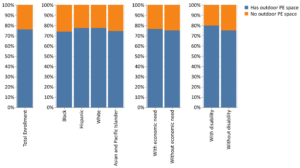
Analysis for this report examined the allocation of outdoor PE space across NYCPS students’ race, economic need, and disability status and did not find significant disparities (see Figure 1). The demographic makeup of the population of students who lack access to outdoor PE space is overall similar to the population who do have outdoor space.
Overall, 24% of students attend a school without outdoor PE space. This compares to 26% of Black students, 26% of Asian students, 23% of White students and 23% of Latino/Hispanic students. Students with Disabilities are slightly more likely to have outdoor PE space access as 20% of Students with Disabilities attend a school with no outdoor PE space.
This report also examined the 48 existing School Streets at NYC Public Schools and found that they are distributed roughly equally across race, economic need, and disability status: students in each category are about equally likely (or unlikely) to attend a school with a School Street. Though the number of current school streets is small, this finding is encouraging and it is important that as School Streets is streamlined and expanded, it continues to be done equitably.
Figure 1: Portion of students attending schools without outdoor PE space by race, economic need, and disability status
The Promise of School Streets
Repurposing existing street space for student use is a creative, efficient, and budget-friendly way to take full advantage of City-owned space while improving the educational experience for students and families.
While it was initially envisioned as a tool to prevent students and teachers from being exposed to Covid-19 by bringing learning outside, the program has developed into an opportunity to transform the school day. School administrators and community organizations interviewed for this report shared that students at schools with School Streets come to school excited knowing that they will have the opportunity to go outside for learning, physical education, recess, and lunch. School Streets operating during arrival and dismissal can also make it easier and safer for families to walk or bike to school while creating opportunities for students, parents, and caregivers to build community. School Streets have also served as an opportunity for student leadership, with student government officers helping staff supervise outdoor time for younger classes.
Non-profit partners have brought enhanced programming, staffing assistance, and portable play equipment to several School Streets and have been funded through contracts with DOT and through individual school budgets. [xxii] NYCPS’s Outdoor Learning Initiative also supports schools to make use of their existing outdoor space to extend learning outside, including by offering grants of up to $5,000 to support school sustainability projects. School Streets create opportunities for play and creativity, exercise and learning, socialization and school safety.
School Streets is an Untapped Opportunity
Given the well-established benefits of outdoor activity and the lack of outdoor physical education space at NYC Public Schools, the City should be using every available tool to expand outdoor space at schools for uses of all types. Yet, despite its potential to expand outdoor space for students, School Streets implementation has been notably limited.
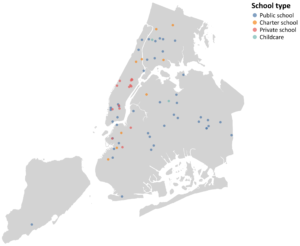
At the start of the 2025-26 school year, just 74 schools hosted School Streets.[xxiii] Of these schools, only 48 were NYCPS schools, while 14 were private schools, 10 were charter schools, and 2 were childcare programs. Figure 2 shows how these schools are distributed across the city.
Analysis completed for this report determined that 26,900 students, just 3.2% of NYCPS public school students, attended a school with a School Street.[xxiv]
Figure 2: 2025-26 School Streets location by school type
Implementation Challenges
Expanding access to the School Streets program offers a promising opportunity to quickly and cost-effectively get kids access to outdoor space during the school day. To date, however, the program has had very limited reach.
The school administrators and non-profit staff interviewed for this report shared that they only learned about the program through word of mouth, suggesting that outreach to principals could be improved. School administrators who are interested in the program then face high administrative barriers to entry including a long and detailed application and approval process. The School Streets application requires a detailed site plan, management, staffing, and operations plan, community outreach plan, and letters of support. Completing these materials requires significant time and technical expertise that fall outside the typical responsibilities and experience of school administrators. Once submitted, School Streets applications require at least 90 days for review and approval, meaning that administrators must plan months in advance if they want their students to have access to additional outdoor space.[xxv]
Non-profit organizations like Open Plans and Street Lab have stepped in to assist some schools with the application process, but that assistance represents a band-aid on a broken system. Currently, the burden falls to individual school administrators, who are already balancing the many responsibilities of running a school, to navigate a multi-step application involving numerous stakeholders.[xxvi] This does not have to be the case.
The City should significantly streamline this process to make School Streets seamlessly available to all schools that want it.
School Streets Prioritization Analysis
Given its potential to widely expand access to outdoor space for students, the School Streets program should be proactively offered as a support to NYC Public Schools, prioritizing those with insufficient outdoor space. To support this effort, the Office of the NYC Comptroller conducted an independent analysis to identify schools that lack outdoor physical education space and have a potentially eligible adjacent street.
Analysis completed for this report is based on two simple criteria:
- Does a school have existing outdoor space for physical education?[xxvii]
- Is there a street adjacent to the school that is likely eligible for a School Street? This report’s analysis defined “likely eligible” as a street where a School Street would not be expected to disrupt public safety or emergency services. DOT regulations appropriately require the agency to consider safety and context of potential Open Streets before determining them to be eligible. [xxviii] To that end, our analysis excludes all streets that:
- Are major thoroughfares (streets with more than two travel lanes or speed limits greater than 30MPH)
- Are designated truck routes
- Have an active bus route
- Are adjacent to hospital
- Are adjacent to a firehouse
There are 371 public schools across the City serving 199,000 students that report having no outdoor space used for physical education.
In total, 1,502 NYCPS schools (in 1,156 unique school buildings) across the City have an adjacent street which this analysis identifies as “likely eligible” to be a School Street.
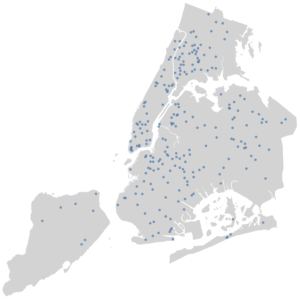
There are 324 schools serving 178,000 students that lack outdoor PE space, have a likely-eligible adjacent street, and did not have a School Street in the last school year. These schools should be prioritized for the School Streets program. A map of these schools is shown in Figure 3.
A full list of public schools along with their outdoor physical education space status and availability of a likely eligible adjacent street is included in the appendix.
Figure 3: Priority locations for school streets: Schools with no outdoor PE space, no current school street, and adjacent eligible street
Recommendations
Expanding access to outdoor space for NYC students requires shifting the paradigm from School Streets as an opt-in program driven by individual principal initiative to School Streets as a resource that is offered proactively to all public schools. The School Streets program offers a clear opportunity for NYC government agencies to collaborate more deliberately to deliver an efficient public service. The City should:
Develop an interagency agreement between DOT and NYCPS that streamlines and expands access to School Streets by:
Shifting the School Streets application responsibility from individual principals to City agencies. Rather than requiring a lengthy application and approval process driven by individual principals, DOT and NYCPS, should take the lead on assessing potential School Streets, confirming site safety and viability, and alerting other necessary agencies and community partners.[xxix] DOT and NYCPS should also partner with school administrators and School Leadership Teams (SLT) to develop implementation schedules and plans so that principals do not need to navigate the system independently.
DOT should also consider ways to proactively solicit interest from and simplify the School Streets application for private schools, charter schools, childcare programs, and higher education institutions.
Proactively assessing principal interest in School Streets at NYC Public Schools. DOT should work with NYCPS to proactively identify principals who are interested in School Streets. This could be accomplished utilizing a survey developed for this purpose or could be embedded into one of the existing surveys that NYCPS conducts with its principals, such as the Principal Annual Space Survey.[xxx]
NYCPS and DOT can then use the survey responses to conduct direct outreach to interested school leaders, collect information necessary to assess viability, and begin the steps toward School Streets implementation. When considering School Streets, NYCPS and DOT should also work with SLTs to ensure implementation is effective and meets the needs of the school community.
Prioritizing School Streets implementation at schools that lack outdoor physical education space. Schools with no outdoor physical education space and a likely eligible street present an immediate opportunity to expand outdoor space access to 178,000 students at 324 schools across the City. These schools should be prioritized for a School Street.
Setting clear and ambitious annual goals to rapidly expand School Streets implementation. DOT and NYCPS should collaboratively set targets to expand School Streets to as many schools and as many students as possible. The targets should take into account the prioritization recommendations above and should remain in place until all public schools that are interested and have a viable School Street can participate in the program. The agencies should also consider creative ways to expand School Streets access at private and charter schools, childcare programs, and higher education institutions.
Continuing to equitably implement School Streets. Our analysis did not find significant disparities in access to outdoor physical education space and access to School Streets by race/ethnicity and measures of economic need. As they look to rapidly expand access to School Streets, it is important for NYCPS and DOT to continue to ensure that outdoor space and School Streets are equitably distributed and that School Streets are prioritized at the schools that need it most.
Developing a comprehensive School Streets implementation manual for principals and school staff. NYCPS currently has a brief Open Streets Application Guide on its website, which was developed in 2021 based on the DOT application process. DOT and NYCPS should work collaboratively and with school leaders, teachers, and staff to develop a comprehensive School Streets implementation manual based on a new streamlined process. The manual should cover everything from safety requirements, staffing needs, and scheduling to guidance for using of the space, including PE, recess, lunch, pick-up, drop-off, outdoor learning, and special events. The manual should also include template materials for parent and community engagement about the School Street. This would also be an opportunity to engage with and incorporate the work of community organizations with experience supporting School Streets.
Designating NYCPS central staff to serve as School Streets liaisons. As part of an interagency collaboration between NYCPS and DOT, NYCPS should designate central staff to liaise with DOT, school administrators, and SLTs across the City and to publicize, expedite, coordinate, and troubleshoot implementation of the School Streets program. These liaisons could also help school staff with parent engagement so that parents are informed about the outdoor space that will be made available to their children.
Conduct a citywide inventory of outdoor school recreation space and publish the results in a publicly accessible database. There is currently no publicly accessible inventory of all outdoor play space used by NYC Public School students for outdoor activities, including recess. The existing data on outdoor space, which was required by LL102 of 2015, only account for space in NYC Public Schools that is used for physical education. NYCPS should conduct and publish a citywide inventory of all school outdoor recreation space, including whether each school has sufficient outdoor space for both recess and physical education.
Methodology
Data on schools which lack outdoor PE space are from NYCPS Physical Education Report for 2024-2025 (the most recent year available).[xxxi]
Data on school enrollment and demographics are from NYCPS Demographic Snapshot for 2024-25 (the most recent year available).[xxxii]
To identify schools that would likely have eligible streets for School Streets, this analysis combined several sources of publicly available data to screen streets for likely eligibility.
Data sources
- School locations: NYCPS LCGMS Report.[xxxiii]
- These data list all current schools with address and contact information, but do not provide a geospatial location. For this analysis, these school data were joined to NYC DCP MapPLUTO data[xxxiv] on BBL to find the property parcel on which each school is located.
- Streets: NYC OTI Planimetric Database: Roadbed.[xxxv]
- This file shows the two-dimensional extent of the street roadbed area, segmented into polygons representing blocks and intersections. These street areas were used as the basis for assessment of eligible streets.
- Truck routes and major thoroughfares: NYC DCP LION[xxxvi]
- These data include line features for every street segment, including various attributes such as whether the segment is a designated truck route, the number of travel lanes, and the posted speed limit.
- All types of truck routes (through, local, limited local) were counted as truck route
- This analysis defined major thoroughfares as street segments with either:
- More than two travel lanes, or
- A posted speed limit of more than 30 MPH
- Bus routes: MTA Bus Routes geometry.[xxxvii]
- These data were filtered to currently active bus routes.
- Firehouses: FDNY Firehouse Listing.[xxxviii]
- Hospitals: NYS DOH Health Facility General Information[xxxix]
- These facilities were filtered to those labeled as Hospital and within New York City.
Data model
- Current schools were joined with property parcels to identify the extend of the property each school occupied.
- Parcels were buffered 30 ft then spatially joined with street roadbed to identify all possible streets which are adjacent to each school
- School-adjacent roadbed segments were labeled as truck routes, major thoroughfares, or bus routes by spatially joining LION street attributes and bus routes to roadbed segments. The linear features were first buffered (by either the actual maximum street width (available in LION data) or a default 50 feet) and combined to single elements, then intersected with roadbed segments. Roadbed segments which were at least 70 percent covered by buffered truck route, major thoroughfare, or bus route features were labeled, respectively, as this type of street. (The coverage parameter was tuned through manual inspection and used to avoid mislabeling roadbed areas which were only grazed by a disallowed route, such as streets perpendicular to, but intersecting a truck route street.)
- Firehouse locations were buffered by 100 ft and hospitals by 200 ft then joined to roadbed segments. Roadbed segments were labeled as having an adjacent firehouse or hospital if the intersected any respective buffer.
- Roadbed segments were labeled as eligible for school streets if they did not have any of the above disqualifying factors.
- Schools were labeled as having an eligible street if any of their adjacent roadbed segments were eligible. (The typically large footprint and location of schools mean many have more than one adjacent street; many schools have corner locations or have frontages on two parallel blocks.)
Appendix
Acknowledgments
This report was authored by Steven Morales, Policy Director for Education, and Bella Caruso, Education Policy Intern, with analysis conducted by Daniel Levine, Director of Data Analytics and writing support by Liya Rechtman, Policy Director for Transportation and Infrastructure, and Jordan Stockdale, Deputy Comptroller for Policy. Report design was completed by Archer Hutchinson, Creative Director and Danbin Weng, Multimedia Designer.
Endnotes
[i] In 2020, then Mayor Bill de Blasio and the NYC Department of Education (now known as NYC Public Schools) launched a program called the “Outdoor Learning Initiative” an interagency program that allowed school principals to apply to hold classes outdoors in a variety of City-owned spaces (“Mayor de Blasio and Chancellor Carranza Announce ‘Outdoor Learning’ Initiative”). In 2021, upon the establishment of the Open Streets program, the NYC Department of Transportation became the lead agency for School Streets (New York City Council, Int 1933-2020).
[iv] “NYC Parents Angry over Too Many Movies at School Recess.” Chalkbeat New York, 7 Nov. 2024, https://www.chalkbeat.org/newyork/2024/11/07/nyc-parents-angry-over-too-many-movies-at-school-recess/.
[v] “Webinar Recordings.” Panel for Educational Policy, 30 Apr. 2026, beginning at 46:57.
[vi] New York City Office of the Comptroller. Streets for People: Open Streets and the Future of Public Space Management in NYC. 25 Apr. 2025, comptroller.nyc.gov/reports/streets-for-people-open-streets-and-the-future-of-public-space-management-in-nyc/.
[vii] United States, Department of Health and Human Services. Physical Activity Guidelines for Americans, 2nd ed., 2018.
[viii] State Compilation of Codes, Rules and Regulations of the State of New York. Title 8, chapter II, subchapter G, part 135.
[ix] Empowering Strong and Healthy Students: The NYCPS School Wellness Policy, New York City Public Schools.
[x] Wang, Jingjing, et al. “Time Outdoors Positively Associates with Academic Performance: A School-Based Study with Objective Monitoring of Outdoor Time.” BMC Public Health, vol. 23, no. 1, 2023, article 645. SpringerLink, https://doi.org/10.1186/s12889-023-15532-y.
[xi] de Lannoy, Louise et al. “Association Between Active Outdoor Play and Health Among Children, Adolescents, and Adults: An Umbrella Review.” Journal of physical activity & health vol. 23,4 452-467. 22 Dec. 2025 https://pubmed.ncbi.nlm.nih.gov/41468218/
[xii] Mori, Y., et al. “Long-Term Trends in Screen Time Use Among Children and Adolescents: A Systematic Review Including Pre- and Post-COVID Periods.” PubMed, https://pubmed.ncbi.nlm.nih.gov/41863157/.
[xiii] Zhu, Xinxin, et al. “Trajectories of Screen Time across Adolescence and Their Associations with Adulthood Mental Health and Behavioral Outcomes.” Journal of Youth and Adolescence, vol. 52, no. 7, 2023, pp. 1433–47, https://doi.org/10.1007/s10964-023-01782-x.
[xiv] Liu, Jianghong, et al. “Screen Media Overuse and Associated Physical, Cognitive, and Emotional/Behavioral Outcomes in Children and Adolescents: An Integrative Review.” Journal of Pediatric Health Care, vol. 36, no. 2, 2022, pp. 99–109. ScienceDirect, https://doi.org/10.1016/j.pedhc.2021.07.011.
[xv] Bento, Gabriela, and Gisela Dias. “The Importance of Outdoor Play for Young Children’s Healthy Development.” Porto Biomedical Journal, vol. 2, no. 5, 2017, pp. 157–60. ScienceDirect, https://doi.org/10.1016/j.pbj.2017.03.003.
[xvi] “Time Outdoors Positively Associates with Academic Performance: A School-Based Study with Objective Monitoring of Outdoor Time.” BMC Public Health, Springer Nature.
[xvii] Data on schools which lack outdoor PE space are from NYCPS Physical Education Report for 2024-2025 (the most recent year available). https://infohub.nyced.org/reports/government-reports/physical-education-reporting
[xviii] 2024–2025 Physical Education Report: External Summary, New York City Public Schools, 30 July 2025.
[xix] Active Design Toolkit for Schools, New York City Department of Health and Mental Hygiene, https://www.nyc.gov/assets/doh/downloads/pdf/environmental/active-design-toolkit.pdf.
[xx] “NYC Parents Angry over Too Many Movies at School Recess.” Chalkbeat New York, 7 Nov. 2024, https://www.chalkbeat.org/newyork/2024/11/07/nyc-parents-angry-over-too-many-movies-at-school-recess/.
[xxi] “Webinar Recordings.” Panel for Educational Policy, 30 Apr. 2026, beginning at 46:57.
[xxii] E.g. Street Lab which hosts School Streets for both one-day pilots and year-long catalyst programs.
[xxiii] “Back to School Open Street Traffic Safety.” New York City Department of Transportation, 2025, https://www.nyc.gov/html/dot/html/pr2025/back-to-school-open-street-traffic-safety.shtml.
[xxiv] This analysis counts schools which were named as having a School Street by DOT, including all schools (and enrollment at all schools) at the Washington Irving Educational Campus. At other school buildings that contain more than one school, only the named school is counted as there is no information provided on how or whether the School Street is shared.
[xxv] Open Streets Program (OSP) 2026 Application.
[xxvi] Stakeholders can include DOT, FDNY, NYPD, Community Boards, elected officials, other City agencies, and local community organizations. DOT supports schools to communicate with some of these entities, but the ultimate responsibility lies with the principal. Note that the FDNY is the only agency from which DOT is legally required to seek approval for School Streets.
[xxvii] There is no publicly available data about outdoor space in charter schools, private schools, childcare programs, or institutions of higher education, therefore our outdoor space analysis includes only NYC Public Schools. Students in other settings, however, should also be able to access to outdoor space. We encourage DOT to work with those institutions proactively to offer access to the School Streets program.
[xxviii] DOT Open Streets regulations govern School Streets approvals and include several factors that the agency considers when reviewing applications. The full set of regulations is available here: Notice of Adoption: Open Streets Program, New York City Department of Transportation.
[xxix] Note that FDNY is the only agency from which DOT is legally required to seek approval for School Streets. DOT should be responsible for obtaining these approvals. DOT and NYCPS should also work together to inform other key stakeholders, including NYPD, about School Streets implementation.
[xxx] The 2024-25 Principal Annual Space Survey is the source of outdoor PE space data analyzed in this report.
[xxxi] https://infohub.nyced.org/reports/government-reports/physical-education-reporting
[xxxii] https://infohub.nyced.org/reports/students-and-schools/school-quality/information-and-data-overview
[xxxiii] https://infohub.nyced.org/in-our-schools/operations/lcgms
[xxxiv] https://www.nyc.gov/content/planning/pages/resources/datasets/mappluto-pluto-change
[xxxv] https://data.cityofnewyork.us/Transportation/NYC-Planimetric-Database-Roadbed/i36f-5ih7/about_data
[xxxvi] https://www.nyc.gov/content/planning/pages/resources/datasets/lion
[xxxvii] https://data.ny.gov/Transportation/MTA-Bus-Routes/bzwk-3hb4/about_data
[xxxviii] https://data.cityofnewyork.us/Public-Safety/FDNY-Firehouse-Listing/hc8x-tcnd/about_data
[xxxix] https://health.data.ny.gov/Health/Health-Facility-General-Information/vn5v-hh5r/about_data