Audit on the Department of Investigation’s Background Investigations for City Employees
Audit Impact
Summary of Findings
At the start of the audit scope period—which runs from July 1, 2022 through December 31, 2024— the New York City Department of Investigation (DOI) had a backlog of 2,720 background investigation cases. During the scope period, it reduced this backlog by 1,060 cases. As of October 16, 2025, a backlog of 22 cases remained.[1]
The audit found that after July 1, 2019, DOI’s processes were effective in preventing the accumulation of a new backlog and that DOI is meeting the 180-day timeframe to complete current investigations.
Although DOI publicly acknowledged the existence of the case backlog and has developed a plan to reduce it, the agency took a long time to address it. DOI’s processes have not been effective in promptly eliminating the backlog of cases—backlogged investigations closed during the audit scope period were pending for an average of 5.7 years, with delays ranging from three to eight years.[2] The audit also found that 40% of all cases closed during this period were administratively closed because the subject of the investigation had already left City service or retired. In some cases, the delay also meant that individuals with adverse findings had been hired and served in positions of trust while background investigations were still pending.
DOI’s internal policy is not to make recommendations regarding the suitability of appointments based on background investigations, and it does not track hiring decisions made by agencies, even when adverse information is identified. These represent potential weaknesses. During the Exit Conference, DOI objected strenuously to this finding, stating that the audit team has fundamentally misunderstood DOI’s role. Although Mayoral Executive Order 16 does not require DOI to perform these tasks, the result is a gap in oversight. DOI has not offered general policy guidance to hiring agencies concerning how they should weigh investigative findings, does not offer any recommendations concerning individual investigative findings, and conducts no central monitoring to assess whether agencies make prudent decisions when adverse information is found and shared.
In addition to the above, the audit also found that DOI’s oversight of its background investigation process could be improved. Sixty percent of the files reviewed by the auditors were missing required documents or lacked evidence that required steps were taken.[3] DOI’s processes for timely completion of investigations are currently unsupported by formal written timeframes for completing expedited, priority, or backlogged investigations once they are initiated. DOI does not conduct periodic reviews to ensure agencies are submitting required individuals for background checks and does not track whether agencies are submitting background packages in a timely manner. Lastly, DOI does not ensure fingerprints are consistently removed from files, as required by the New York State Division of Criminal Justice Services.
Intended Benefits
The audit determined to what extent background investigations are completed before individuals begin their new positions, as well as the primary reasons for the backlog and the strategies to eliminate it. The audit also identified a need to improve DOI’s background investigation process.
Introduction
Background
DOI is New York City’s independent inspector general, serving as a nonpartisan watchdog for the City government and conducting oversight of dozens of Mayoral and non-Mayoral agencies and over 300,000 City employees. DOI staff consists of inspectors general, investigators, attorneys, forensic auditors, computer forensic specialists and administrative personnel. Mayoral Executive Order 16 (July 26, 1978), as amended by Mayoral Executive Order 72 (April 23, 1984), requires DOI to conduct background investigations of City employees who are appointed to or employed in positions of responsibility in Mayoral agencies, as defined in the criteria listed below.[4] According to DOI, the purpose of these investigations is for the appointing agency to determine whether the appointee has the appropriate qualifications, is free from actual or potential conflicts of interest, and is someone the public can trust.[5]
According to City Council testimony from DOI’s Commissioner in February 2020, the purpose of a DOI background investigation is to identify any adverse information that may affect a candidate’s suitability to hold a position of public trust. This requirement applies to both individuals entering City service and to current employees promoted to certain positions of responsibility, such as authority to enter into financial agreements or negotiate and approve contracts, and others, as outlined below.
DOI’s Background Investigation Unit (BIU) is the office responsible for conducting background investigations. Candidates who fall into at least one of the following categories established by DOI (according to the March 13, 2020 background investigation criteria) are required to undergo a background check:
- City employees who earn more than $125,000 annually;
- Members of the Management Pay Plan level M4 or higher;
- All employees—regardless of civil service status—who have the authority to enter into financial agreements valued at $10,000 or more, and those who have authority to negotiate, authorize, or approve contracts, leases, franchises, revocable consents, concessions, or applications for zoning changes, variances, and special permits;
- All employees—regardless of civil service status—whose regular duties give them administrator-level access to digital security systems established to prevent the unauthorized use of City networks, computer systems containing confidential City information, or electronic systems used for the handling of negotiable instruments; and
- All employees—regardless of civil service status—assigned to DOI.
In addition to the criteria above, City agencies may request a background investigation for an employee holding a position of trust within their agency. A background investigation is not required for City employees who have already undergone one within the last five years and have maintained continuous City service.
The Mayor’s Office compiled a Boards and Commissions Guidebook that specifies which boards and commissions require background investigations.[6]
Based on the hiring agency’s discretion, job candidates requiring DOI background investigations are generally hired or promoted before a required background investigation is completed. Exceptions include judicial appointments, DOI hires, appointments requiring City Council confirmation, and cases in which an agency chooses (at its discretion) to delay the appointment until the investigation is complete. DOI indicated that agencies may also vet candidates.
For DOI prospective hires, DOI conducts investigations in two phases. Phase One includes fingerprinting, verification of current employment, an attempt to verify past employment, a check of BIU’s internal database, a Google name search, social media review, and a review of the Payroll Management System. Phase Two includes any outstanding verifications from Phase One and additional checks that may include motor vehicle registration, parking summonses, and if applicable, a credit report.
Candidates are not given a start date until successfully completing Phase Two. This two-phase process is designed to provide preliminary clearance for DOI internal hires as quickly as possible, allowing DOI to decide on hiring candidates sooner, unlike other agencies, which may onboard employees while background checks are ongoing.
According to a Memorandum issued by DOI’s Commissioner to Mayoral agency heads and personnel directors on March 13, 2020, City agencies are responsible for identifying candidates who meet the criteria for a background investigation and submitting a complete package to DOI within 30 days of promotion or hiring. If an agency is unsure whether a candidate meets the criteria, it may contact DOI for guidance.
The package must include the Background Investigation Questionnaire (BIQ), Terms and Conditions of Appointment Form, Authorization to Release Information Form, Stop Credit Discrimination in Employment Act (SCDEA) Compliance Form, and if necessary, the Fair Credit Reporting Act (FCRA) Compliance Form and a Financial Background Investigation Questionnaire (FBIQ).[7] Once received by BIU, the package is reviewed for completeness and to confirm that a background investigation was not completed for the person within the last five years. The Background Investigation Checklist is used by BIU’s administrative assistant to verify that all necessary documents are included upon receipt. The assistant contacts the referring agency/entity if items are missing. If the package is complete, the investigation is opened in BIU’s Background System and assigned to an investigator.[8]
According to DOI officials, DOI’s timeframe for completing routine investigations is less than 180 days (approximately six months).[9] In addition to routine investigations, referring agencies may request that some investigations be completed in a shorter time period. DOI indicated that the general estimate for priority investigations is 45 days and 90 days for expedited investigations.[10] Background investigations are prioritized for board and commission members, senior-level appointments made by City Hall, DOI employees (paid, unpaid, and on-loan), and City marshals. Agencies may also request an expedited investigation when a case is considered sensitive or requires faster processing time than a routine investigation.[11]
An investigator begins the process by reviewing the submitted documents for any potential concerns. The investigation includes but is not limited to a review of the following:
- Background Investigation Questionnaire (BIQ): The BIQ is completed by the candidate and serves as the main source of disclosure. It includes personal information, driving/motor vehicle record, education, professional licenses, employment history, military service, criminal history, business affiliations (including sources of income, net worth, assets, liabilities), tax information, conflicts of interest, and political party positions.
- Employment/Work History: Employment is verified by confirming titles, dates, disciplinary history, and type of separation, through contact with prior employers. BIU also utilizes The Work Number, a database that provides access to many private and government employment records. In addition, BIU has access to the City’s Payroll Management System (PMS) for most City employment information.[12]
- Education: Verification is typically conducted through the National Student Clearinghouse (NSC). Foreign education is verified by sending an email or letter directly to the school. GED verification is performed through New York State’s public website or by contacting the high school directly.[13]
- Licensure: BIU verifies professional licenses are in good standing through relevant licensing boards, such as the New York State Office of the Professions for medical and engineering licenses. DOI checks attorney credentials and standing with the New York State Bar Association.
- Criminal History: Candidates are fingerprinted by IDEMIA, the sole-source vendor contracted by the New York State Division of Criminal Justice Services (DCJS) to process fingerprints for criminal record checks.
- Credit/Judgment: The referring agency completes the Stop Credit Discrimination in Employment Act (“SCDEA”) Compliance Form to determine whether a financial background investigation is required for the candidate. If a candidate meets the criteria, they must complete and submit a Fair Credit Reporting Act (FCRA) Compliance Form release and a Financial Background Investigation Questionnaire (FBIQ).[14] DOI contracts with Command Credit to retrieve credit reports via Experian.
- DMV Vehicle Violations: As a standard practice, driver’s licenses are verified for all candidates through the New York State Department of Motor Vehicles (DMV), and out-of-state licenses are checked via eJusticeNY.
- Taxes: With a signed tax release from the candidate, BIU can access records from the New York State Department of Taxation and Finance.
- Social Media: BIU requests candidates’ usernames for social media accounts and makes efforts to validate internet-based social media information as part of the hiring process.
BIU also conducts additional checks, including confirmation of military service, reviews of DOI’s Case Management system, checks for any DOI Inspector General cases, and searches using Google and LexisNexis.[15]
DOI uses five closing dispositions for background investigations:
- No Adverse: Investigations closed with no adverse findings.
- Criminal History: Investigations closed with the identification of criminal history. Not all criminal history is reportable. Pursuant to Executive Law § 296(16), Criminal Procedure Law §§ 160.5 (1) and 160.55, New York City Administrative Code 8-107 (10), (11), and (11-a-b) and Corrections Law Article 23-A, if DOI is prohibited from reporting a criminal disposition, the applicant is not required to disclose information pertaining to that disposition (or a related arrest or criminal accusation).
- Other: This disposition serves as a “catch-all” category used when findings do not fit into any of the other classifications. It may include cases where substantial debt or adverse financial information is identified; education credentials are inconsistent with what was reported or cannot be verified; adverse social media activity is found; work history inconsistencies are identified; residency requirement has not been met; the individual is the subject of an open Inspector General investigation; or a family member is employed by the City, etc.
- Administrative Closing: Investigations are administratively closed when a candidate is no longer in City service (due to retirement, resignation, or termination) or when the candidate no longer meets the criteria.
- No Terms & Conditions: This disposition is applied when a candidate is not cooperating with an investigation. According to DOI, this disposition is rarely used, and auditors identified only one investigation closed as “No Terms & Conditions” during the audit scope period.
DOI categorizes Background Investigations into two timeframes: those received before July 1, 2019 (referred to as backlogged cases) and those received on or after July 1, 2019 (referred to as current investigations). Table 1 below shows the closing dispositions for the 5,082 background investigations closed between July 1, 2022 and December 31, 2024, for both backlogged and current investigations.
Table 1: Background Investigations by Closing Type
| Closing Type | Number of Backlogged Investigations | Number of Current Investigations | Total Number of Investigations |
|---|---|---|---|
| Other | 325 | 2,227 | 2,552 |
| No Adverse | 273 | 1,397 | 1,670 |
| Administratively Closed | 429 | 282 | 711 |
| Criminal History | 32 | 116 | 148 |
| No Terms and Conditions | 1 | 0 | 1 |
| Total | 1,060 | 4,022 | 5,082 |
Investigations are generally reviewed by a DOI supervisor. However, if an investigation yields no findings, senior investigators are permitted to self-review and close the case without supervisory review. Once an investigation is complete, BIU prepares a findings letter which is sent to the referring agency. The Director or Associate Director review findings letters that contain more complex or significant adverse findings, and in cases involving criminal history, the letters are also reviewed by the General Counsel’s Office.
The findings letter includes a general statement that appointment decisions are the responsibility of the appointing agency or entity, not DOI. It notes that nothing in the letter should be construed as an endorsement or approval by DOI of the candidate’s appointment and that DOI does not make recommendations regarding whether the candidate should be retained or terminated. DOI does not follow up with the agency to determine whether the candidate was retained or terminated.
DOI reports on both backlogged and current investigations in the Mayor’s Management Report (MMR).[16] The MMR indicates that the goal to complete current background investigations is 180 days; however, no goal was indicated for completing investigations received prior to July 2019 (cases in the backlog). According to the 2024 MMR, DOI completed 1,712 (99%) of the background investigations received during FY2023 within 180-days of receipt. The MMR further states that at the end of FY2023, a backlog of 729 cases remained open. In FY2024, DOI completed 1,714 (99%) background investigations within the target timeframe and reduced the backlog to 360 cases.
Objective
The objective of this audit was to determine whether DOI adequately conducts background investigations to ensure that any adverse information bearing on the suitability of candidates to hold positions of public trust is identified in a timely manner.
Discussion of Audit Results with DOI
The matters covered in this report were discussed with DOI officials during and at the conclusion of this audit. An Exit Conference Summary was sent to DOI on September 23, 2025, and discussed with DOI officials at an exit conference held on October 6, 2025. On November 6, 2025, we submitted a Draft Report to DOI with a request for written comments. We received a written response from DOI on December 4, 2025.
In its response, DOI agreed with four recommendations (4, 8, 10 and 11) and disagreed with the remaining eight recommendations.
DOI’s written response has been fully considered and, where relevant, changes and comments have been added to the report. The full text of DOI’s response is included as an addendum to this report.
Detailed Findings
DOI Accumulated a Backlog of Over 6,400 Background Investigations by July 1, 2019
According to the MMR, in Fiscal Years 2018 and 2019 DOI set an average target of 300 days to complete background investigations (measured from the date of receipt) and aimed to close 60% of investigations within 12 months. However, the figures reported in the MMR for these two fiscal years show that DOI’s average timeframes far exceeded its goal, with delays averaging 533 days in 2018 and 605 days in 2019. In addition, only 39% of investigations in 2018 and 40% of those received in 2019 were closed within 12 months. As of July 1, 2019, DOI had accumulated a backlog of 6,479 background investigations pending completion. However, no new backlog cases were created after July 1, 2019.
According to DOI, the primary reason for the backlog was staffing shortages, which were exacerbated in 2015 and in subsequent years by increased City hiring, which also increased the volume of required background investigations. In the 2016 MMR, DOI reported that staff shortages, combined with an increased volume of investigations, resulted in fewer investigations being closed within 12 months. In testimony before the City Council in March of 2019, DOI officials indicated that while DOI had historically carried some backlog, it had grown to 1,900 by 2016 and continued to grow as case numbers increased. According to testimony, DOI received an average of 236 new investigations each month during FY2018 but was only able to close an average of 193 of these. The backlog increased by roughly 42 investigations per month during this period.
Pending Backlogged Investigations Remained Open for Almost Six Years
According to DOI, its goal for completing new background investigations is 180 days. This goal was not applied to the backlog. The backlog grew to 6,479 investigations by July 1, 2019, before DOI began reducing it. DOI reduced the backlog by 5,902 cases between FY2020 and FY2024.
For the 1,060 backlogged investigations closed between July 1, 2022 and December 31, 2024, the average completion time was 5.7 years (calculated from the open date to the closed date), with delays ranging from approximately three to eight years. Eleven investigations remained pending for over eight years, involving the following titles:
- Computer Specialist
- Computer Associate (Operations)
- Computer Systems Manager
- Associate Executive Director (Hospitals)
- Administrative Public Information Specialist
- Criminalist Assistant Director of Laboratory
- Telecommunications Manager
- Senior Estimator (General Construction)
If the goal of background investigations is to limit the risk associated with hiring individuals with potentially problematic findings, then identifying these years after they have already been hired arguably defeats the purpose. For example, Computer Systems Managers have access to and decision-making over Information Technology and potentially manage the day-to-day activities of a large computer operation, and Computer Specialists oversee the implementation and maintenance of various systems. These positions allow access to critical systems which may contain confidential City information and may provide insight into IT security system weaknesses.
Individuals with Criminal Histories or Other Adverse Findings Not Identified Promptly Due to Backlog
As part of the background investigation process, DOI is required to check for criminal history or other adverse information. Although not all criminal history is reportable, based on applicable laws, DOI’s policy summarizes the criminal history that is both reportable and not reportable.[17] Based on a review of DOI’s investigation case files, auditors found evidence of criminal history in 27 of 30 sampled files, including petty larceny, driving while intoxicated, attempted criminal possession of a controlled substance, and aggravated unlicensed operation of a motor vehicle.[18] These 27 investigations were pending in the backlog an average of 2,182 days (almost six years) to the close date, ranging from 1,221 days (over three years) to 3,022 days (over eight years).[19] Once opened, the average time to complete the investigations was 498 days, ranging from 22 days to 1,428 days (almost four years).
During this period, there were 325 backlogged investigations closed with a disposition of “Other,” which means that the related investigations may have identified adverse information. These were pending in the backlog for an average of 2,214 days, ranging from 1,151 days (over three years) to 3,073 days (over eight years). On average, it took DOI 406 days to complete these investigations, ranging from zero days to 2,645 days (over seven years).
Auditors also found one backlogged investigation was closed with a disposition of “No Terms & Conditions of Appointment” due to the applicant’s failure to cooperate with the investigation. A review of the data and the hardcopy file showed that the time between the creation date and closing date was over seven years. When this individual’s investigation was finally opened, the individual did not respond to inquiries from DOI investigators and delayed completing requirements of the background investigation. The agency ultimately terminated their employment eight years after the background investigation was submitted to DOI. This individual’s position had granted them potential access to multiple critical systems and City data during the seven years of employment before DOI opened its investigation.
The purpose of conducting background investigations is to identify adverse information that could bear on the suitability of a candidate. These investigations gather information on issues such as tax compliance, arrests or convictions, accuracy of a candidate’s reported work history and educational background, potential conflicts of interest, and, where legally appropriate, financial vulnerabilities that could make a candidate susceptible to bribery or extortion. When background investigations are not conducted in a timely manner, DOI does not meet its mandated mission to screen all sensitive and high-level City employees. This increases the risk that unsuitable candidates are employed in positions of trust.
40% of Backlogged Investigations Were Administratively Closed
DOI administratively closes background investigations when an individual has retired, resigned, or been terminated while the investigation was pending. This not only means candidates referred for background investigations were hired before they were completed, but also that they had already departed City service before it was complete.
Of the 1,060 backlogged investigations closed between July 1, 2022 and December 31, 2024, 429 (40%) were administratively closed within an average of 158 days, ranging from zero to 2,282 days (over six years) after the start of the investigation. In these instances, investigators need only review the City’s Payroll Management System (PMS) to see if the individual is still employed by the City or, for certain employees who are not in PMS, to confirm their employment status with the agency. This accounts for the relatively low average processing time. The average processing time for the remaining 60% was 347 days.
It also highlights a missed opportunity in working through the backlog. Had DOI checked all backlog cases as of July 2019, and each year thereafter, to make sure the applicants were still employed before beginning work on them, they may have eliminated many backlog cases much earlier.
DOI’s Strategies Have Reduced, but Not Timely Eliminated, the Backlog
As stated above, as of July 1, 2019, there were 6,479 backlogged investigations. DOI has employed several strategies to tackle this backlog, such as restructuring the background investigation team and implementing new policies. Although these changes have significantly reduced the backlog and prevented new cases from accruing, they have not timely eliminated it.
In late 2018, the Background Unit was reorganized into four teams:
- Team One (Intake Team) conducted an initial review of applications to assess if there were any that should be expedited due to red flags.[20]
- Team Two (Expedite Team) finalized applications with identified red flags.
- Teams Three & Four (Routine Teams) processed routine applications in the order they were received.
This four-team reorganization lasted less than a year from late 2018 until July 1, 2019, when DOI created the Background Attack Team (BAT). Over time, DOI has temporarily redirected staff resources to the Background Investigation Unit (BIU) and created a three-month rotation in BIU for newly hired investigators. In addition, existing DOI administrative staff from other parts of the agency were assigned BIU tasks, such as labeling and filing, to help advance the Unit’s efforts to complete and close background investigations.
DOI created BAT to focus specifically on background checks received prior to July 1, 2019. BAT successfully reduced the backlog of 6,479 investigations to 759 by February 2023, at which point BAT staff were merged with (and backlog cases reverted to) BIU. As of February 2025, backlogged cases are assigned to one supervisor and two investigators with 184 remaining investigations.
DOI also requested 13 additional positions for BIU, and new funding for 10 of the 13 positions.[21] The request included 10 investigators, two supervisors, and one administrative assistant. According to DOI, these positions were all filled by February 2020, bringing the total budgeted staff count to 32.[22]
In March 2020, DOI updated its criteria so that candidates with salaries below $125,000 no longer required a background check.[23]
During this period, DOI made good progress; during FYs 2020 and 2021, it closed 3,759 of the 6,479 (58%) backlog cases. However, progress continued at a slower pace, as reflected by the decreasing number of cases closed each year from FY2022 through FY2024, and as shown below in Chart 1. After FY2022, the pace of closed investigations slowed considerably, with only 700 cases closed over the next two fiscal years—less than half of the number closed in FY2022.
Chart 1: Number of Backlogged Investigations Closed by Fiscal Year
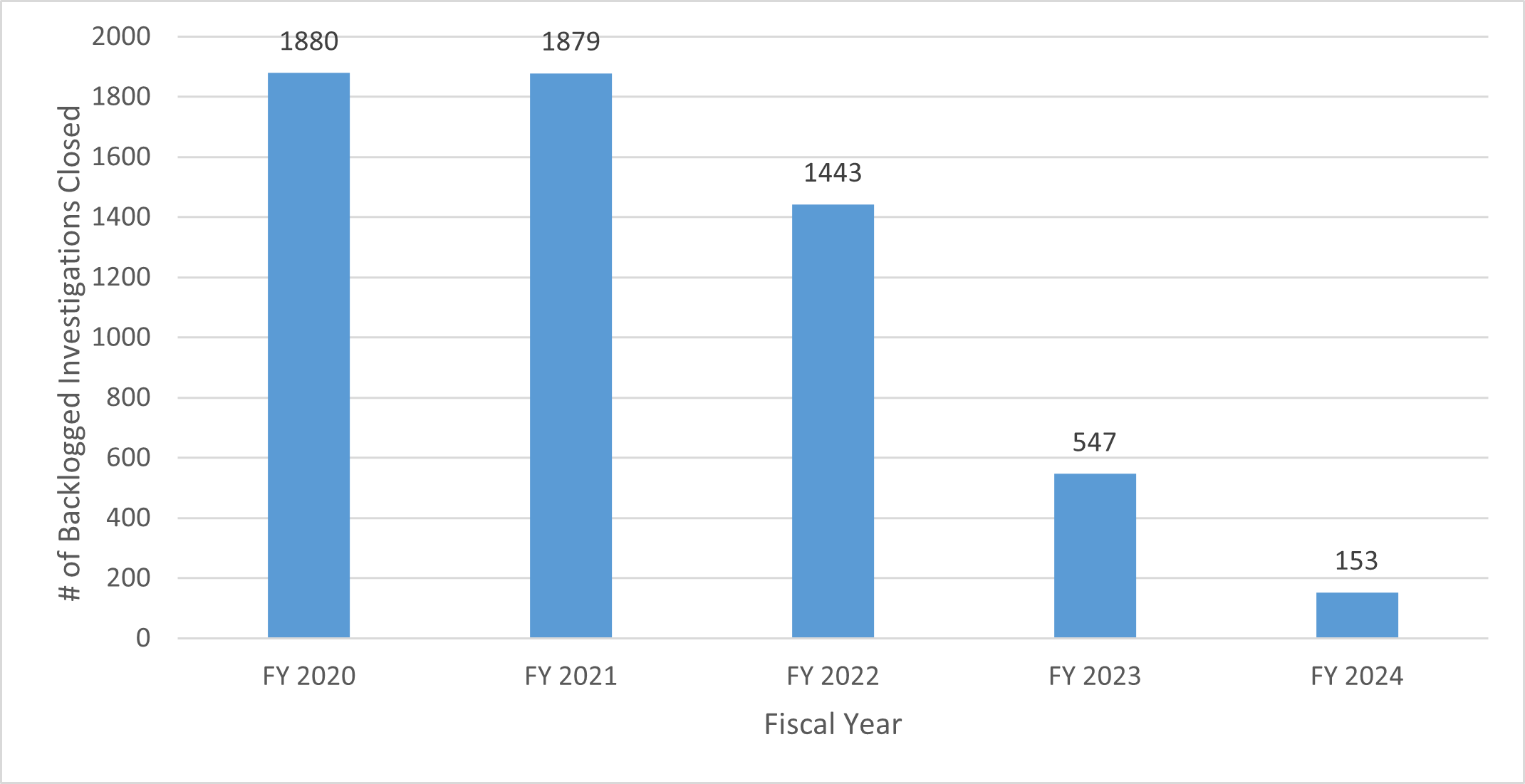
The then-DOI Commissioner testified before City Council in March of 2022 that DOI expected to complete the remaining backlog of 5,122 investigations by September 2023. However, by the close of FY2024, 360 (7%) cases remained, and as of February 2025, 184 (4%) applications were still in the backlog. DOI told auditors that the target was not met primarily because of staffing challenges (i.e., hiring and retention) and that it is aiming to complete the backlog by the end of 2025. As of October 17, 2025, DOI reported that 22 (less than 1%) of the backlog remained.
DOI officials indicated that the estimate for completing the backlog was based on the available resources at that time. They noted that there is currently a “two-for-one” hiring freeze in place, and that BIU experienced staff attrition.[24] Auditors compared staffing levels and found that BIU had 25 staff in January 2022; this had decreased to 17 staff by October 2024, so staffing levels decreased over time.
Despite its reduced resources, DOI has been successful in preventing the accumulation of a new backlog. From July 1, 2022 through December 31, 2024, DOI completed 99% of the routine background investigations it received in under 180 days.
DOI Does Not Make Recommendations Regarding Suitability of Appointments or Follow Up on Hiring Dispositions
According to Executive Order No. 16, Section 7 Background Investigations, the appointment or employment of any person requiring a background investigation requires the completion of an investigation and a determination by the appointing authority that the appointee has the appropriate qualifications, is free from actual or potential conflicts of interest, and is one in whom the public trust may be placed.
DOI does not assess the suitability of a candidate or make any recommendations to hiring agencies concerning whether a candidate should be retained or terminated. The findings letters issued to agencies state that nothing within the letter should be construed as an endorsement or approval by DOI of the candidate’s appointment, and that DOI does not make recommendations as to whether the candidate should be retained or terminated.
DOI stated that it functions solely as a fact-finding body and that the final decision rests with the agency. A DOI official also stated that this approach is consistent with applicable mayoral executive orders and legal requirements, including the City’s Fair Chance Act, which prohibits automatic disqualification of applicants based on criminal history. However, the Fair Chance Act also states that employers may terminate employees based on criminal history if there is a direct relationship between the alleged or convicted crime and the job, or if employing the person poses an unreasonable risk to people or property.
DOI’s practice of not making recommendations poses a potential risk to the City, especially in instances when nepotism may be a factor, or when an agency disregards significant negative findings identified by DOI, and/or in the face of non-cooperation or failures to disclose requested information.
Red Flags Were Identified but Not Acted Upon for Certain High-Level Candidates
In two instances, agencies appointed candidates to high-level positions despite the identification of red flags during their background investigations.
In one case, a candidate appointed to a high-level position did not identify any prior disciplinary actions when asked about their disciplinary record. However, DOI found that this candidate had multiple instances of past disciplinary action of a serious nature in the record. DOI’s investigation was closed with a disposition of “Other.” The individual retained their position and was later promoted to a higher title. At that time, another background investigation was not required because the promotion occurred within five years of the prior background investigation.
In another case, a former senior official had multiple findings stemming from multiple omissions and unanswered and incorrectly answered questions throughout the background investigation. This included questions related to misconduct, involvement in a prior criminal case, and past involvement with a private company. The candidate did not respond to follow-up inquiries from DOI’s investigator and the investigation was escalated. Based on the failure to cooperate with the investigation, according to DOI’s policy, the investigation should have been closed as “No Terms & Conditions of Appointment,” which DOI uses when an applicant does not cooperate. Instead, this investigation was closed with a disposition of “Other.”
DOI Does Not Track Whether Candidates are Retained or Terminated When Adverse Information is Identified
As stated above, City employees are generally hired prior to the completion of a background investigation, with a few exceptions. DOI presents its findings to the referring agency via a findings letter. However, DOI does not track whether candidates with adverse information are retained by agencies.
The auditors reviewed current PMS records for 18 candidates (excluding nine H+H candidates who are not in PMS) to determine whether candidates with identified criminal histories or no terms and conditions retained their positions. As of June 11, 2025 (the date of the PMS review), 15 of the 18 candidates were still employed by the City and one candidate had retired. The remaining two candidates were dismissed or terminated:
- One candidate was dismissed over five years after their investigation was opened. The individual had prior criminal history. It is unclear whether the dismissal was tied to DOI’s investigation because the dismissal occurred more than a year after the investigation was completed. This individual held this position for over three years before the background investigation was completed.
- One candidate was terminated eight years after their background investigation was submitted to DOI. The investigation was closed after the individual did not cooperate with DOI and the individual did not approve any terms and conditions placed on their appointment. DOI documented a prior criminal history for the candidate. This individual held this position for over seven years before the background investigation was completed.
DOI continues to disagree with the findings above and related recommendations. In its response to the draft, DOI reiterated its position that agencies should make their own decisions. The audit, however, does not recommend that DOI make decisions for agencies, but merely that DOI provide useful guidance to agencies and track outcomes to ensure the City is safeguarded as it should be, based on adverse findings from background investigations. As things currently stand, no guidance concerning how agencies should evaluate findings exists; no recommendations are provided, even when very serious findings are found; and nobody tracks whether agencies have onboarded or maintained candidates and employees, even if very serious risks are identified.
DOI’s Oversight of the Background Investigation Process Needs Improvement
60% of Sampled Files Lacked Documents or Evidence of Completed Steps
DOI maintains hardcopy files containing investigation documents, including the BIQ and other documents submitted by the agency and the candidates, evidence of searches, and the findings letter. Of 65 sampled background investigations, 15 were administratively closed and an investigation was not completed.[25]
Of the remaining 50 sampled files, 30 (60%) were missing required documents or evidence that certain investigation steps were performed. The details are as follows:
- 26 files did not have a resume which is required to be submitted along with the BIQ for employment checks; however, DOI indicated that employment history is requested on the BIQ and used to verify past employment.[26]
- Eight files were missing evidence of a current federal tax release form. Therefore, DOI did not ensure current federal tax compliance.
- Eight files were missing evidence of a current state tax release form. Therefore, DOI did not ensure current state tax compliance.[27]
- One file was missing a Terms and Conditions form.
- One file had no evidence of a criminal history check or that fingerprints were taken, so any potential criminal history may not have been identified; the findings letter does not indicate that a criminal history search was performed.
- One file was missing an Authorization for Release of Information Form which allows DOI to obtain necessary information for the background investigation including past and present employers, educational institutions, government bodies, and licensing, disciplinary, or grievance bodies.
- One file was missing evidence of education verification. While the findings letter indicated there was an attempt, the file had no evidence (e.g., email, letter) of such. DOI subsequently provided a document showing an attempt that the investigator located in his email.
- One file was missing a Financial BIQ, which forms the basis of the financial background investigation.[28]
Of the 30 files, 18 files were missing one document, seven were missing two, and five were missing three.
In addition, 28 files lacked evidence of LexisNexis searches. LexisNexis was used by DOI to conduct Comprehensive Person Reports (e.g., real property searches, bankruptcy, judgment and lien searches, out-of-state criminal history searches), comprehensive business searches, criminal history name searches, and federal and state court searches. DOI indicated that LexisNexis reviews were only conducted for investigations requiring financial background investigations and for priority background investigations. Auditors requested written criteria delineating when LexisNexis reviews are required, but DOI indicated that it does not have a written policy.
Documents were missing because investigators are not required to use review forms as a checklist to ensure all required searches are conducted, and because supervisors are not required to use supervisory checklists to document their review of the investigation or record notes/comments for the investigator. While auditors found these forms in some files, DOI indicated that their use is optional. Of the 30 files that were missing documentation, 12 (40%) did not have review forms on file and 17 (57%) had no evidence of supervisory checklists.
When steps in the investigation process are not conducted, there is an increased risk that adverse information affecting the candidate’s suitability may not be identified or shared with the agency.
DOI objected to the use of a small sample to draw audit conclusions and disputes the validity of the findings above on this basis. However, the auditors did not use the sample to extrapolate findings and the report merely states what the sample of 50 cases showed that over 60% of what the auditors reviewed had deficiencies. This is inarguable.
DOI also objected to certain other of the above findings; these mirror arguments made previously by DOI that were previously considered by the auditors. No modifications based on the response are therefore warranted.
DOI Has Not Established Completion Timeframes for Expedited, Priority, or Backlog Cases
DOI categorizes background investigations in two ways: backlog investigations received before July 1, 2019, and current investigations received on or after July 1, 2019. DOI also categorizes investigations as routine, expedited (when requested by an agency for sensitive positions), and priority (e.g., board and commission members, City Hall appointments, etc.).
DOI has established a less than 180-day timeframe for completing routine background investigations. During the audit, DOI initially indicated that expedited investigations had a 90-day timeframe and priority investigations had a 45-day timeframe. However, when the auditors shared the findings, DOI later indicated that the timeframes they provided in writing to the auditors were only intended to convey an estimate of how long it typically takes for these investigations to be completed. DOI indicated that the goal to complete all investigations is less than 180 days. However, auditors question why DOI categorizes these investigations as expedited and priority if the timeframe is the same for routine investigations. DOI also did not establish a formal written timeframe for completing backlog cases once they have begun.
Auditors calculated the time it took to complete current routine investigations and found that 99% were completed within less than 180 days. However, of the 147 current expedited investigations, 14 (10%) were not completed within 90 days. Of the 571 priority investigations, 281 (49%) were not completed within 45 days. On average the priority investigations took 56 days.
In addition, of the 1,060 backlog cases closed between July 1, 2022 and December 31, 2024, 348 (33%) were not completed within the less than 180-day timeframe. These investigations were open an average of 270 days. DOI stated that it did not set specific timeframes to complete background investigations received before July 1, 2019, because these investigations were already late, but aimed to resolve these cases as quickly as possible. As noted above, at one point DOI had set a timeframe goal of clearing the entire backlog by end of FY2023. This was not met, and no subsequent goals were shared with the auditors. Based on current projections, DOI stated that all backlog cases should be cleared by end of CY2025. Assuming this occurs, DOI will have taken more than six years to clear the cases that were designated as part of the backlog in July 2019.
When investigations are not completed in a timely manner, it delays the determination of whether the candidate is suitable. In the case of delays for expedited and prioritized investigations, it can delay the start date for the candidate.
DOI Does Not Segregate Investigation Timeframes in MMR Reporting
DOI only reports on the percentage of current investigations completed within six months (180 days) in the MMR and aggregates expedited and priority investigations in that calculation. It does not separately report them. DOI also does not report on timeframes for completing backlogged investigations; it only reports the number closed.
This results in skewed completion timeframes being reported to stakeholders and the public, and an inaccurate overall representation of DOI’s performance based on completing background investigations. For example, when reviewing the FY2023 data, the percentage of current routine background investigations closed within six months matched what was reported in the MMR with 99%. However, when including backlogged investigations, the percentage drops to 90%. In addition, only 50% of priority investigations and 61% of expedited investigations were completed within the shorter timeframes originally indicated by DOI.
Over Half of All Investigations Closed under Catch-all Disposition of “Other”
DOI uses five closing types for background investigations, including “Other,” a catch-all disposition used when findings do not fit into one of the other categories. It can include instances when substantial debt or adverse financial information is identified, education credentials do not match what was reported or cannot be verified, adverse social media posts are found, work history contains inconsistencies, residency requirements are not met, the individual is the subject of an open Inspector General investigation, and/or a family member works for the City.
More than half of the investigations closed between July 1, 2022 and December 31, 2024—2,552 (50%) of 5,082—were closed as “Other,” a designation that offers little insight into the issue(s) identified by the investigation. While auditors recognize that it is not feasible to create a closing type for every outcome, DOI created a closing type of “No Terms and Conditions,” for which only one investigation was categorized during the same period.
DOI indicated that it can determine the results of an investigation by reviewing the findings letter and is unsure of the operational benefit of creating additional closing types. However, this approach does not allow DOI to identify the types of findings on a cumulative basis for reporting purposes and would be time consuming. In addition, grouping a wide range of findings into the “Other” category gives them the same implied weight. For example, a candidate who simply has a relative who works for the City is not comparable to a candidate who has an open Inspector General investigation, but the lack of nuance in the “Other” disposition does not reflect the differing severity of these issues.
Fingerprints Were Not Consistently Removed from Files
Per DOI’s eJusticeNY Usage General Order, all fingerprint records obtained for background investigations through eJusticeNY must be destroyed within three months of closing the investigation. However, DOI does not consistently comply with the process it has in place to ensure this occurs.
Fingerprint results were found in 31 (41%) of 75 sampled files. Auditors witnessed BIU personnel removing the fingerprint results from 29 files prior to handing them over to the audit team. For two additional files, auditors found fingerprint results in the folders. This was cited as an issue in a 2021 audit of DOI conducted by the New York State Division of Criminal Justice. The audit found that DOI retained fingerprint background checks after the hiring decision was made.
In response to the audit, DOI stated that it updated its eJusticeNY policies and procedures to state that all fingerprint records must be destroyed within three months of the closure of a background investigation. DOI also provided evidence that it reinforced this policy in January 2023. However, DOI is still not consistently complying with this policy. By not removing fingerprint results as required, DOI risks exposing the records to unauthorized access/use and potentially places its continued access to eJusticeNY at risk.
DOI Does Not Hold Hiring Agencies Accountable for Investigation Requirements
DOI Does Not Conduct Periodic Reviews to Ensure All Individuals Requiring Investigations are Submitted by Agencies
According to a March 13, 2020, memorandum issued by DOI to agency heads and personnel directors, hiring agencies are responsible for identifying individuals who require background investigations based on the established criteria, and for providing DOI with the paperwork required to commence the investigation.
DOI indicated that it primarily relies on agencies to initiate the background investigation process and that there is no large-scale analytics or monitoring program to identify agency non-compliance. DOI stated that such oversight falls outside of its purview. DOI also noted that payroll titles alone do not identify whether an individual requires a background investigation. For example, certain responsibilities (such as access to sensitive IT systems) may not be evident from payroll titles and instead are known only to the agency.
However, DOI has a responsibility to ensure City agencies are following procedures and applying the requirements correctly. In the absence of any monitoring, DOI has only limited assurance that all individuals who require investigations are being referred to DOI. While auditors recognize that DOI may not be able to identify the responsibilities for certain titles, it could focus on employees it is able to identify, including members of the Management Pay Plan level M4 or higher, and all employees appointed or promoted to a non-competitive or provisional position with a salary of $125,000 or more. Regular reviews are important to ensure that agencies are submitting all required individuals for background investigations.
DOI Does Not Track Whether Agencies Submit Background Packages Promptly
As stated previously, City agencies are required to submit a background investigation package to DOI within 30 days of an individual’s appointment or promotion. However, DOI does not track whether agencies are submitting these packages within the stated timeframe.
Based on a sample of 75 background investigation files, only two packages were received by DOI prior to the candidate’s appointment by the agency. Thirteen files did not require a Terms and Conditions Form.[29] For the remaining 60 investigations, one file was missing a Terms and Conditions Form (on which the appointment date should be recorded), while nine were missing either the hire/promotion date or the date the file was received by BIU. Therefore, auditors were unable to determine whether the referring agencies submitted the packages within the required 30 days.
Only 50 of the sampled packages included both the date of appointment and the date the package was received by DOI. Of those 50, only 23 (46%) were submitted by the agencies within 30 days, as shown in Chart 2.
Chart 2: Range of Days from Hire/Promotion Date to Date Package Received by DOI
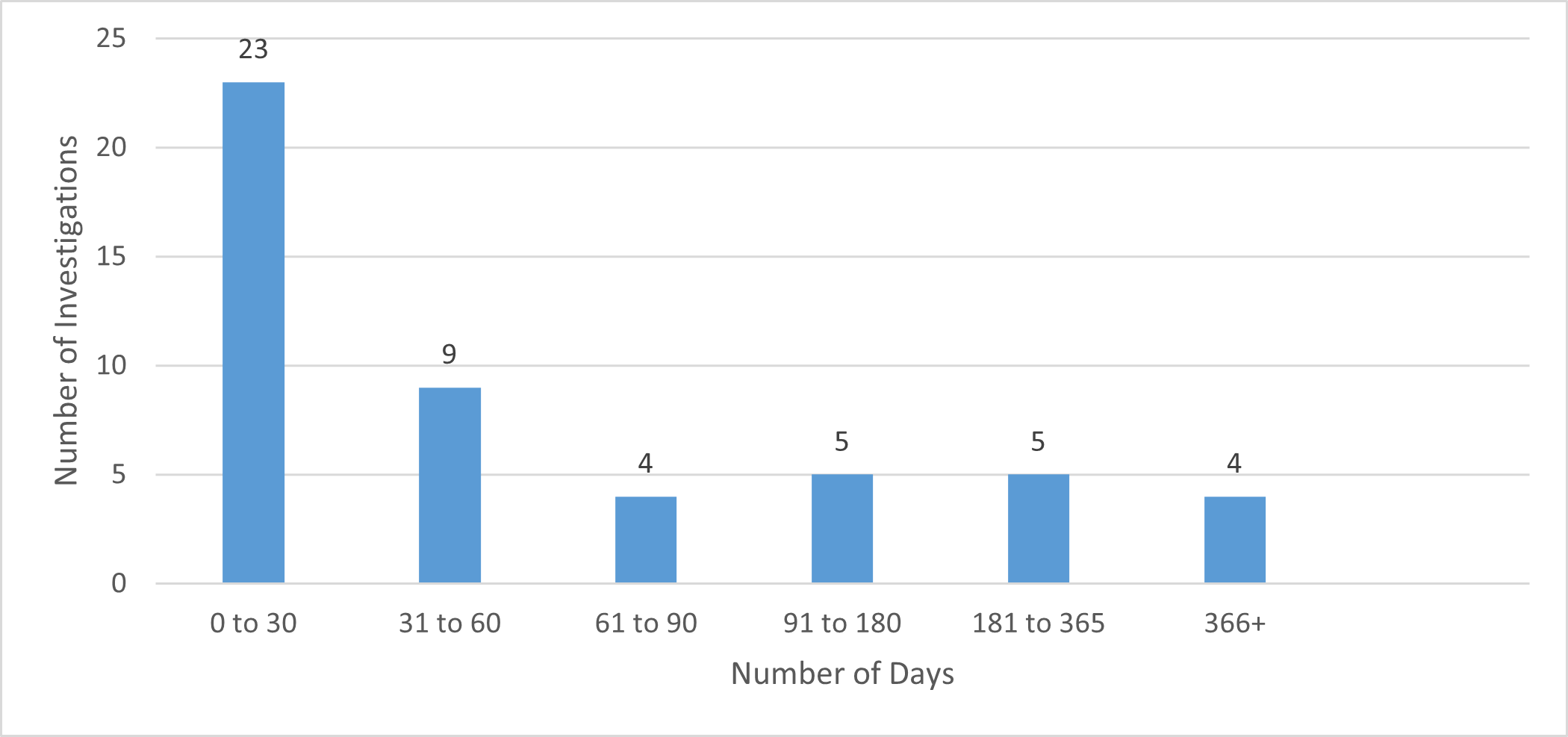
As shown in the chart, 27 packages were not submitted in a timely manner and four of the 27 (15%) were submitted to DOI more than a year after the hire or promotion date.
DOI currently cannot verify that agencies are submitting background packages in a timely manner. Any delay in submission results in investigations not being conducted promptly and adds to the time that a candidate works in a position without adequate vetting.
While the submission of packages is the responsibility of the hiring agencies, DOI has a responsibility to ensure that agencies are complying with the policy to submit packages within 30 days of appointment/promotion dates. DOI may need to send a reminder to agencies—the last memo issued to agencies outlining the background investigation criteria and process, including the hiring agency’s responsibilities, was issued in March 2020.
As stated previously, when agencies do not submit requests for background investigations in a timely manner, it delays the identification of adverse information that could impact the suitability of a candidate to hold a position of trust.
Lack of Data Dictionary for Background System
Data systems documentation helps ensure that information is collected, understood, accessible, and useable. A data dictionary serves as a centralized source of information on data elements, providing definitions, data types, meanings, and usage rules to ensure all users have a common, accurate understanding of the data. Data dictionaries are useful for documenting and standardizing data, which leads to improved data quality, consistency, and analysis, and ensures consistent data usage across the organization.
Recommendations
To address the abovementioned findings, the auditors propose that DOI should:
- Assign administrative staff to review PMS for the remaining backlog cases to determine whether individuals are still employed by the City and, if not, administratively close their cases.
DOI Response: DOI disagreed with this recommendation, on the basis that this has been in place since July 2019.
Auditor Comment: While DOI’s response asserts that this practice has been in place since 2019, DOI does not take this step until an investigation is ready to begin. The audit found that by the time this step was taken, 40% of cases in the backlog had already been administratively closed due to individuals no longer being in their positions. If PMS reviews were performed for the backlog on a regular basis, many investigations would have been closed much earlier.
- Consider making recommendations or providing some other kind of guidance to agencies regarding the impact of certain types of adverse information on the suitability of appointments.
DOI Response: DOI disagreed with this recommendation. DOI stated, “This is not an appropriate role for DOI. As a fact-finding agency, we report our findings to the hiring agencies. The hiring agencies in turn are best equipped to assess the import of our findings for each individual candidate in light of the unique requirements of the specific position and the candidate’s strengths and weaknesses, as revealed through the hiring process.” DOI also stated that it disagreed with the proposal that DOI issue guidance to agencies concerning how to review findings.
Auditor Comment: The audit identified red flag investigations with adverse findings that did not result in the related agencies halting the appointments, despite significant negative findings that should have prevented hire. The auditors note in this regard that DOI does not generally hesitate to issue recommendations to agencies following an investigation; the unwillingness to issue it in a matter that directly impacts their role and is within their expertise is confounding. Auditors urge DOI to reconsider its position.
- Consider tracking whether candidates are retained or terminated based on background investigations that identify adverse information.
DOI Response: DOI disagreed with this recommendation.
Auditor Comment: DOI’s view appears to be that once it delivers findings to agencies, it has no further responsibility to provide guidance (as noted in recommendation 2 above), or to follow-up with agencies concerning the use of the information they provide. Collecting this information would allow DOI to monitor the impact of its investigations and identify instances where significant adverse information does not impact hiring or result in termination. Auditors urge DOI to reconsider its position.
- Require the use of checklists and review forms to ensure all applicable investigation steps are conducted and documented.
DOI Response: DOI agreed with this recommendation.
- Establish written timeframes for completing expedited, priority, and backlog investigations.
DOI Response: DOI disagreed with this recommendation on the basis that every investigation is unique and the time to completion often depends on matters outside of DOI’s control. DOI also referred to its informal goal of completing investigations no later than 179 days.
Auditor Comment: Written timeframes provide a basic goal for the agency to meet, especially in cases that are specifically designated as priority or expedited. It is unclear why DOI established priority and expedited designations if these investigations have the same completion goal of 180 days, like routine investigations. In addition, although DOI now indicates the goal was to complete backlogged investigations within 180 days, DOI did not consistently meet that goal. Auditors urge DOI to reconsider its position.
- Report separately on completion timelines for routine, expedited, priority, and backlog investigations in the MMR to provide a complete and accurate picture of DOI’s performance.
DOI Response: DOI disagreed with this recommendation and asserts that its reporting in the MMR is sufficient.
Auditor Comment: DOI does not report on expedited and priority completions, preferring instead to report against a 180-day target for all cases. DOI should establish timeframes for expedited and priority investigations and report separately in the MMR on its compliance with meeting these timeframes. DOI should also have reported the timeframes for completing backlogged investigations once the investigations were started.
- Consider creating additional closing types or creating levels for the “Other” category, such as Level 1 for less serious findings and Level 3 for the most serious.
DOI Response: DOI disagreed with this recommendation, indicating that each candidate’s fact-specific findings and positions are difficult to meaningfully categorize in a manner that would allow them to be tracked effectively, including when background findings fall into more than one category.
Auditor Comment: The “Other” category currently represents half of all case closures, significantly limiting the utility of tracking by disposition. Additional closure options do not need to be numerous, complex, or time consuming; a few clear categories would allow DOI to track recurring findings and potentially improve process management. For example, when the Mayoral Executive Order of 1978 was enacted, social media did not exist and was not a consideration when categorizing closing types. In instances where background findings fall into multiple categories, DOI could categorize these as “multiple findings.” Auditors urge DOI to reconsider its position.
- Ensure that fingerprints and results are removed from background investigation files within required timeframes. Establish monitoring activities on a periodic sample basis to ensure they are removed and destroyed.
DOI Response: DOI agreed with this recommendation.
- Conduct periodic reviews to ensure agencies are submitting all required candidates for background investigations.
DOI Response: DOI disagreed with this recommendation, stating, “Hiring agencies are responsible for identifying candidates that require backgrounds and submitting them. DOI lacks the resources to gather this information proactively and to conduct extensive periodic reviews. However, as indicated below, DOI accepts recommendation 11 which is a reasonable way to reinforce hiring agency responsibilities to submit required candidates for backgrounds.”
Auditor Comment: While we agree that agencies bear the main responsibility for identifying candidates, if DOI performs periodic checks it would provide assurance that agencies are fully complying with the requirement. Auditors urge DOI to reconsider its position.
- Consider tracking appointment dates to determine whether agencies are submitting applications for background investigations within required timeframes.
DOI Response: DOI agreed with this recommendation.
- Issue updated memos or guidance to City agencies at least every two years to help ensure they are aware of their responsibilities for submitting background investigation packages.
DOI Response: DOI agreed with this recommendation.
- Ensure that Kaseware has adequate documentation, including a data dictionary.
DOI Response: DOI disagreed with this recommendation, stated that they were already in the process of creating a data dictionary and training materials on Kaseware before the Comptroller raised the issue.
Auditor Comment: DOI’s response essentially agrees with the need to provide training materials and create a data dictionary. As DOI has not completed either, this recommendation will be tracked until fully implemented.
Recommendations Follow-up
Follow-up will be conducted periodically to determine the implementation status of each recommendation contained in this report. Agency reported status updates are included in the Audit Recommendations Tracker available here: https://comptroller.nyc.gov/services/for-the-public/audit/audit-recommendations-tracker/
Scope and Methodology
We conducted this performance audit in accordance with Generally Accepted Government Auditing Standards (GAGAS). GAGAS requires that we plan and perform the audit to obtain sufficient, appropriate evidence to provide a reasonable basis for our findings and conclusions based on our audit objectives. We believe that the evidence obtained provides a reasonable basis for our findings and conclusions within the context of our audit objective(s). This audit was conducted in accordance with the audit responsibilities of the City Comptroller as set forth in Chapter 5, §93, of the New York City Charter.
The scope of this audit was July 1, 2022 through December 31, 2024.
To understand how BIU conducts investigations on City employees, the auditors conducted interviews with key personnel, including the Director of BIU, the Director of Intergovernmental Affairs, the Associate Director of BIU, an Administrative Assistant within BIU, a Senior Investigator, a Confidential Investigator, Special Counsel, and the Deputy Commissioner/Chief Compliance and Privacy Officer & EEO Officer.
To determine DOI’s responsibilities with regard to background check processes, auditors reviewed and, where applicable, used the following as audit criteria:
- Mayoral Executive Order 16 of 1978
- Mayoral Executive Order 72 (April 23, 1984)
- Mayoral Executive Order 78
- Mayoral Executive Order 105
- New York City Charter Ch 34
- NYS Executive Law 837-m & NYS Law 1728
- Background Investigation Criteria
- DOI Background Investigation Questionnaire
- DOI Financial Background Investigation Questionnaire
- Background System Report Descriptions
- Supervisor Checklist
- Background System Review Form
- Terms and Conditions of Appointment Form
- Credit Release (FCRA Compliance Form June 2018)
- Criminal History Reporting Policy
- City Council Testimonies 2019 and 2020
- eJusticeNY Policy
- Social Media Policy
- 2000 NYCHA Memo
- 2002 HHC MOU
- 2019 DCJS Agreement
- 2023 DCJS Agreement
In addition, auditors reviewed various emails relating to background investigations policies.
Auditors requested and received a Closed Case Inventory Report, which contained 5,078 investigations for the period of July 1, 2022 through December 31, 2024. To assess the reliability of this report, auditors randomly pulled 50 closed background investigation files from DOI’s file room to ensure that they were included in the report. In addition, auditors randomly selected closed cases from the report and reviewed the corresponding hardcopy files. Auditors also reviewed the report for missing or incomplete data, blanks, and duplicates. To determine whether required investigation steps were performed and whether steps and findings were adequately documented, auditors randomly selected 60 files and conducted a full file review. All files were randomly chosen using the RAT-STATS program. The selections were as follows:
- Random selection of 10 of 32 backlogged investigations closed as “Criminal History.”
- Random selection of 5 of 27 investigations closed as “Other” within zero to five days.
- Random selection of 10 of 398 investigations Administratively Closed within zero to five days.
- Random selection of 5 of 32 investigations closed as “No Adverse” within zero to five days.
- Random selection of 10 of 364 investigations without fingerprint dates.
- Random selection of 10 of 116 investigations opened after July 1, 2019 and closed as “Criminal History.”
- Random selection of 5 of 1,638 investigations closed as “No Adverse” that were open for more than 6 days.
- Random selection of 5 of 2,525 investigations closed as “Other” that were open for more than 6 days.
In addition, auditors judgmentally selected investigations for three high-level appointees to assess whether the required investigation steps were completed in these instances and judgmentally selected one candidate whose investigation was closed as “No Terms and Conditions” and one candidate for which the investigation closing date was prior to the open date. In total, auditors conducted a complete file review of 65 background investigations. In addition, auditors randomly selected an additional 10 of the 32 investigations closed as “Criminal History” from the backlog and did not do a full file review but reviewed to identify the findings reported.
For the 5,082 closed cases, auditors also calculated the number of days between the (1) “create date” and “open” date; (2) “open” date and “closed” date, and (3) “complete” date and “closed” date. Auditors also calculated the average timeframes between “complete” dates and “closed” dates for various closing types and for current and backlogged investigations. To determine whether DOI is correctly reporting information on background investigations in the MMR, auditors calculated the percentage of current investigations closed within 180 days and compared it to the MMR reports for Fiscal Years 2023 and 2024.
To determine whether candidates identified as having a criminal history were still employed by the City, auditors reviewed information from the City’s Payroll Management System.
To determine whether agencies submitted background investigation packages to DOI timely, auditors calculated the number of days between hire/promotion dates and the dates the packages were submitted to DOI for 75 sampled files.
Auditors also reviewed the data for the 5,082 closed cases to determine whether financial background questionnaires were submitted for titles clearly requiring them.
The results of the above tests, while not projectable to their respective populations, along with information collected during interviews with DOI officials, provide sufficient and reliable evidence to support the audit’s findings and conclusions.
Addendum
Endnotes
[1] Following the issuance of the draft report and receipt of DOI’s response to the report, DOI informed the Office of the Comptroller that all remaining backlogged cases have been resolved as of December 15, 2025.
[2] “Pending” indicates the background investigation package was received but the investigation was not initiated or was initiated but not completed.
[3] From a sample of 65 files, auditors removed 15 administratively closed investigations.
[4] Certain non-Mayoral agencies have a Memorandum of Understanding with DOI to conduct background checks of their employees.
[5] DOI does not conduct background investigations for Department of Education teachers, School Construction Authority employees (with the exception of the Inspector General), City Council Members, New York City Police Officers, or uniformed officers from the Department of Correction, Department of Citywide Administrative Services, New York City Fire Department, and Department of Sanitation. These agencies conduct their own background investigations. In addition, elected officials are not required to undergo a background check.
[6] This document dates back to 2013 and many of the individuals listed are no longer in their positions; however, DOI indicated that it is the most recent version.
[7] Not all candidates require a financial background investigation. The SCDEA form is completed by the referring agency and indicates whether a review of an employee’s consumer credit history can be conducted and reported to hiring agencies as part of DOI’s financial background investigation.
[8] In February 2025, the Background System was replaced by Kaseware.
[9] DOI does not have any written internal policies and procedures identifying an established timeframe for routine background investigations. According to the Mayor’s Management Report, DOI conducts routine investigations within six months.
[10] If an incomplete package is received by BIU, the timeframe will not commence until the pending documents are received and the case is “opened” in the Background System.
[11] Per DOI officials, expedited investigations are rarely conducted. Based on a review of 5,082 investigations closed between July 1, 2022 through December 31, 2024, only 174 (3%) were expedited cases. DOI indicated that this is no longer a designation in DOI’s new system Kaseware.
[12] Employees of Health+Hospitals and the Economic Development Corporation are not in PMS.
[13] DOI stated that education is not verified for DOI interns.
[14] DOI indicated that SCDEA forms are not required for DOI interns or DOI legal fellows.
[15] As of October 2023, DOI discontinued the use of LexisNexis for background investigations.
[16] DOI reports in the MMR the number of backlogged investigations closed, the number of current investigations closed, and the percentage of current investigations closed within six months.
[17] Based on applicable laws, if DOI is prohibited from reporting a criminal disposition, the applicant is excused from disclosing information pertaining to that disposition (or a related arrest or criminal accusation). For example, convictions of marijuana possession in small amounts are no longer reportable but driving while impaired/intoxicated is reportable.
[18] For three of those investigations, the closing dispositions were incorrectly listed as “criminal history” in the Background System—auditors found no evidence of criminal history in the files, and the findings letters did not indicate a criminal history.
[19] The “open” date runs from the date DOI received completed applications.
[20] Red flags include information the investigator believes may result in finding adverse information (e.g., criminal history, Inspector General investigations, etc.).
[21] Three of the positions were self-funded by DOI.
[22] According to documentation provided by DOI, as of October 2025, the number of budgeted staff has decreased to 23.
[23] When asked, DOI was unable to provide the number of candidates that were removed from the backlog due to the change in the salary criteria from $100,000 to $125,000.
[24] The City’s “two-for-one” hiring policy states that an agency may only hire one new employee for every two that leave City service.
[25] Of the 75 sampled background investigations, auditors conducted a full file review of 65 investigations.
[26] In its response to the Draft Report, DOI argues that a resume is not necessary. However, the BIQ indicates that a resume must be provided in addition to providing the information in the BIQ itself. If submitting a resume is no longer a requirement, DOI should revise the BIQ.
[27] In its response, DOI also argues that it does not in practice refresh tax information for backlog cases, however, auditors identified instances where DOI did obtain updated tax release forms for backlogged investigations, and further, failure to do so limits the accuracy of its tax compliance findings. When tax releases are not updated, DOI is relying on information that is years out of date.
[28] In its response, DOI argues that the questionnaire was not missing and that at the time DOI used one questionnaire that included both general background questions and financial background questions. DOI did not provide any documentation to demonstrate the change in practice, and further, at least one other file from the same time-period contained a separate financial background questionnaire, undermining DOI’s argument. The finding stands.
[29] Per DOI officials, these 13 candidates did not require a Terms and Conditions form because they were internal DOI hires/interns, judges, and New York City board members. However, DOI does not have a written policy in place identifying which candidates require a Terms and Conditions form.