
Investigation Summary
Outdoor dining has become an important part of New York City’s streetscape and restaurant economy. But for the permanent Dining Out NYC program to succeed, restaurants need a permitting process that is predictable, timely, transparent and easy to navigate.
The findings of this investigation indicate that the program has not yet met that standard. This investigation is based on analysis of data provided by the Department of Transportation (DOT) covering the period from the program’s launch in March 2024 through June 15, 2026 and supplemented by ongoing records maintained by the Comptroller’s Office through permit review process.
This investigation was conducted as a follow-up to a May 14, 2026 Request for Information issued to DOT regarding the Outdoor Dining program. The request was prompted by concerns about prolonged permit processing times, limited transparency into application status, and the pace at which applications were advancing through the revocable consent approval process. Given the program’s importance to restaurants and small businesses across the City, the investigation sought to evaluate the efficiency and effectiveness of DOT’s review practices, determine factors contributing to processing delays, and identify opportunities to improve the administration of the Outdoor Dining permit program.
The Comptroller’s Office sought from DOT average processing times for each stage of the process, including both internal DOT review and external review by Community Boards and City Council.
Our investigation found that more than half of restaurants that received outdoor dining licenses since the program began in March 2024 waited over 19 months for approval. That timeline is far longer than the eight-month timeline the New York City Department of Transportation (DOT) has communicated. Those delays have real consequences. For roadway cafés, which up until now have only been able to operate from April through November, a lengthy approval has meant losing much or all of an outdoor dining season. Many applicants have waited long enough to lose more than one season of outdoor capacity.
In 2026, DOT has substantially increased the pace of outdoor dining permit submissions. From the program’s launch in March 2024 through January 2026, DOT submitted an average of 29 permits per month to the Comptroller’s Office. Beginning in February 2026, DOT significantly accelerated the pace of outdoor dining permits submissions, averaging more than 228 permits per month. Submission peaked at 475 in July of 2026, the highest monthly total since the program began.
While this increase represents meaningful progress, it does not erase the lengthy delays experienced by applicants or establish whether the program can consistently deliver timely approvals going forward. As of mid-June, when data was collected as part of this investigation, only one roadway application filed in 2026 had resulted in a license within six months. DOT was still working through large numbers of older applications, and 2,115 applications remained pending.
Just as important, the investigation found that DOT does not have the internal management systems necessary to properly manage the program or understand why applications take as long as they do. DOT does not track how long applications spend at individual stages of review, where bottlenecks occur, how much delay is attributable to applicants versus government review, DOT review versus statutorily required public hearings, Community Board, or City Council review, or performance against stage-specific targets. Without that information, an increase in the number of applications processed does not necessarily demonstrate that the underlying process has become more efficient or that recent improvements will be sustained.
The program therefore needs more than a temporary acceleration in approvals. DOT should use the progress it has made as a foundation for a more fundamental improvement in how Dining Out NYC is administered: establishing a reliable system of record that captures each major stage of an application, setting and tracking clear processing targets, clearing the remaining backlog, improving the applicant experience, and using data and technology to reduce unnecessary manual review. These changes are necessary not only to shorten processing times, but to give DOT the tools to identify bottlenecks, measure performance, and effectively manage the program going forward.
This investigation was constrained by significant limitations in the quality and completeness of the data provided by DOT, as well as the lengthy processing times relative to the program’s short history. Because applications submitted in 2024 remained unresolved as of June, 2026, when DOT provided the data, it was not possible to calculate a complete average processing time. Despite these limitations, we hope this investigation will help the City more precisely identify where and why delays are occurring, direct the resources necessary to address those bottlenecks, and continue improving the program. Dining Out NYC should work efficiently for the New Yorkers who use and enjoy outdoor dining and for the small businesses that depend on a predictable, timely, and well-functioning process.
Dining Out NYC
DOT’s Dining Out NYC Program, assessed in this report, was established under Local Law 121 of 2023 (LL121) and implemented in March 2024. The law provides a process for authorizing eligible Food Service Establishments (FSEs) to operate sidewalk cafés year-round and roadway cafés between April 1 and November 29 each year.[1] Local Law 135 of 2026 (LL135) enacted in August 2026 amends LL121 and permits roadway cafes to operate year-round. LL135 adds requirements for permitting year-round roadway cafes but does not impact any of the existing requirements for permitting.
To participate, restaurants must obtain both:
- A DOT outdoor dining license; and
- A revocable consent agreement authorizing the use of public space.
The application process has many steps, including public hearings and coordination with Community Boards, City Council Members, DOT, the Financial Information Services Agency (FISA), the Mayor’s Office of Contract Services (MOCS), and the Office of the Comptroller, before DOT can issue a final license.
While outdoor dining has been embraced by restaurants and the public, the process established by LL121 is complex and cumbersome. Since its implementation, the process has been plagued by complaints of lengthy delays and a backlog of pending applications.
Key Takeaways
- DOT estimated that most applications take four to six months to process.[2] The Commission on Government Efficiency estimates that applications take three to eight months to process.[3] However, data obtained by the Comptroller’s Office as of June 15, 2026, show that processing timelines are far longer.[4] Only 15 applications (0.04%) submitted in 2024 had licenses issued within eight months and only five applications (1%) submitted by October 15, 2025 had licenses issued within eight months.
- Of 4,911 permit applications submitted, DOT had only approved 28.6% of applications as of June 15, 2026. Of those applications, more than half took over 19 months from application submission to license issued.
- Given the long license processing timelines, the comparatively short lifespan of the program to date, the significant application backlog, and the lack of adequate tracking of intermediate processing steps, this analysis cannot adequately assess trends in the processing times of licenses.
- There has been an increase in the volume of applications submitted to the Comptroller’s Office since the start of this review. An additional 1,092 applications have been submitted to the Office of the Comptroller for registration between June 15, 2026 and October 21, 2026.[5] As of June 15, 2026, however, 2,115 applications were still pending with DOT.[6]
- The Comptroller’s Office registers Dining Out contracts in an average of 7.9 days, representing less than 1.5% of the total average processing time for outdoor dining applications. Further, DOT can currently allow restaurants to operate under their permits as soon as DOT files them with the Comptroller’s Office.
- Restaurants often engage in monthslong dialogue with DOT staff to complete preliminary application package documentation requirements. Documentation packages require FSEs to produce technical grade renderings of their proposed outdoor dining set-up. These requirements necessitate skills far beyond the reasonable capacity of a small business owner. Applicants expressed difficulty navigating the process.
- DOT lacks an adequate system-of-record that supports the capture of data needed to determine the cause of delays or to identify bottlenecks affecting timelines. This is being built, but in the interim, despite having had responsibility for the program since March 2024, DOT has still not established performance targets or mechanisms for capturing key milestone dates.
- DOT could not provide any aggregate data that would enable the Department or any other stakeholder to determine how long an application spends within DOT undergoing internal review, how long applicants spend at each step of the required external processes, how long the City waits for applicants to submit or correct information, or what types of information and documentation take the longest for applicants to provide.
- The absence of meaningful and complete data significantly hinders DOT’s ability to understand the causes of delays and how to fix them.
Findings
The Role of the Comptroller
Although there have been sporadic public reports that the registration of revocable consent agreements by the Comptroller’s Office has been a source of delay, the registration process has not been a factor in Dining Out approval delays. Since September 16, 2024, DOT has been permitted to allow eligible food service vendors to begin outdoor dining as soon as DOT files approved applications with the Comptroller’s Office. This means that as soon as DOT submits an approved application for registration, the applicant should be able to offer outdoor dining. Notably, even if this were not the case, the Comptroller’s Office takes just 7.9 days on average to register approved applications. This would account for less than 1.5% of the total average processing time for outdoor dining applications.[7]
A Sizeable Backlog Remained as of June 15, 2026
Based on data obtained from DOT in June 2026, over the lifetime of the Dining Out program, DOT received 4,911 permit applications and issued 1,405 since March 2024. That ratio means that less than one in three (28.6%) of permit applications submitted have so far resulted in a successful license issuance. A larger share of applications (2,115 applications or 43.1% of all applications submitted) are currently pending, representing a significant backlog.
Table 1. Portion of license application submissions that have been issued licenses, by year of submission as of June 15, 2026
| Year application submitted | Applications submitted | Licenses issued |
| 2024 | 3,702 | 1,300 |
| 2025 | 498 | 104 |
| 2026 | 388 | 1 |
| No application date recorded | 323 | 0 |
| Total | 4,911 | 1,405 (28.6%) |
DOT’s data shows that it had received a total of 4,911 applications for outdoor dining by June 15, 2026. Of these, 4,588 applications (93.4%) were assigned an application identification number and were therefore reviewed. In addition to the 1,405 applications that were approved (28.6%), 1,153 applications were denied (23.5%), and 1,792 (36.5%) were still being processed as of that date.
Several of these categories were unclear and not clarified by DOT. The denied applications represent the combined total of denied (not feasible) and denied (other) categories in the table. DOT did not clarify what criteria led to the categorization of “not feasible” for a permit application nor did DOT share what may lead to “denied (other)” categorization. The data also shows 238 applications (4.8%) have been cancelled. The data does not show on what grounds the applications were cancelled or who made the decision to cancel. Further, 323 applications (6.6%) are missing an application date in the data provided by DOT.
DOT could not provide a projection or target completion timeframe for the applications which remained pending. As of June 15, 2026, the backlog consisted of 1,577 sidewalk café applications and 215 roadway café applications.
Based on the number of applications submitted to the Comptroller’s Office, DOT had issued 2,314 licenses by August 20, 2026, but no corresponding data has been provided that would support an analysis of processing times to date, or the total number of applications still waiting to be processed. Further applications may well have been submitted to DOT after June 15, 2026.
Applicant Processing Times Are Excessive
The Dining Out Program established by Local Law 121 and implemented in March 2024 has been active for 55 months (approximately 1,678 days).
Out of the 3,702 permit applications submitted in the first year of the program, only 1,300 applications (35.1%) have led to an issued license. The average time from submission to issue for those 1,300 successful applications submitted in 2024 is 18 months (548 days). The median time to issue is 19.7 months (600 days). However, some of those applications remain in the backlog and have not yet led to a license being issued, denied, or cancelled. There were 58 applications that were some of the first submitted when the program began in March 2024 and had remained pending for more than two years (as of June 2026 when data was shared by DOT).
In 2025, 498 applications were submitted. In the 18 months from the start of 2025 to the time that DOT shared permit processing data, 104 applications submitted in 2025 had been approved. Those applications took an average of 12.2 months (372 days) to process. However, because these approved applications represent only one in five applications submitted, it is not yet possible to assess what the typical processing time will be for all applications submitted last year, except to note that the final average will almost certainly be more than 12 months.
Table 2 below demonstrates overall time to issue (in months) for permits that have been successfully processed from application submitted to license issued. While this dataset of successful applications is a fraction (28.6%) of overall applications, it does demonstrate that more than half of successful applications are issued more than 19 months after submission.
The Commission on Government Efficiency has assessed that roadway café applications take three to five months. However, this data shows that zero roadway café applications have been issued within five months. The Commission on Government Efficiency also assesses that sidewalk café applications take six to eight months. However, this data shows that only 12 sidewalk café applications (2% of applications submitted) have been issued within eight months. A very small fraction of permits (1%) was issued within seven months.
Figure 2. Cumulative portion of issued licenses by months of processing time
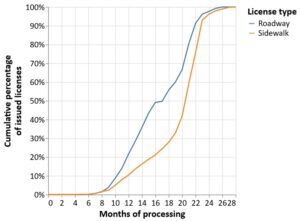
Figure 3: Number of licenses issued by months of processing time
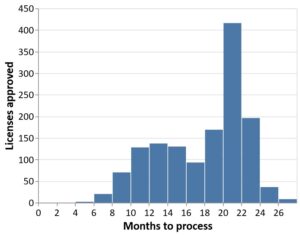
Note: This measure only includes applications which have been processed to license issuance, and cannot account for the in-process applications
An analysis of the data by year of issuance shows that the number of licenses issued by DOT increased each year. However, until the backlog is cleared, we are unable to assess the complete average and median days to issuance for even the 2024 permit applications.
The delays experienced by FSEs substantially reduced the benefit of the program. This has been particularly true for roadway cafés, which were only permitted to operate for eight months each year, from April 1 to November 29 in 2024 and 2025. As of September 2026, roadway dining is now a year-round program per Local Law 135. As the average time for completing roadway applications filed in calendar years 2024 and 2025 exceeded a year, many FSEs lost the opportunity to operate for more than one season.
Absence of Data Prevents Diagnosis and Cure
The investigation revealed the extent to which DOT lacks the management information necessary to effectively assess the licensing process. Although DOT tracks the total time required to issue a license, it does not track how long applications spend in individual stages of review or identify where delays occur. Without such data, DOT is unable to accurately measure operational performance, evaluate process improvements, or determine whether delays are attributable to DOT, applicants, or other reviewing entities.
Based on representations made to the Comptroller’s Office, DOT does not track and therefore lacks the capacity to calculate several data points, either for individual applications or in the aggregate. These include:
- Number of days spent at each stage of processing within DOT;
- Average number of days applicants take to supply information, documentation DOT requires to process applications, and the types of information or documentation that cause the greatest delays;
- Average number of days public comment or hearing processes take;
- Average number of days applications undergo Community Board review and approval;
- Average number of days applications undergo City Council review; and
- Average number of days applications take to move from final approval, to payment, to license issuance.
Charter Commission Ballot Measure
The recently issued Final Report of the 2026 Charter Revision Commission suggests changes to the outdoor dining revocable consent process that it posits will reduce the “eight-month” time frame by 75%, or, in other words, to two months. The Commission on Government Efficiency Final Report and Ballot Measure Proposal look to expedite the roadway and sidewalk café application process primarily by removing or shortening external review timelines such as public hearings, timeline for inclusion in the City Record, elimination of public hearing newspaper notice, the opportunity to waive notices to City Council, Borough President, and Community Boards, and elimination of required Community Board review.
If the ballot measure is adopted, this office will track available data related to DOT’s permitting timelines to determine whether these goals are achieved.
Recommendations
To address the above-mentioned findings, we propose that DOT should:
Data Transparency
- Produce and publish routine management reports showing processing times, pending workloads, and stage-specific performance.
Program Management
- Develop performance targets for each review stage and begin manually tracking progress against such performance targets, for each stage of review, both internally and externally.
- Produce and release a plan, with supporting data and staged timeframes, detailing how DOT will achieve the two-month completion target contemplated by the Charter changes.
- Establish targets for clearing the backlog and work collaboratively with participating agencies to ensure these targets are met.
Enhanced User Experience
- Enhance the user experience interface for Food Service Establishment (FSE) permit applicants with auto-populating information based on FSE location (such as proximity to known street features) and an easy-to-use mapping tool for sketching proposed street furniture placement. See Appendix A for a prototype identifying likely-eligible restaurants.
- Support more flexible design standards that provide for a broader range of street furniture features, including all-season furniture, and lower upfront capital costs for FSEs.
Appendices
Appendix A: DOT Communication on Expected Process and Timeline
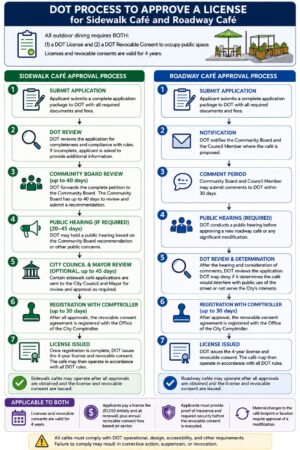
In the infographic below, DOT outlines a process for sidewalk and roadway café approvals. The Commission on Government Efficiency Final Report details a DOT process that currently takes three to five months for roadway café applications and six to eight months for sidewalk café applications.[8] DOT’s data, however, shows DOT that more than half of restaurants that have received outdoor dining permits since the program’s launch in March 2024 waited over 19 months for approval, as of June 15, 2026.
Appendix B: Prototype of Restaurant Fast-Tracking Toolkit
The DOT Dining Out application process requires applicants to complete a combination of approvals and siting specifications that often require technical abilities that may not be easily available to small business owners. However, much of the required application clearance information is publicly available on the NYC Open Data Portal. DOT could reduce administrative burden on applications by pre-populating clearance status for a Food Service Establishment (FSE) address. Applications could be categorized into those with few site-specific barriers to outdoor dining and those that may need further assessment. Restaurants that do not have any disqualifying criteria or clearance limitations could be fast-tracked.
The Office of the Comptroller developed a prototype screening tool that could auto-populate key site features using publicly available geospatial data. The tool can identify locations that have no known obstructions and may be eligible for fast-tracking. The tool does not replace engineering or architectural expertise. Rather, it provides a first-pass, data-driven triage that could reduce administrative burdens for both applicants and DOT staff. If deployed by DOT, a tool like this could cut down the number of locations that need time-intensive, robust review.
DOT’s roadway café rules state specific siting requirements. Certain features, such as bike lanes, bus stops, fire hydrants, and subway entrances, require a clearance zone or may be a disqualifying structure. In practice, figuring out whether a restaurant’s frontage clears all these requirements has historically taken manual, site-by-site review.
Findings
Of the 27,060 locations screened, 13,974 (about 52%) cleared every disqualifying criterion and clearance distance, meaning they were likely eligible for a roadway café. The remaining 13,086 (about 48%) were categorized as maybe eligible, flagged for closer review.
Address Search Tool
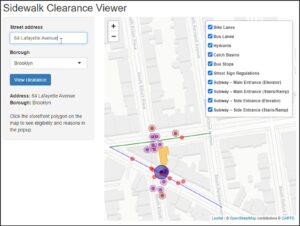
Of the 215 roadway cafes in the DOT permit approval process as of June 15, 2026, 81 meet our screening criteria for eligibility, representing 38% of the total. An additional 111 restaurants — about 52% of the total — are considered potentially eligible based on preliminary review.
| Count | Percent | |
| Eligible | 98 | 46% |
| Maybe Eligible | 113 | 53% |
| Not Enough Information[9] | 4 | 2% |
| Total | 215 | 100% |
Methodology
The unit of analysis is the building footprint tied to each FSE. The tool matches each FSE from LiveXYZ data (filtered to cafés, restaurants, and bars) to its building footprint (DOITT Building Footprints) using a spatial join on containment, with a nearest-footprint fallback for locations that did not fall inside any footprint polygon. Every location was then checked against a set of disqualifying features and features that require clearance zones, using NYC Open Data layers, each buffered to DOT’s minimum clearance distance. If a building footprint intersected a buffer, we flagged it as not clearing that criterion. A location that cleared every criterion was classified as eligible. Anything that failed one or more checks was classified as maybe eligible, pending further review.
| Criterion | Type | Clearance Applied | Public Data Source |
| No Standing (anytime or during posted hours)/No Stopping Zones/Reserved and dedicated-use parking (car share only, authorized vehicles only, permit parking) | Disqualifying | ~30 ft proxy buffer around regulatory sign | Parking Regulation Locations and Signs |
| Bus lanes | Disqualifying | Direct Adjacency | Bus Lanes, Local Streets |
| Bus stops | Disqualifying | Direct Adjacency
(in-effect stops only) |
MTA Bus Stops |
| Bicycle lanes | Disqualifying | Direct Adjacency | NYC Bike Routes |
| Fire hydrants | Required Clearance | 15 ft | NYCDEP Citywide Hydrants |
| Catch basins | Required Clearance | 5 ft | NYCDEP Citywide Catch Basins |
| Subway entrance, entry side, elevator | Required Clearance | 10 ft | MTA Subway Entrances and Exits (2024) |
| Subway entrance, entry side, non-elevator | Required Clearance | 15 ft | MTA Subway Entrances and Exits (2024) |
| Subway entrance, non-entry side, elevator | Required Clearance | 5 ft | MTA Subway Entrances and Exits (2024) |
| Subway entrance, non-entry side, non-elevator | Required Clearance | 5 ft | MTA Subway Entrances and Exits (2024) |
Data Gaps and Exclusions
Several DOT-listed disqualifiers and clearance requirements did not make it into this version of the tool, either because no clean, citywide open dataset exists for them or because the available data couldn’t reliably support automated screening:
- Part-time and full-time travel lanes: no citywide open layer distinguishes active travel lanes.
- MTA/FDNY curb cuts and standard curb cuts (10 ft / 5 ft): not screened. No reliable public curb-cut layer was identified.
- Emergency exit hatches (5 ft): not screened. Not consistently published.
- Citi Bike docks, bike share racks, and micromobility corrals (5 ft): not screened.
- Rain gardens: the drainage layer used covers catch basins only. Rain garden locations were not included.
- Elevated train infrastructure, transformer vaults, vent infrastructure, and thermoplastic markings (3 ft, 3 ft, 1’6″, and 6″ respectively): not screened. These smaller-clearance items are hard to source reliably at citywide scale and would likely need field-level or agency-internal data.
Sign-regulation data is published as points rather than street-segment geometry, so we applied a uniform 30-foot buffer around each regulatory sign as a stand-in for the length of curb it governs. This is a conservative approximation, not the true regulated segment. Bus stops were treated as an absolute disqualifier, meaning any intersection with an in-effect stop counted against a location, in line with DOT’s rule that they can never host a roadway café. We did not treat bus stops as a distance-based clearance.
A Note on Public vs. Internal Data
This tool runs entirely on public, open datasets. Several of them are point-based stand-ins for information DOT likely holds in more precise form internally: exact curb-regulation segments, verified sign inventories, engineering-grade utility and subway infrastructure locations, and up-to-date field conditions. The results here should be read as a demonstration of feasibility and a first-pass triage, not a final determination. With access to its own internal data, DOT could likely build a more accurate and complete version of this same screening approach, closing the gaps noted above and cutting reliance on proxy buffers.
Acknowledgments
This report was authored by Deputy Comptroller for Audits Maura Hayes-Chaffe, Policy Director for Transportation and Infrastructure Liya Rechtman, Executive Director of Operations Nicole Symon, Director of Data Analytics Daniel Levine, Policy Data Analyst Jacob Bogitsh, and additional contributors Senior Director of Contract Analysis Dan Roboff, Research & Analysis Manager Sharifa Gow-Jones, Lead Research Analyst Carolina Garcia, and Intern Alex Polanco. Report design was completed by Creative Director, Archer Hutchinson, and Senior Multimedia Designer, Danbin Weng.
[1] NYC DOT Notice of Adoption – Dining Out NYC Rules
[2] DOT Dining Out NYC PowerPoint Presentation to NYC Comptroller’s Office Meeting June 2026, provided on June 29, 2026.
[3] Commission on Government Efficiency Proposed Final Report pg. 27: “Currently, sidewalk café applications take six to eight months, and roadway café applications take three to five months.”
[4] Lifetime days were calculated based on all submissions and all issuances in the dataset provided by DOT
[5] Permit applications approved by DOT are submitted by DOT to the Office of the Comptroller’s Bureau of Contracts for final registration. This final stage provides an additional, though limited, set of data in assessing the performance of the program by allowing us to observe delays in the Administration’s final execution of approved permits.
[6] Combined data provided by DOT on June 15, 2026. DOT has provided limited updates since then that are unsupported by data.
[7] As of October 21, 2026, the Comptroller’s Office received 2,571 approved applications from DOT and has completed registering 2,550 (99%) of them. While these review times do not factor into the overall permit delays for restaurants, the Comptroller’s Office registered 1,485 (57%) in seven days or less.
[8] Commission on Government Efficiency Proposed Final Report, page 31.
[9] Some FSEs could not be matched based on business name or location.