Comptroller Stringer Analysis Of Citywide Housing Conditions Shows Rapidly Deteriorating Housing At NYCHA
NEW YORK, NY – Despite years of economic prosperity and real estate appreciation, housing maintenance conditions have worsened, especially at New York City Housing Authority buildings, potentially putting the health and safety of residents at risk, according to a new analysis “How New York Lives” released today by New York City Comptroller Scott M. Stringer.
“Housing conditions at NYCHA have become a laundry list of tenant frustration, from broken windows and peeling paint, to faulty heaters and scurrying rats,” Comptroller Stringer said. “New York City’s housing stock is among the most valuable in the world, but my report today shows that there are great disparities in how New Yorkers live. Securing funding for NYCHA maintenance and repairs and vigorously enforcing the housing code must be a priority for this Administration.”
The Comptroller’s report analyzed data on rent-regulated apartments, market-rate rental apartments, owner-occupied housing and public housing apartments using data from the New York City Department of Housing Preservation and Development (HPD) and U.S. Census Bureau’s triennial Housing and Vacancy Survey (HVS) from 2002-2011. The survey’s main purpose is to determine whether a housing emergency exists, but HVS also amasses microdata on various housing statistics, including the physical condition of the City’s housing stock as a whole.
The report notes that despite years of government and private-sector investment, significant enclaves of poor quality housing persist. Nearly 30 percent of the City’s housing units have multiple maintenance deficiencies. The report examined two major categories, structural defects and patterns of deficient maintenance:
Key Findings of the Report on Housing Structural Defects and Maintenance Deficiencies
- 99.8 percent of all housing types in New York City were in structurally decent condition as of 2011. However, NYCHA developments experienced increased signs of deterioration. In 2002, 60 percent of public housing apartments had at least one deficiency. That figure jumped to 79 percent by 2011.
- The number of broken or missing windows in NYCHA housing surged by 945 percent from 2005 to 2011. In 2011, broken or missing windows were observed in NYCHA buildings at three times the rate of the overall housing stock.
- Heating equipment breakdowns continue to trouble New Yorkers, with 20 percent of rent-stabilized tenants and 11 percent of market-rate tenants reporting heating system breakdowns in 2011. Heating system breakdowns in public housing increased by more than 72 percent from 2008 to 2011, with an estimated 43,000 reported breakdowns observed in that final year.
- The percentage of NYCHA residents reporting broken plaster and peeling paint nearly doubled from 2008 to 2011. Reported plaster and paint conditions rose slightly in market-rate and rent-stabilized housing. However, from 2005 to 2012, the number of children with dangerous blood levels resulting from lead paint dropped by 58 percent.
- Nearly one-third of public housing tenants reported water leaks in their apartments in 2011. The frequency of water leaks in rent-stabilized apartments was almost as high.
- In 2011, almost one-quarter of New York City households reported seeing evidence of rodents in their dwelling during the previous three months. Rodent sightings were most frequent in public housing, where they increased from 26 percent of NYCHA apartments in 2005 to 37 percent in 2011.
Patterns of Deficient Maintenance in New York City’s Housing Stock
For the purposes of this report, housing units are considered deficient if three or more major maintenance conditions are present at the same time.
Frequency of units with three or more housing deficiencies in 2011
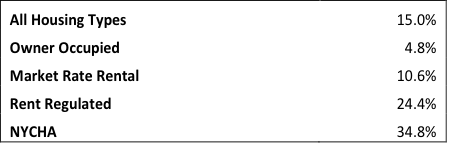
The Comptroller’s report found that the maintenance condition of rent-stabilized housing units appeared to be generally worse than that of market rate rental units. Structure size affected rates of maintenance problems, with large buildings seeing significantly fewer deficiencies than small and mid-sized buildings. Surprisingly, the study found little evidence that maintenance quality is related to the amount of rent a tenant pays.
- Geographically, Staten Island has the City’s highest quality rent-regulated and market-rate rental housing stock, with deficiency rates of 11.8 and 2.5 percent respectively. The quality of dwelling units in the boroughs by these same measures were, in descending order, Queens, Manhattan, Brooklyn and the Bronx.
- African Americans are most likely to live in poorly maintained housing, with 34 percent of black households in rent-regulated apartments reporting three or more serious maintenance deficiencies in their dwellings, compared with 28 percent of Hispanic households, 18 percent of Asian/Pacific Islander households and 16 percent of white households.
- Low-income tenants often endure worse conditions than affluent tenants in rental apartments. More than a quarter of rent-regulated units occupied by households earning less than $51,540 (60 percent of the area median income) report three or more deficiencies compared to one-fifth of units occupied by households earning over $150,000.
“While much of New York City’s housing stock remains in good condition and asset values have increased, significant pockets of our City’s housing are deteriorating. We still have much work to do to ensure that every New Yorker has a safe place to call home. Policymakers and the public must maintain pressure on all levels of government, especially the U.S. Department of Housing and Urban Development, the federal agency responsible for NYCHA, to bring our city’s affordable housing stock back into good repair,” Stringer said.
To read the full report, please click here.
###