Review of the City’s Animal Population Control Efforts
Introduction
Background
Title 17, Chapter 8 (Animal Shelters and Sterilization Act) of the New York City (City) Administrative Code establishes the Department of Health and Mental Hygiene’s (DOHMH) responsibility for operating a full-service shelter in each borough of the City, enforcing mandated sterilization and microchipping programs, administering dog licenses and provisions related to free-roaming cats, promoting adoptable animals, issuing related violations, and establishing an animal population control program.[1] Section 17-809 of the Administrative Code also grants DOHMH authority to offer “additional services or facilities to facilitate the decline in numbers of unwanted and uncared for animals in New York City.”
Section 17-811 of the City Administrative Code mandated that DOHMH establish an Animal Population Control Program (the Program) for the purpose of reducing the population of unwanted stray dogs and cats (i.e., homeless animals that were once owned and were either lost or abandoned) by “encouraging residents of the city of New York who are the owners of dogs and cats to have them spayed or neutered by providing no- or low-cost spaying and neutering services to such owners.” The section required DOHMH to establish rules and regulations “necessary to establish [the Program] including, but not limited, to creating clinics or mobile units where such services [are] performed and establishing criteria for pet owner eligibility for such services.” It also authorized the agency to “solicit and accept funds from the animal population control fund established [in Section] 17-812 . . . and any other public or private source to help carry out the provisions of this section.”
Section 17-812 established the Animal Population Control Fund (the Fund) in the joint custody of the City Comptroller and the Commissioner of Finance to subsidize the Program and specified that the Fund would consist of any funds solicited by DOHMH per Section 17-811 and all revenue collected from additional fees (surcharges) for issuing or renewing a license for unsterilized dogs.
DOHMH subsequently issued rules and regulations governing the Program in the Rules of the City of New York Title 24, Chapter 29 (Animal Population Control Program). The rules permit the agency to subsidize the provision of no- or low-cost spaying and neutering services to owners of cats and dogs who would otherwise be unable to pay for such services and establish and support programs for the education of owners regarding the benefits of having their dogs and cats spayed or neutered.[2] The rules define spaying and neutering services and establish owner eligibility and service provider requirements.[3] The rules permit DOHMH to “enter into contracts with or award grants or otherwise reimburse for spay and neuter services New York City animal shelters or animal protective associations, and to the extent that funds are or become available, to private veterinarians practicing in New York City.”
DOHMH’s Contract with the ASPCA
To implement the Program, DOHMH entered into a contract with the American Society for the Prevention of Cruelty to Animals (ASPCA) to provide free or low-cost spaying and neutering services to eligible pet owners in all five boroughs, for the period from November 1, 2022 through October 31, 2028 (Fiscal Years 2023 through 2029).[4] The “total not to exceed amount” under this contract is $3 million; this was based on DOHMH’s anticipated revenue from dog licensing surcharges, based on revenue achieved in prior years.[5] (The estimated costs for the respective fiscal years are $332,500, followed by five years at $500,000 each, and a final year at $167,500.) Despite its authority to do so under Section 17-811 of the City Administrative Code, DOHMH did not solicit funding from other private or public funds but relied solely on revenues from dog licensing surcharges. Although permitted to use other organizations, DOHMH has limited the reimbursement for animal population control to services provided under the contract with the ASPCA.
The contract covers reimbursement for a maximum of 24,000 sterilization surgeries at a rate of $125 per surgery. (While five of the years allow for 4,000 reimbursed surgeries each, the first and last years are capped at 2,660 and 1,340 surgeries, respectively.)[6]
According to the terms of the contract, the ASPCA is required to:
- Promote the Program using various methods of promoting, advertising, and conducting outreach to distribute information widely about ASPCA’s sterilization services offered to eligible residents and the Program.
- Provide free and low-cost spaying and neutering services to eligible owners of female and male dogs and cats.
City Animal Care and Control Statistics
DOHMH has a 34-year contract (from September 1, 2018 through June 30, 2052) with Animal Care and Control of New York City, Inc. (ACC) to provide for the care and shelter of stray, abandoned, mistreated, neglected, and seized (due to being a public threat) animals, to promote adoptions, and to reunite lost pets with their owners. The “total not to exceed amount” under this contract is approximately $1.9 billion, of which $75 million was allocated for the construction, renovation, and outfitting of the Queens Animal Care Center.[7] Minus this allocation, the ACC contract averages approximately $53.7 million per year.
Table 1 below shows shelter intake and outcomes found on ACC’s website for Fiscal Years (FY) 2023 through 2025. Based on the reported data, 25,781 (58%) of the total 44,381 dogs and cats that entered animal shelters were strays. A significant number of animals—11,889 cats and 6,404 dogs (a total of 18,293)—were also relinquished to the shelter by their owners. The trends show that the number of cat intakes (28,168) exceeds the number of dog intakes (16,213) by 74%.
Overall, 4,149 (9.3%) of the total 44,381 dogs and cats that entered the shelters were shelter-euthanized. The percentage differs somewhat between dogs and cats—approximately 10.7% of dogs were shelter-euthanized, against 8.6% of cats. Live outcomes were also proportionately higher for cats than dogs; 88% of dog intakes had live outcomes, against 90% of cat intakes.
Table 1. ACC Statistics on Shelter Intakes and Outcomes
| Type of Metric (Intake or Outcome) |
FY 2023 | FY 2024 | FY 2025 | Grand Total | Combined Total | ||||||||
|---|---|---|---|---|---|---|---|---|---|---|---|---|---|
| Intakes | Dogs | Cats | Dogs | Cats | Dogs | Cats | Dogs | Cats | Dogs & Cats (All) | ||||
| Stray/At Large | 2,746 | 5,353 | 3,454 | 5,267 | 3,541 | 5,420 | 9,741 | 16,040 | 25,781 | ||||
| Relinquishment by Owner | 2,293 | 4,150 | 1,876 | 3,629 | 2,235 | 4,110 | 6,404 | 11,889 | 18,293 | ||||
| Other Intakes | 10 | 75 | 35 | 81 | 23 | 83 | 68 | 239 | 307 | ||||
| Total Intakes | 5,049 | 9,578 | 5,365 | 8,977 | 5,799 | 9,613 | 16,213 | 28,168 | 44,381 | ||||
| Outcomes | Dogs | Cats | Dogs | Cats | Dogs | Cats | Dogs | Cats | Dogs & Cats (All) | ||||
| Total Live | 4,510 | 8,535 | 4,671 | 8,235 | 5,049 | 8,530 | 14,230 | 25,300 | 39,530 | ||||
| Total Non-Live | 471 | 1,018 | 637 | 881 | 693 | 874 | 1,801 | 2,773 | 4,574 | ||||
| Died in Care | 25 | 140 | 19 | 97 | 22 | 111 | 66 | 348 | 414 | ||||
| Lost in Care | 1 | 5 | 1 | 3 | 1 | – | 3 | 8 | 11 | ||||
| Shelter Euthanasia | 445 | 873 | 617 | 781 | 670 | 763 | 1,732 | 2,417 | 4,149 | ||||
| Grand Total Live & Non-Live Outcomes | 4,981 | 9,553 | 5,308 | 9,116 | 5,742 | 9,404 | 16,031 | 28,073 | 44,104 | ||||
Note 1: Total Live outcomes include animals adopted, returned to their owner, or transferred to another agency.
Note 2: Beginning January 2023, ACC reclassified “Owner-Intended Euthanasia” (OIE) as a community service (one where an owner requests the service due to a medical or behavioral condition or selects the service as the best treatment after consulting with a veterinarian) rather than a shelter intake/outcome to align with national standards. Consequently, these figures are excluded from Table 1. Supplemental data shows an additional 2,631 dogs and 1,345 cats underwent OIE between January 2023 and June 2025. [8]
Stakeholder Concerns About the City’s Animal Population Control Efforts
This review was prompted by concerns raised by animal rights groups advocating for animal welfare, many of which were echoed in testimony given during a City Council hearing held on September 13, 2024.[9] Veterinarians, animal rescuers, and non-profit leaders called for additional funding to bring down animal shelter populations, support pet owners, and reduce the number of stray animals living on City streets.[10]
Objectives and Scope
The objectives of this review were to: (1) evaluate the effectiveness of the City’s animal population control efforts through DOHMH’s implementation, administration, and enforcement of the Program; and (2) consider approaches tried elsewhere.
The scope of this review was July 1, 2022 through June 30, 2025.
Discussion of Review Results with DOHMH
The matters covered in this report were discussed with DOHMH officials during and at the conclusion of this review. On March 11, 2026, we submitted a Draft Report to DOHMH with a request for written comments. We received a written response from DOHMH on March 31, 2026.
In its response, DOHMH generally agreed with two recommendations (#s 6 and 8), partially agreed with one (# 7), and either disagreed with or characterized the remaining six recommendations (#s 1, 2, 3, 4, 5, and 9) as unnecessary. The review notes that DOHMH’s response includes new information that was not shared with the review team at any point before or after the summary of the review’s preliminary findings was provided to DOHMH on December 29, 2025. On January 7, 2026, agency officials contacted the Deputy Comptroller for Audit to detail their concerns with several of the review’s preliminary findings and to request a meeting. On January 22, 2026, DOHMH’s Deputy Commissioner for the Division of Environmental Health and Assistant Commissioner for Audit Services met with the Deputy Comptroller for Audit and Assistant Comptroller for Audit. During that meeting, the Deputy Comptroller asked officials to provide any information that they believed to be relevant to the review’s preliminary findings. On January 29, 2026, DOHMH provided additional information, which was reviewed and considered in completing the Draft Report. This did not include new material and data not provided, even in response to that meeting, despite time allotted for DOHMH to do so.
Because the new data presented by DOHMH was not shared during the review or following the meeting during which DOHMH indicated it would be provided, the team was unable to examine the validity of the information as needed. Absent that opportunity, the review team offers no opinion on the validity of the newly provided information and/or its potential impact on the review’s findings.
DOHMH’s written response has been fully considered to the extent possible given these circumstances, and where relevant, changes and comments have been added to the report.
The full text of DOHMH’s response is included as an addendum to this report.
Key Takeaways
The review was undertaken to consider DOHMH’s implementation of the animal population control initiative established under Section 17-811 of the City Administrative Code and to briefly explore alternative options for controlling stray animal populations in other cities and as advocated by animal welfare experts.
Although the review found that DOHMH has complied with Section 17-811 of the City Administrative Code by establishing a no- and low-cost spaying and neutering program to provide such services to eligible pet owners and used funding generated from dog licensing surcharges, as mandated by Section 17-812, to fund the Program, the review also found that DOHMH has not been proactive in pursuing animal population control overall.
DOHMH has not sought or obtained additional funding from public or private sources to support the initiative as it could have under Section 17-811 and has not established other initiatives to support animal population control, as it is authorized to do under Section 17-809. By limiting its efforts to establishing no- and low-cost sterilizations, and in choosing to rely on a single source of limited funding, DOHMH has reduced its potential impact on controlling the stray population of cats and dogs in the City, one of the primary causes of the sizeable animal shelter population.
DOHMH’s reliance on dog licensing surcharges as the sole funding source has meant that fewer than expected surgeries could be performed by the ASPCA. Analysis shows that outreach events to encourage dog licensing have only been held in five (3%) of the City’s more than 170 zip codes, specifically within Queens and the Bronx, and a survey of residents and data reviewed by the review team indicates that dog licensing requirements are not well known or adhered to. Between FYs 2022 and 2024, DOHMH collected only $950,819 from dog licensing surcharges—falling well short of the $1.5 million that was anticipated to be collected. This meant that 37% fewer surgeries than anticipated were performed. The ASPCA performed a total of 6,733 sterilizations during FYs 2023 to 2025, 3,927 (37%) less than the 10,660 sterilizations anticipated under the contract.
The funding limitations are likely reflected in other ways. DOHMH has not reimbursed or made regular grants to other entities or private veterinarians to support sterilization efforts outside of the contract with the ASPCA, and DOHMH’s outreach efforts to encourage pet owners to have their dogs and cats spayed—one of the core components of the Program and one of the ASPCA’s responsibilities under the contract—have been sparse.[11]
The review team’s assessment of DOHMH’s oversight of the ASPCA contract also found the need for improvement. The review examined contract performance and found that certain targets were not met due, at least partly, to staffing issues. DOHMH subsequently issued purchase orders to the Toby Project, Inc. to cover gaps in coverage capacity.[12] DOHMH did not ensure that the ASPCA established a corrective action plan to address this gap in the future.
DOHMH has not established any performance metrics or evaluation criteria to assess the impact of the ASPCA’s outreach efforts under the contract. The review team found that outreach conducted by the ASPCA to promote spaying and neutering services was primarily concentrated in the Bronx and Brooklyn. Although requested, the ASPCA did not disclose its selection methodology, so it is not clear how well the ASPCA planned to serve low-income populations in the City’s other boroughs. DOHMH does not publicly report data or metrics related to the outcomes of its animal population control efforts. DOHMH is encouraged to do so in the future, in the interest of increasing transparency.
The review team also looked at practices employed in other municipalities to help reduce stray populations. Reviewers reached out to two other municipalities and one state agency that have animal population control programs comparable to New York City’s and found that, unlike the City, they use multiple funding streams—such as licensing fees for dogs and cats, “animal friendly” license plates, and voluntary state income tax contributions—to provide free or low-cost sterilization services.
Other cities also operate Trap-Neuter-Return (TNR) programs aimed at reducing community cat populations, which consist of stray and feral cats. Although the City Council allocated $500,000 in discretionary funding in September 2025 to support expanding the spay/neuter services, including TNR programs, DOHMH does not support or sponsor such programs.
DOHMH indicated to the review team that TNR programs remain controversial. Officials also emphasized the need to address owner-relinquishments to shelters; they stated that this is another way in which the City’s affordability crisis is impacting shelter populations. DOHMH did not provide any studies or data to support the correlation with affordability, and a national study (discussed in more detail below) found only 6% of owner relinquishments were based on fiscal issues. Nonetheless, it is evident from ACC’s shelter intake statistics that owner-relinquishments represent a sizeable percentage of the shelter population. The underlying causes in the City should be considered and addressed.
DOHMH has conceded a need to re-evaluate the City’s overall approach to controlling animal populations and for reducing unwanted and uncared-for pets. This is an acknowledgement that the very small Program established and implemented by DOHMH is insufficient to address the scope of the overall problem.
DOHMH did not inform the review team of any initiatives created to address this need. During the review, DOHMH’s efforts remained focused on operating animal shelters to provide needed care, and this Program. In this respect, it is worth noting that the cost of maintaining animal shelters (under a 34-year contract with ACC) cost the City almost $1.9 billion. On an annual basis, this translates to almost $54 million. In contrast, the Program—which was ostensibly created to address one of the root causes of the need for animal shelters—received an average of only $316,000 in each of the last three fiscal years reviewed.
PART I: Animal Population Control Program
Funding Is Inadequate to Meet Demand for Sterilization Services
As noted above, the Fund’s only mandated source of revenue is through a surcharge of $25.50 collected as part of annual dog licensing costs. The $25.50 surcharge is the difference between the $8.50 pet owners pay for dog licenses if their dog is spayed/neutered and the $34.00 pet owners pay for dog licenses if their dog is not.
DOHMH has not attempted to quantify the total number of pet dogs in the City since its last estimate 18 years ago and is therefore unable to calculate the total potential revenue that could be generated through this vehicle, but, as noted above, the revenue generated from dog licensing surcharges fell well short of anticipated revenue and was not sufficient to cover the cost of planned sterilizations by the ASCPA. In 2008, DOHMH conducted a phone survey which resulted in an estimate that there were approximately 500,000 pet dogs in the City. DOHMH has not attempted to update this figure. According to American Community Survey data, the City had a population of nearly 8.4 million in 2008, which works out to a ratio of one pet dog for every 17 City residents.[13] If the ratio of pet dogs to City residents has remained relatively constant, the review team estimates that the figure has not significantly changed since then (based on the City’s population of nearly 8.5 million as of July 1, 2024). According to data reported in the City’s Mayor’s Management Report (MMR), approximately 70,000 dogs—well less than 25% of the estimated population—have been licensed. The City currently collects approximately $595,000 annually from dog licenses; if the remaining approximately 430,000 dogs were licensed, the potential annual revenue would range between $3.7 million and $14.6 million, depending on whether the dogs were spayed or neutered.
Data reported in the MMR shows a steady decrease in the number of dog licenses purchased since the surge that occurred during the pandemic, when 93,200 dogs were licensed in FY 2021. Since then, the number of dogs licensed has steadily dropped: from 79,900 in FY 2023, to 75,700 in FY 2024, and finally to 70,100 in FY 2025. This widespread non-compliance with dog licensing requirements indicates that there is potential to increase funding by ensuring more dogs are licensed.
Despite this decline in the issuing of dog licenses, when asked at the September 2024 City Council hearing on animal welfare about the kind of funding the agency would need to comply with the spaying and neutering laws, DOHMH responded unequivocally that they “do not need any additional resources” at the current time. When the review team later requested data to support this statement, DOHMH was unable to provide any, instead stating they had misunderstood the question and thought it concerned only resources for spaying/neutering free-roaming cats.[14]
According to historical revenue data from dog licensing surcharges gathered by DOHMH, a total of $950,819 was collected for the Fund in FYs 2022 through 2024.[15] Table 2 below summarizes the breakdown of the revenue from dog licensing surcharges collected per fiscal year:
Table 2. Revenue from Dog Licensing Surcharges: FYs 2022 through 2024
| Fiscal Year Dog Licensing Surcharge Revenue Collected | Date Range of Revenue Collection Entries in the City’s Financial Management System | Amount of Dog Licensing Surcharge Revenue Collected | # of Surgeries Achievable With Dog Licensing Surcharge Revenue Collected ($125 Per Surgery) |
|---|---|---|---|
| 2022 | 8/25/2021 – 7/13/2022 | $326,477 | 2,612 |
| 2023 | 8/17/2022 – 7/18/2023 | $310,233 | 2,482 |
| 2024 | 8/15/2023 – 7/12/2024 | $314,109 | 2,513 |
| Total | $950,819 | 7,607 |
Note: Revenue for the period 8/28/2024 – 3/14/2025 totaled $169,481. This table only reflects revenue collected for full fiscal years.
As noted above, the maximum reimbursement amount in DOHMH’s contract with the ASPCA was established based on DOHMH’s anticipated revenue from dog licensing, an estimate based on revenue achieved in prior years. The contract covers reimbursement for a maximum of 24,000 sterilization surgeries at a rate of $125 per surgery, or the equivalent of 4,000 surgeries per fiscal year, for a total of $500,000. As shown in Table 2, for FYs 2022 through 2024, DOHMH collected $950,819 in revenue from dog licensing surcharges, which would cover 7,607 surgeries over the three-year period.
This falls short of the expected annual reimbursement amount of $500,000 for 4,000 surgeries per fiscal year—a gap of $173,523 for FY 2022 (or 1,388 surgeries), $189,767 for FY 2023 (or 1,518 surgeries), and $185,891 for FY 2024 (or 1,487 surgeries). This shows that DOHMH is not receiving sufficient funds to cover the cost of the 4,000 surgeries it expected and agreed to subsidize. This has led to a substantial decrease in the Program’s service capacity compared to the contracted goal. [16]
The review team reached out to two municipalities and one state agency that have an animal population control program comparable to New York City’s.[17] Unlike the City, however, they use multiple funding streams for providing free or low-cost sterilization services as follows:
- Animal Care and Protective Services in Jacksonville, Florida—Funded via cat and dog licensing fees.
- State of New Jersey Department of Health—Funded via dog licensing fees, “animal friendly” specialty license plates, and voluntary state income tax contributions.
- City of San Antonio Animal Care Services—Funded via the City’s General Fund and donations from Petco, PetSmart, and Petco Love. San Antonio also replaced dog licensing with mandatory microchipping for cats and dogs to increase pet return rates and owner compliance.
The decline in dog licensing has meant that the Program’s funding has been reduced and it has been unable to support the expected number of surgeries ASPCA was contracted to perform.[18] Because DOHMH set surgery targets based on expected revenue from dog licensing surcharges, rather than based on an estimate of the overall need for subsidized sterilizations, the total service gap is unknown.[19]
Dog Licensing Events Concentrated in Only 3% of City’s Zip Codes
Dog licensing events have been shown to significantly increase the number of people who license their dogs. However, the review found significant inefficiencies in DOHMH’s administration of these events, which could have a direct impact on low licensing compliance rates and funding for the Program.
According to DOHMH, the agency conducts outreach and educates City dog owners to promote the dog licensing requirement. Additionally, permitted entities, including grooming facilities, boarding facilities, and dog day care facilities are required to offer license applications. Each dog re-homed to a City resident by ACC or other permitted animal shelters is issued a dog license.[20] DOHMH stated that the key performance indicators used to measure the agency’s outreach/education efforts are the number of outreach events and the number of dogs licensed. However, the agency did not indicate the methodology or specific criteria used to select the locations for its outreach events. This lack of a targeted strategy persists even as DOHMH notes in the MMR that it is “exploring ways to better educate the public about the requirement and promote the benefits of dog licensing.”
The review team reviewed the dataset containing DOHMH’s outreach and education efforts during the period of July 1, 2022 through June 30, 2025. In total, the agency conducted 192 dog licensing events. Reviewers analyzed the zip codes where dog licensing events took place and found that DOHMH concentrated its outreach and education efforts in only five (3%) of the City’s more than 170 zip codes. These five zip codes were associated with 140 (73%) of the 192 events as shown in Table 3 below:
Table 3. Top Five Zip Codes Per Fiscal Year Where Dog Licensing Events Took Place
| Borough | Zip Code | Neighborhoods | Events FY 2023 |
Events FY 2024 |
Events FY 2025 |
Total Events | Percentage |
|---|---|---|---|---|---|---|---|
| Queens | 11368 | Corona, Jackson Heights, and Flushing | 16 | 21 | 14 | 51 | 36% |
| Bronx | 10461 | Pelham Bay, Morris Park, Westchester Square, and Pelham Parkway | 11 | 12 | 12 | 35 | 25% |
| Bronx | 10462 | Parkchester, Morris Park, Pelham Parkway, Van Nest, and Castle Hill | 7 | 8 | 9 | 24 | 17% |
| Brooklyn | 11224 | Coney Island, Seagate, and West Brighton | 11 | 0 | 0 | 11 | 8% |
| Brooklyn | 11220 | Sunset Park and Bay Ridge | 0 | 8 | 11 | 19 | 14% |
| Total | 45 | 49 | 46 | 140 | 100% |
As shown in the table, of the 140 events conducted, 110 (79%) were conducted in three zip codes within Queens and the Bronx during each of the three fiscal years.
Low licensing compliance results in less revenue for the Fund. Moreover, in the absence of a clear methodology of how sites are selected, there is an increased risk that DOHMH’s resources are not being disbursed in an effective manner throughout the City to educate dog owners on the need to obtain licenses for their pets and increase revenues for the Program.[21]
DOHMH’s Oversight Over the Program Could Be Improved
DOHMH is responsible for administering the Program and overseeing its contract with the ASPCA. The review found several ways in which the agency could strengthen its efforts in these areas, as outlined below.
DOHMH Does Not Adequately Monitor ASPCA’s Contract Performance or Impact on Animal Population Control
According to the contract, DOHMH must develop and implement a monitoring plan that should specify reasonable, clear, and understandable standards for ASPCA’s performance. The plan should include a time frame for all management and oversight functions such as site visits and evaluation criteria covering: (1) the timeliness of deliverables, reports, and services; (2) staff appropriateness; (3) recordkeeping; (4) adherence to target population/areas, and (5) accuracy of fiscal reports/payment requisitions.
However, the plan provided to the review team limited DOHMH’s reviews to invoices submitted by the ASPCA seeking reimbursement for surgeries; it does not include site visits or criteria for evaluating other aspects of the contract, such as the timeliness of deliverables, reports, or services and staffing levels or qualifications.[22]
DOHMH provided the review team with a dataset on May 21, 2025 showing that the ASPCA conducted 1,528 outreach events (1,312 spaying and neutering clinic events and 216 community-based events) to promote its sterilization services from November 2022 through February 2025.[23] DOHMH provided no mechanism for verifying the reported outreach figures, stating instead that they rely on trust. The review team found that for the months of April, May, and June 2024, the ASPCA provided invoices but not supporting documentation detailing its outreach activities, as required.
As stated above, the contract between DOHMH and the ASPCA also calls for the ASPCA to use various methods of promoting, advertising, and conducting outreach to distribute information about the sterilization services available to eligible residents. To this end, the ASPCA is to promote sterilization services on their website, host events at their clinics, and host community-based meetings in each borough at least twice a year, distributing materials to promote the Program. The ASPCA is required to provide a summary report to DOHMH within 45 days after each month such services are provided, including information such as the number of clinic events and community-based meetings conducted and the list of methods used to promote sterilization services.
However, these summary reports serve little purpose if the oversight agency does not utilize the data. DOHMH has not established any performance metrics and does not conduct assessments or track data (e.g., zip codes) to determine areas in the City where the need for sterilization services is greatest, instead simply requiring the ASPCA to list the zip codes of owners whose pets received sterilization services in monthly reports. Moreover, the lack of evaluation criteria relating to ASPCA’s outreach efforts hinders DOHMH’s ability to ensure that the ASPCA is meeting its service obligations and utilizing public funds effectively.
ASPCA Provided Fewer than Expected Sterilization Services
The ASPCA offers free sterilization services in their three stationary veterinary clinics (in Brooklyn, Queens, and the Bronx) and in mobile units.[24] On ASPCA’s website, effective December 2022, zip codes eligible for mobile unit services within each borough are posted on certain days of each month. Residents within these zip codes can sign up virtually for the waitlist starting at 6:00 a.m. on the morning of the date posted.[25] The exact location of the unit is shared when residents are successfully placed on the waitlist. At stationary clinics, appointments are open to residents within zip codes nominated by the ASPCA.
According to spaying and neutering surgery statistics provided by the ASPCA to DOHMH, the ASPCA performed a total of 6,733 surgeries during the first three fiscal years of the contract and did not meet its target of 10,660 surgeries over the three-year period. The breakdown by year is shown in Table 4 below.
Table 4. Comparison of Target Vs. Performed Surgeries: FYs 2023 through 2025
| Fiscal Year | Target # of Surgeries | Actual # of Surgeries Performed | Difference |
|---|---|---|---|
| 2023 | 2,660 | 1,303 | 1,357 |
| 2024 | 4,000 | 2,251 | 1,749 |
| 2025 | 4,000 | 3,179 | 821 |
| Total | 10,660 | 6,733 | 3,927 |
As indicated above, the ASPCA conducted 37% fewer surgeries than called for in its contract (a deficit of 3,927 surgeries). The primary reason for the shortfall was inadequate capacity. As the ASPCA acknowledges on its website, its ability to provide services is extremely limited due to staff shortages and high demand. To address this shortfall, DOHMH issued two purchase orders to Toby Project, Inc. in FYs 2023 and 2024 to assist with performing 271 additional sterilization surgeries.
According to the contract, if the number of surgeries performed at the end of each fiscal year is lower than expected, the ASPCA must submit a report to DOHMH within 30 days to include the reasons for the lower-than-expected surgeries and plans to increase the number of surgeries for the next fiscal year. However, the review found no indication these reports were submitted by the ASPCA or that DOHMH ever followed up.
ASPCA Outreach for Program Services Concentrated in Two Boroughs
The Program is intended to provide low- or no-cost spaying and neutering services to pet owners who would otherwise be unable to pay for such services. According to the ASPCA, this is accomplished by selecting lower income areas throughout the City to conduct program outreach and provide related services.
The review team reviewed the dataset related to sterilization expenditures DOHMH provided on May 30, 2025, and selected 19 spaying and neutering invoices for services reimbursed to the ASPCA by DOHMH.[26] [27] In total, DOHMH reimbursed ASPCA for 3,600 spaying and neutering surgeries across 128 zip codes.[28]
A review of those zip codes revealed that they were predominantly areas in which the median household income was below the Citywide median income. The analysis showed that surgeries were primarily concentrated in two boroughs—the Bronx (44%, 1,582 surgeries) and Brooklyn (37%, 1,330 surgeries)—which represented 81% of the total surgical volume. The highest number of surgeries occurred in zip code 11207 (encompassing the neighborhoods of East New York, Bushwick, and Brownsville), accounting for 289 surgeries. According to the American Community Survey, the median household income for this zip code is below the Citywide median household income.
The remaining 19% of surgeries were distributed among the other boroughs—Queens accounted for 10% (378), Staten Island accounted for 5% (172), and Manhattan accounted for 4% (138). Although requested, the ASPCA did not share the methodology employed to select the targeted areas, so the review team was unable to assess the degree to which the ASPCA ensured that areas receiving services met the income level criteria. (The full results are included in Appendix I.)
The review team also notes that the geographic targeting employed may limit the Program’s reach, in that people who meet income thresholds but live in higher-median-income areas are effectively excluded. Furthermore, while resources have been largely concentrated in the Bronx and Brooklyn based on borough-level income data, there are opportunities to increase outreach in low-income populations in the City’s other boroughs. The geographic concentration in the two boroughs suggests that eligible residents in high-need neighborhoods outside these areas may be experiencing a service gap due to the lack of localized outreach.
DOHMH Does Not Publicly Report Statistics Relating to Animal Population Control Efforts
DOHMH publicly reports various animal-related statistics on NYC Open Data, including data on dog bites and dog licensing. There are also animal-related complaint statistics on NYC Open Data derived from general 311 Service Requests, including data on unleashed and unlicensed dogs, animal facilities operating without permits, illegal animals sold or kept as pets, and unsanitary animal facilities. Dog licensing data also appears in the MMR.
However, DOHMH does not publicly report any data regarding the activities and outcomes relating to the Program. Specific data that could and should be publicly available includes the following:
- The total number of spaying and neutering surgeries performed under the Program (broken down by species and sex).
- The zip codes where eligible owners resided who received sterilization surgeries for their pets under the Program.
- The number of pet owners who received sterilization surgeries categorized by eligibility criteria (i.e., Medicaid, food stamps, public housing assistance).
- The number of sterilizations that were requested but could not be performed by the Program due to funding and capacity issues.
Furthermore, DOHMH does not publicly report data on the prevalence of unsterilized dogs and cats within the City. While national trends reported in the Shelter Animals Count’s Altered Status Data Report (2019-2023) show that by 2023, only 22.3% of dog intakes and 22.0% of cat intakes were already sterilized at shelter entry (a decline from 2019 levels), the City does not currently publicly report this specific metric, an essential indicator for measuring the success of animal population control efforts.[29]
Publicly reporting program performance data would help measure and provide transparency on whether services are being delivered efficiently, effectively, expeditiously, and equitably. DOHMH officials argue that the law calling for the implementation of the Program has a broad legislative goal and that the Program is a tiny piece of achieving that goal. Officials also argue that the Program is not going to have a measurable impact on stray animals. These points may be valid; however, the size of the Program is not a good reason not to measure its effectiveness. DOHMH has not established metrics by which the overall impact of the Program can be measured.
Survey Results Indicate that Most Respondents Are Not Aware of the Program or Dog Licensing Requirements
The review team distributed a survey questionnaire over a period of five days to 431 intended participants going in and out of Petco and/or PetSmart locations in each of the five boroughs and received 106 (25%) responses.[30] [31] [32] The survey questionnaire was administered anonymously to ensure participant confidentiality and consisted of 18 questions intended to capture responses on whether respondents had pets; whether they were aware of the Program, and if so, to obtain their feedback; whether they had issues with stray animals in their neighborhoods; whether they knew that dogs must be licensed; and their opinions on the effectiveness of City government’s animal population control efforts. (The full survey results for all closed-ended questions are presented in the report Appendix II.)
The following summarizes the key points of the survey results:
- Of the 106 respondents, 78 (74%) stated that they own a pet—37 (47%) stated they own at least one dog, 34 (44%) stated they own at least one cat, and 7 (9%) stated they own at least one cat and one dog.
- Of the 78 respondents who were pet owners, 53 (68%) stated that they had their pets spayed or neutered. For 14 (26%) of the 53 respondents, their pets were spayed or neutered for free or at low-cost through the Program, with 12 (86%) of the 14 respondents rating their experience as either “excellent” or “good.”[33]
- Of the 106 respondents, 74 (70%) stated that they were not aware that qualifying residents of the City could have their pet cats or dogs spayed or neutered free of charge or at low-cost through the Program. Of the 32 respondents who were aware of the Program, 15 (47%) learned about the Program through either ASPCA outreach activity or DOHMH’s website. The remaining 17 (53%) respondents learned about the Program through friends, relatives, or advertisements in stores.
- Of the 106 respondents, 66 (62%) stated that they encounter stray dogs or cats in their neighborhoods with some regularity. Of those 66, 41 (62%) stated that they encounter the strays often (i.e., daily or several times per week), while the remaining 25 (38%) stated that they encounter the strays occasionally (several times per month).
- Of the 106 respondents, 65 (61%) stated that they were unaware that, in the City, it is mandatory for an owner to obtain a license for their pet dog, which must be attached to the dog’s collar while in public. Of the 41 respondents who were aware of this requirement, 10 (24%) learned about this through either the DOHMH or ASPCA website, or through DOHMH or ASPCA outreach activity. The remaining 31 (76%) respondents learned through grooming and dog day care facilities, friends, and relatives.
- In response to the question asked about whether the local government was effective in their animal population control efforts, 72 (68%) of the 106 respondents rated their local government as either “fair” or “poor” in this regard.
These survey results highlight a notable lack of awareness of the Program and of dog licensing requirements, highlighting the need for greater outreach efforts. The review team notes that DOHMH has not conducted a survey related to the Program.
DOHMH could use surveys to gain insight into the knowledge that New Yorkers have regarding animal welfare and their practices with their own pets (e.g., spaying and neutering; keeping their pets indoors rather than free roaming; and licensing their dogs). This insight is crucial for tailoring public education campaigns and community engagement initiatives that support program goals. Additionally, surveys can reveal potential challenges or barriers to program implementation, such as lack of access to spaying and neutering services, or insufficient enforcement of animal control ordinance such as requiring dog licenses. Essentially, an agency can adjust goals and strategies based on evidence, not assumptions.
PART II: Shelter Data Supports Need for Other Solutions
Reliable statistics concerning the total size of stray and uncared-for dogs and cat populations in the City are unavailable, but shelter data maintained by ACC provides indications of the size and nature of the problem. These bear further examination and consideration, particularly given the relative cost of caring for animals in shelter and the minimal funding dedicated to eliminating one source of the problem. As noted above, the City currently spends almost $54 million per year to provide care for animals in shelter but spent less than $400,000 in each of the last three fiscal years on subsidizing low- and no-cost sterilizations for eligible pet owners.
The total population of dogs and cats in shelter rose from 14,627 in FY 2023 to 15,412 in FY 2025. This represents an increase of approximately 5.4% during these two years. The data shows that this is driven largely by stray animals and owner relinquishments.
Intake of Strays
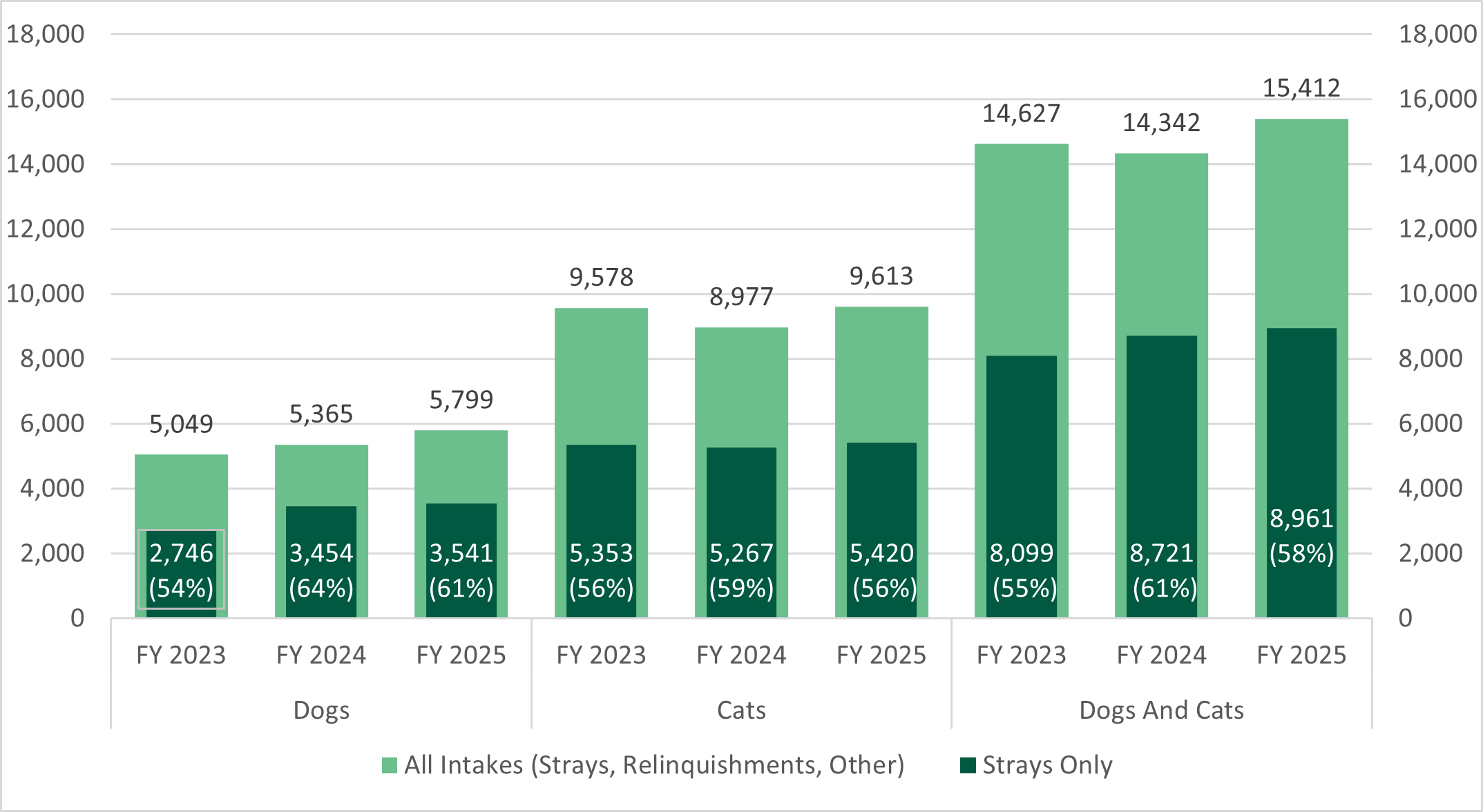
According to figures reported by ACC, the percentage of stray dogs and cats that made up the total animal intake increased from 55.4% in FY 2023 to 60.8% in FY 2024, then slightly decreased to 58.1% in FY 2025. This shows that stray dogs and cats consistently remained the primary source of the total shelter intakes during this three-year period.
The number of dogs in shelter grew steadily from 5,049 to 5,799 between FY 2023 and FY 2025, but the number of strays that entered shelter jumped significantly from 2,746 (54%) to 3,454 (64%) between FY 2023 and FY 2024, before flattening in FY 2025.
The number of cats in shelter decreased from 9,578 in FY 2023 to 8,977 in FY 2024 and grew to 9,613 in FY 2025. The percentage of stray cats of total cat intakes was 56% in FY 2023. This grew to 59% in FY2024 and then dropped to 56% in FY 2025.
A breakdown showing the stray intake figures for the three fiscal years are found in Chart 1 below:
Chart 1. Trends in Stray Intake of Dogs and Cats: FYs 2023 through 2025
Trends in Owner Relinquishments
ACC data shows that owner relinquishments for dogs decreased by 18% in FY 2024 (dropping from 2,293 in FY 2023 to 1,876 in FY 2024) before increasing by 19% in FY 2025 (rising to 2,235). Similarly, owner relinquishments for cats experienced a 13% decrease in FY 2024 (dropping from 4,150 in FY 2023 to 3,629 in FY 2024) before increasing by 13% in FY 2025 (rising to 4,110).
Overall, for the three-year period, owner relinquishments represent a significant portion of the total intakes, accounting for 44% of total intakes in FY 2023, 38% in FY 2024, and 41% in FY 2025. Additionally, owner relinquishments accounted for an average of 40% of all dog intakes and 42% of all cat intakes during the same period.
A breakdown showing owner relinquishment figures for the three fiscal years are found in Chart 2 below:
Chart 2. Trends in Owner Relinquishments for Dogs & Cats: FYs 2023 through 2025
A national study published in September 2024 in the journal Animals, “Investigating the Reasons behind Companion Animal Relinquishment: A Systematic Content Analysis of Shelter Records for Cats and Dogs, 2018-2023,” analyzed 2,836 randomly selected owner relinquishment records over the six-year period to determine why owners surrender their pets.[34] The study found the following most frequent factors contributing to owner relinquishment: behavioral issues (28%), housing/moving (18%), inability to care (16%), too many pets (10%), financial (6%), and owner allergies (5%). Additionally, the study highlights that behavior problems account for nearly 60% of re-relinquishments (returns) after being adopted. These figures suggest that intake is not merely a result of stray animals, but a failure of retention support for owned animals.
The study also details common behavioral reasons for owner relinquishment, such as aggression (32%), social conflict (28%), house soiling (13%), excessive energy (9%), and destructive behaviors (6%). Additionally, the study notes demographic trends: dogs are more frequently surrendered for behavioral issues (35%), while cats are often surrendered based on “too many pets” (16%).
The study found that an average of 3,109 dogs and 3,357 cats entered shelters each year during the six-year period due to owner relinquishments. While there was no significant increase in owner relinquishments attributed to financial or housing pressures during the pre-pandemic period, the study documents an increase in 2022 and 2023 compared to pre-pandemic rates because owners were otherwise unable to care for their pets.
The review team notes that the data regarding stray intake, shelter euthanasia, and owner relinquishments is reported in summary format only by ACC; data specific to zip codes or neighborhoods is not reported. ACC does not publicly report reason for owner relinquishment, but this information would help inform the overall issue.
PART III: Other Potential Approaches
Trap-Neuter-Return Programs (TNR)
New York City has an active network of participants (including independent volunteer caretakers, not-for-profit organizations/rescue groups, and animal welfare advocates) that provide TNR for community cats.[35] These include feral cats (i.e., animals that were never owned, were born and raised in the wild, had little to no human contact, are fearful of people, and are unlikely to adapt to the indoors) and stray cats (i.e., previously owned animals that are either lost or abandoned). Under the TNR method, community cats are trapped, sterilized (identified through a clipped ear-tip), vaccinated for rabies, and released back to the areas on the streets where they were trapped. Proponents of TNR argue that by sterilizing cats, the network halts reproduction and mating-related nuisance behaviors while reducing the spread of illnesses like rabies.
TNR programs are of particular interest because shelter intake statistics reported by ACC indicate that stray cats far outnumber stray dogs in the City by almost two to one. During FYs 2023 through 2025, stray cats accounted for 16,040 (62%) of all strays taken in by ACC.
Some critics of TNR argue that the management of these colonies across the five boroughs has exceeded the capacity of independent volunteers and not-for-profit organizations to handle without City investment, and that colonies remain mostly unmanaged, contributing to complaints, disease risks, and public health concerns.
Proponents argue that a coordinated, City-backed strategy to sterilize community cats would help mitigate these concerns.
While DOHMH’s website lists not-for-profit organizations that offer TNR information and facilitate TNR activities, it specifically states that it does not endorse, inspect, regulate, or monitor the organizations that are involved with TNR.
The ASPCA, Flatbush Cats, and the Brooklyn Bridge Animal Welfare Coalition/Brooklyn Cat Café provide free and low-cost spaying and neutering services to TNR rescuers. Flatbush Cats, located in Brooklyn, began in 2017 as a small TNR rescue group that focused on reducing and managing the outdoor cat population. In August 2023, the organization opened Flatbush Veterinary Clinic to provide low-cost spaying and neutering services to both pet owners and rescuers.[36] The Brooklyn Cat Café, which opened in 2016, is run by the Brooklyn Bridge Animal Welfare Coalition, an organization founded in 2007 with a mission to rescue and place animals for adoption. In 2021, the group also opened a rescue clinic offering low-cost spaying and neutering services to pet owners and rescuers. The ASPCA provides free spaying and neutering services to eligible pet owners and TNR rescuers.[37]
The review team contacted these organizations to obtain the number of active TNR rescuers registered with each group; the number of spaying and neutering TNR surgeries performed; and the amount spent (either “out-of-pocket” or via private donations) for FYs 2023 through 2025.[38] Based on the data collected, the total amount spent on privately-funded TNR sterilization services—costs not covered by any City contract—was nearly $3 million across a network of approximately 2,381 TNR rescuers.[39] Table 5 below summarizes the results in more detail.
Table 5. Approximate Number of Active TNR Rescuers & Approximate Amount Spent on Spaying and Neutering Services FYs 2023 – 2025
| Non-Profit Organization Providing Free or Low-Cost Surgeries to TNR Rescuers | Approximate # of Active TNR Rescuers Registered with the Non-Profit Organization | # of TNR Spaying & Neutering Surgeries Performed by the Non-Profit Organization | Approximate Amount Spent on TNR Surgeries | Average Cost Per Surgery |
|---|---|---|---|---|
| Flatbush Cats | 828 | 2,252 | $263,954.12 | $117.21 |
| Brooklyn Cat Café | 553 | 4,659 | $512,490.00 | $110.00 |
| ASPCA | 1,000 | 17,300 | $2,162,500.00 | $125.00 |
| Totals/Weighted Average | 2,381 | 24,211 | $2,938,944.12 | $121.39 |
Note 1: ASPCA surgeries are funded by private donations (no fees to rescuers), while Flatbush Cats and Brooklyn Cat Café rely on rescuer fees to cover costs.
Note 2: The data for Flatbush Cats (non-profit organization) covers the period of August 26, 2023 through July 30, 2025.
As shown in Table 5 above, most TNR surgeries were performed by the ASPCA, representing 17,300 (71%) of all surgeries performed by the three organizations. At an average cost of $125.00 per surgery, the ASPCA subsidizes these services entirely through private donations, without City reimbursement. While smaller neighborhood-based organizations like Flatbush Cats and Brooklyn Cat Café together managed 6,911 surgeries (equivalent to 40% of the ASPCA’s output) at a lower weighted average cost of $112.35, they are forced to pass these costs onto rescuers due to insufficient donor funding. Ultimately, the total private expenditure of nearly $3 million underscores a significant financial burden that is currently being absorbed by the private sector rather than the City.
The review team found that one of the municipalities they contacted emphasized the importance of TNR rescuers in reducing the community cat population. An Animal Care Services representative in San Antonio (Texas) stated that the TNR method is “huge” and is funded by San Antonio’s General Fund.
The review team identified a widespread consensus among stakeholders that TNR should be incorporated in New York State law. An attempt was made in January of 2015 to amend the State law and include TNR as part of the New York State’s animal population control measures. The bill, which was passed by the legislature, allowed not-for-profit organizations to provide low-cost spaying and neutering services not only to qualified dog and cat owners but also to community-based initiatives aimed at “trapping, neutering, vaccinating, and releasing feral cats.” The stipulation was that these services had to be performed by veterinarians licensed in New York State.
In October 2015, the New York State Governor at the time vetoed this bill, citing concerns that TNR programs are not effective at reducing community cat populations and that these animals pose a significant risk to wildlife (e.g., predation, competition for resources), especially threatened and endangered species. In addition, opponents of TNR also raised concerns about public health risks, such as the transmission of rabies.
Other cited limitations of TNR include high sterilization thresholds, slow population decline, immigration and the “vacuum effect”—when new, unsterilized cats move into a managed area, offsetting the benefits of TNR—and limited large-scale success. Conversely, the ASPCA supported the bill, arguing that TNR is the only humane method for stabilizing and reducing community cat populations. The ASPCA also argued that sterilized cats cause less noise, engage in less fighting, have lower cancer risks—noting that spayed female cats attract fewer roaming male cats.[40]
While historical efforts focused on amending New York State law to include TNR in the State’s Animal Population Control Program, Section 17-809 of the City Administrative Code already grants DOHMH authority to implement additional services to facilitate the decline in numbers of unwanted and uncared for animals and institute a local population control strategy such as TNR. DOHMH has the existing regulatory authority to formalize and potentially fund community-based TNR initiatives within the City, regardless of the status of State-level legislation.[41]
In September 2025, the New York City Council approved $500,000 to expand spay/neuter services in its FY 2026 budget, including TNR programs.[42] These funds were allocated to Flatbush Cats and will pay for the sterilization of 3,500 cats for both TNR rescuers and pet owners. This demonstrates that City funds can significantly expand capacity, cover thousands of surgeries, and free up nonprofits to help more animals.
Increasing Enforcement and Tracking: Spaying/Neutering Law for Free-Roaming Cats
Section 17-804 of the City Administrative Code requires owners to spay or neuter cats permitted to roam outdoors to decrease unwanted reproduction. According to DOHMH, owners must be prepared to provide proof of sterilization to DOHMH if their cats are found roaming outside. The civil penalty for the violation is up to a maximum of $500 and offers another potential avenue for funding the Program.
According to DOHMH, they find out about pet owners who allow their cats to roam outdoors through complaints and referrals from elected officials and animal advocates. DOHMH conducts inspections in response to complaints and referrals, during which they observe the cat outdoors and identify the owner before issuing a summons.
However, DOHMH informed the review team that, based on their records, only five such violations were issued during FYs 2023 through 2025.
At the September 2024 City Council hearing on animal welfare, DOHMH was asked to provide an estimate of the number of requests for proof of sterilization made in the past year to pet owners whose cats were found roaming outdoors. DOHMH responded that it is not part of their protocol to track this type of data, although they do collect such information when summonses are issued. DOHMH’s lack of tracking limits enforcement of the spaying and neutering law for free-roaming cats.
Furthermore, DOHMH’s enforcement is hindered by a lack of proactive public education. DOHMH does not advertise or conduct outreach campaigns regarding the sterilization requirements for free-roaming cats; instead, this information is only available on the DOHMH website. This passive approach places the burden of awareness entirely on the pet owners, so that many remain unaware of their legal obligations until a complaint is filed.
In the City, residents can make complaints via the NYC311 website or by calling 311. Data from these complaints is then published on the NYC Open Data portal. However, free-roaming cats is not a standalone category for these complaints to be recorded. The review team attempted to determine the number of complaints related to free-roaming cats but was unable to do so because no specific category exists. Input for the 311 system is sourced from various City agencies, including DOHMH, which define the specific service requests they are equipped to handle. These definitions, in turn, shape the available complaint categories. By law (City Administrative Code Section 23-309), the 311 Customer Service Center must review and update its protocols for request and complaint types annually to ensure they accurately reflect City needs. To date, DOHMH has not established a dedicated category for free-roaming cats. This omission directly limits the City’s ability to track and address community cat issues through the 311 system.
Strategic Interventions to Reduce Owner-Relinquishments
As previously mentioned, the study highlighted the multifaceted reasons for the relinquishment of companion animals to shelters. It emphasized the significant role of animal behavioral issues and the varied nature of human-related factors such as housing and financial constraints, and personal circumstances like the inability to care for pets or having too many pets. The findings provide valuable insights for animal welfare organizations and policymakers to develop strategies to better understand animal relinquishment and improve the welfare of both animals and their owners.
Notably, the findings underscore the need for targeted interventions aimed at addressing challenging behaviors, which were particularly prevalent among returned animals. This suggests that post-adoption support, behavioral training, or extending foster care stays could effectively reduce readmission rates. Furthermore, the increase in relinquishments due to an inability to care for animals points to the broader impact of societal changes, potentially exacerbated by post-pandemic trends. The study also suggests that education and pre-adoption counseling regarding limits on the number of animals in one’s household could also be beneficial in reducing the shelter intake attributed to owners having too many pets.
According to the article “How to Build a Pet Retention Program That Works,” published by 24Pet in January 2026, effective pet retention programs shift the focus from intake at the shelters to prevention.[43] Key recommendations include:
- Financial assistance: Providing vouchers for emergency veterinary care, pet food pantries, or temporary housing stipends.
- Behavioral support: Offering helplines and access to certified trainers to handle challenges before they escalate.
- Community outreach: Creating multilingual flyers or social media campaigns to spread awareness about available pet assistance.
While the City currently allocates over $53 million annually to post-intake sheltering care, the primary drivers of intake could arguably be reduced through community-based interventions. Transitioning to a proactive model that funds retention support would reduce the fiscal dependency on high-cost shelter housing.
Other Suggestions from Survey Respondents for Reducing the Stray Animal Population
Survey respondents were asked an open-ended question regarding whether they had any suggestions on how the City could reduce the number of stray dogs and cats.[44] Their suggestions included the following:
- Require all pets (both cats and dogs) to be licensed annually and impose penalties for abandonment. Additionally, publicize that abandonment is a form of cruelty with fines and possible legal consequences, which may deter neglect.
- There should be programs provided within City schools, as well as workshops in community centers, to teach about empathy, care, and the responsibilities of owning a pet and to spread awareness about pet abandonment. Additionally, there should be more public service announcements about pet care and the dangers of overpopulation.
- For community cats, there should be more TNR efforts, which should be supported to “humanely control stray populations while avoiding euthanasia.” One respondent stated that “discounts and tax breaks” should be provided to rescuers who use their own funds to care for community cats. The respondent further stated that the City “is not doing enough. ASPCA is only available to low income in certain zip codes [f]orcing us to go to private vets and paying ‘out of pocket’ for a stray cat.”
- Another respondent, who was a TNR rescuer, stated that the ASPCA has reduced the number of appointment spots available for rescuers to get trapped community cats sterilized for free. Thus, they had to go to a private veterinarian and paid “out of pocket” to get the community cats sterilized, adding that the costs could be as high as $1,000 per cat.
- Work with landlords to encourage more pet-friendly housing options so fewer animals are surrendered when tenants move.
- Provide information about local animal shelters, foster networks, or temporary boarding to owners experiencing housing, financial, or health crises so they don’t abandon pets.
- Increase the number of available appointment slots at the ASPCA for eligible New Yorkers to receive free or low-cost spaying and neutering services. One respondent stated that in their borough there were not enough zip codes offered by the ASPCA for eligible resident pet owners to get their animals sterilized via the mobile units. Another respondent stated that they are low-income and live in a “good neighborhood,” but never sees the mobile units in their neighborhood and had to go to a private veterinarian and pay a lot of money. Furthermore, one comment from a respondent highlighted the need to increase the number of animal clinics providing spaying and neutering services (more available resources).
Overall, respondents suggested that the City must increase accessibility to affordable sterilization services, enhance public awareness campaigns through schools and media, support TNR rescuers, and strengthen enforcement of existing pet licensing and abandonment laws to effectively reduce stray animal populations. DOHMH stated that they will explore attending the ASPCA’s clinics on surgery days to gauge New Yorkers’ experience and DOHMH’s impact on communities.
Strategic Policy Recommendations from the 2024 City Council Hearing: Addressing Animal Welfare Crisis
The testimony during the September 13, 2024 City Council hearing focused on shelter overpopulation. Testimony included several recommendations to address “upstream” causes of animal homelessness. There appeared to be consensus concerning these approaches:
- Targeted High-Volume Spay/Neuter Funding—Several stakeholders called for high-volume, low-cost sterilization, as the most effective way to prevent animals from entering the shelter system in the first place, specifically highlighting the need to fund and expand TNR programs to manage the outdoor community cat population, which reportedly rose nearly 10% in early 2024.
- The hearing called for an overhaul of the City’s spay/neuter reimbursement system under the Program, which advocates claim is currently a “bottleneck” because many veterinarians do not accept the low City reimbursement rates offered under the ASPCA contract with DOHMH. It was recommended that the Program transition from a passive reimbursement system to a high-quality, high-volume spay/neuter program that actively funds mobile clinics and high-capacity non-profit organizations. Additionally, stakeholders called for TNR to target high-density “hot spots.”
- Legislative Reform on Pet Sales—The hearing discussed conforming local laws to a New York State law that prohibits the sale of dogs and cats in retail pet shops, to stop the influx of dogs from “puppy mills.” Furthermore, anyone selling such animals to the public in the City must obtain a DOHMH permit, and, if they meet state volume thresholds, a New York State pet dealer license. This law was subsequently enacted by City Council and took effect on December 15, 2024.
- Full-Service Shelters in All Boroughs—Reiteration of the mandate for full-service animal shelters in all five boroughs to ensure equitable access to surrender prevention services.
- Reporting and Accountability—A proposed bill discussed during the hearing would require DOHMH to issue monthly public reports on contracted shelters. These reports would categorize animal health status (e.g., healthy vs. treatable) and track outcomes like euthanasia and adoptions more transparently.
- Structural Change: Department of Animal Welfare—There was significant testimony advocating for the creation of a dedicated City Department of Animal Welfare. This proposal seeks to move animal welfare oversight from DOHMH into a new, specialized City department. Council members and advocates criticized DOHMH for its oversight of ACC, suggesting that animal welfare is often secondary to the agency’s primary public health focus.
- Safety Net and Retention Support—The hearing discussed keeping pets and people together by providing pet owners with resources to prevent surrenders due to financial or housing instability.
- Financial and Community Support Systems—Council members proposed establishing City-supported pet food pantries to prevent surrenders driven by food insecurity. Additionally, ACC advocated for a dedicated fund to provide one-time medical or behavioral crisis grants to pet owners as an alternative to surrender.
- New York City Housing Authority (NYCHA) Specific Services—Recommendations included proactive, on-site veterinary and sterilization clinics within NYCHA developments to address the high concentration of community cats in public housing.
- Expanding the Scope of the Program Fund—Suggestions were made to use Program surcharges to fund capital improvements (e.g., surgical equipment, mobile vans) for clinics that commit to serving low-income zip codes.
- New Protections for Pet Owners—At the hearing, a proposed bill was discussed regarding paid sick time for pet care which would allow New Yorkers to use their accrued sick leave to care for a “covered animal” (service or companion pet) that needs medical diagnosis or preventative care.
- Public Awareness and Marketing—It was discussed that many New Yorkers do not know about the Program, and advocates recommended a Citywide educational campaign to promote the Program and the benefits of adopting from municipal shelters.
Recommendations
Based on this review, the review team has identified several areas for improvement. DOHMH should:
- Spearhead a re-evaluation of the City’s overall approach to animal population control and develop a new strategy for reducing all major drivers of animal shelter intake across the City, including an evaluation of what resources are needed to reduce dependence and spending on shelter services.
DOHMH Response: DOHMH disagreed with this recommendation, stating that the City has a robust animal population control and animal welfare program, including work conducted by [DOHMH] that is routinely updated to match changing conditions. A ‘re-evaluation’ is not needed.”
Review Team Comment: The fact remains that DOHMH’s overall efforts to control animal population outside of the shelter setting is minor. Fiscally, the City spends almost $54 million a year on shelter programs (and commits the City to approximately $2 billion over 30 years) and relatively little on identifiable animal population control measures. DOHMH provided no evidence at any point during the review of additional programming dedicated to addressing the root causes of animal shelter population.
- Require ACC to track the causes of intakes based on owner relinquishments and develop strategies for reducing this source of shelter intake.
DOHMH Response: DOHMH disagreed with this recommendation as “not needed” and asserts that ACC also tracks this data.
Review Team Comment: DOHMH provides no evidence to support its assertions – this was generally true of its responses. Notably, if this data is collected, it is not published and was not provided to the review team during the review. ACC should publish the data in the interest of transparency.
- Focus on reducing community cat populations by considering a range of new options, including a formal assessment of the viability of introducing City-funded TNR programs with appropriate oversight and control measures.
DOHMH Response: DOHMH disagreed with this recommendation as “not needed.” The agency response relies on a 10-year old veto of New York State legislation in support of TNR.
Review Team Comment: The review recommends an updated assessment of TNR and other possible approaches to addressing the shelter population of cats, which remains roughly double that of dogs. DOHMH should consider all possible options, including TNR programs, to reduce community cat populations.
- Improve public awareness and enforcement of free-roaming cat regulations, including a formal system to track and document enforcement-related activities for pet owners whose cats are found to be roaming outside. DOHMH should exercise its authority under Section 23-309 to establish a specific 311 service request category for free-roaming cats.
DOHMH Response: DOHMH disagreed with this recommendation as “not needed,” stating that the agency enforces the free-roaming cat sterilization law and that the low volume of related complaints and violations is not enough to justify investment in the creation of a new 311 complaint category.
Review Team Comment: DOHMH provided no evidence of its efforts to enforce free-roaming cat regulations and provided no indication of the cost involved in modifying tracking of 311 data, so the review team is unable to evaluate its response.
- Develop a strategic plan to ensure that dog licensing outreach and education events are appropriately distributed across all five boroughs to improve awareness Citywide and increase dog licensing rates.
DOHMH Response: DOHMH disagreed with this recommendation as “not needed,” stating that the agency “conducts outreach and education regarding the dog licensing requirement as funding allows” and that increasing revenue from the dog licensing fee “could support expanded outreach and education.”
Review Team Comment: The review stands by its conclusions and the need for a formalized strategy to target neighborhoods with the lowest dog licensing rates in each borough. DOHMH’s resistance to expanding outreach is puzzling given its acknowledgement that expanding outreach could increase the fees it relies on to support this Program.
- Explore additional funding avenues as permitted under Section 17-811, including by petitioning the City Council to amend Section 17-812 (Animal Population Control Fund) to add mandatory revenue streams to support the Program.
DOHMH Response: DOHMH agreed with this recommendation.
- Develop, formalize, and implement a monitoring plan for the ASPCA contract and establish specific, clear, and measurable key performance indicators that are publicly reported and that support an overall effectiveness of the Program.
DOHMH Response: Although DOHMH stated that this recommendation is “not needed,” the response indicates partial agreement in that it agreed to “formalize a monitoring plan that is consistent with the contract scope of services and can consider making spay neuter numbers public.”
- Ensure that the ASPCA submits required reports for a lower-than-expected number of sterilization surgeries.
DOHMH Response: Although DOHMH stated that it partially agrees with this recommendation, the response “acknowledges that the number of sterilization surgeries has been lower than budget” and “generally agrees with the recommendation to increase reporting on performance measures and will work with the ASPCA to ensure compliance with all contractual reporting requirements.”
- Consider conducting surveys on a periodic basis of New York residents to help determine the effectiveness of the Program in reducing the unwanted stray animal population and to identify areas for improvement.
DOHMH Response: DOHMH disagreed with this recommendation, stating it “will continue to rely on shelter intake data, licensing statistics, and other quantitative measures to assess Program effectiveness.”
Review Team Comment: While shelter intake and dog licensing data provide valuable internal metrics, they cannot identify the community-specific barriers, such as geographic gaps in service or lack of public awareness, Consequently, the review team urges DOHMH to reconsider its response.
Recommendations Follow-up
Follow-up will be conducted periodically to determine the implementation status of each recommendation contained in this report. Agency-reported status updates are included in the Audit Recommendations Tracker available at:
https://comptroller.nyc.gov/services/for-the-public/audit/audit-recommendations-tracker/
Appendix I
Geographic Distribution of 3,600 Sterilization Surgeries Across 128 Zip Codes: FYs 2023 – 2025
| Borough | Zip Code | Neighborhoods | Median Household Income | # of Spaying/Neutering Surgeries Performed | Percentage of Total Surgeries Performed |
|---|---|---|---|---|---|
| Bronx | 10451 | Mott Haven and Concourse | $38,770 | 185 | 5.1% |
| Bronx | 10456 | Morrisania and Melrose | $34,954 | 185 | 5.1% |
| Bronx | 10459 | Longwood and Foxhurst | $38,006 | 121 | 3.4% |
| Bronx | 10457 | Belmont, East Tremont, and Tremont | $42,683 | 113 | 3.1% |
| Bronx | 10455 | Mott Haven | $36,115 | 105 | 2.9% |
| Bronx | 10473 | Soundview, Clason Point, and Castle Hill | $52,462 | 98 | 2.7% |
| Bronx | 10460 | West Farms, Crotona, and Van Nest | $36,309 | 88 | 2.4% |
| Bronx | 10452 | Highbridge, Morris Heights, and Mount Eden | $41,288 | 84 | 2.3% |
| Bronx | 10454 | Mott Haven | $24,086 | 81 | 2.3% |
| Bronx | 10458 | Fordham, Bedford Park, Belmont, and Jerome Park | $40,800 | 81 | 2.3% |
| Bronx | 10472 | Soundview, Parkchester, and Unionport | $41,039 | 78 | 2.1% |
| Bronx | 10453 | Fordham, Morris Heights, Tremont, and University Heights | $33,186 | 74 | 2.1% |
| Bronx | 10467 | Williamsbridge, Norwood, Allerton, and Fordham | $49,330 | 62 | 1.7% |
| Bronx | 10468 | Fordham, University Heights, Bedford Park, Kingsbridge, Morris Heights, and Tremont | $46,233 | 38 | 1.1% |
| Bronx | 10462 | Parkchester, Morris Park, Pelham Parkway, and Castle Hill | $60,966 | 36 | 1.0% |
| Bronx | 10466 | Wakefield, Williamsbridge, Eastchester, and Edenwald | $65,969 | 32 | 0.9% |
| Bronx | 10474 | Hunts Point | $41,586 | 26 | 0.7% |
| Bronx | 10469 | Pelham Gardens, Allerton, Williamsbridge, and Baychester | $76,020 | 25 | 0.7% |
| Bronx | 10461 | Pelham Bay, Morris Park, and Westchester Square | $67,028 | 23 | 0.6% |
| Bronx | 10465 | Throggs Neck, Country Club, and Edgewater Park | $87,985 | 19 | 0.5% |
| Bronx | 10463 | Kingsbridge, Riverdale, Spuyten Duyvil, and Marble Hill | $74,974 | 16 | 0.4% |
| Bronx | 10475 | Co-op City and Eastchester | $62,712 | 9 | 0.3% |
| Bronx | 10470 | Woodlawn Heights and Wakefield | $90,046 | 2 | 0.1% |
| Bronx | 10471 | Riverdale and Fieldston | $103,046 | 1 | 0.0% |
| Subtotal Bronx | 1,582 | 43.80% | |||
| Brooklyn | 11207 | East New York, Bushwick, and Brownsville | $56,523 | 289 | 8.0% |
| Brooklyn | 11212 | Brownsville | $41,355 | 215 | 6.0% |
| Brooklyn | 11208 | East New York and Cypress Hills | $62,077 | 205 | 5.7% |
| Brooklyn | 11236 | Canarsie, Starrett City (Spring Creek), Georgetown, and Flatlands | $81,464 | 84 | 2.3% |
| Brooklyn | 11233 | Bedford-Stuyvesant, Ocean Hill, Brownsville, and Crown Heights | $62,411 | 46 | 1.3% |
| Brooklyn | 11220 | Sunset Park and Bay Ridge | $69,883 | 41 | 1.1% |
| Brooklyn | 11221 | Bushwick and Bedford-Stuyvesant | $85,736 | 41 | 1.1% |
| Brooklyn | 11239 | East New York, Starrett City, Canarsie, and Flatlands | $38,015 | 41 | 1.1% |
| Brooklyn | 11206 | Bushwick and Bedford-Stuyvesant | $61,430 | 34 | 0.9% |
| Brooklyn | 11216 | Bedford-Stuyvesant and Crown Heights | $101,277 | 26 | 0.7% |
| Brooklyn | 11224 | Coney Island and Sea Gate | $43,648 | 25 | 0.7% |
| Brooklyn | 11226 | Flatbush, Midwood, Kensington, and East Flatbush | $81,014 | 24 | 0.7% |
| Brooklyn | 11213 | Crown Heights, Bedford-Stuyvesant, and Wingate | $65,127 | 23 | 0.6% |
| Brooklyn | 11237 | Bushwick | $85,196 | 23 | 0.6% |
| Brooklyn | 11235 | Brighton Beach, Sheepshead Bay, Manhattan Beach, Gravesend, and Gerritsen Beach | $59,661 | 18 | 0.5% |
| Brooklyn | 11214 | Bensonhurst, Bath Beach, and Gravesend | $65,895 | 17 | 0.5% |
| Brooklyn | 11229 | Sheepshead Bay, Marine Park, Mill Basin, Gerritsen Beach, Midwood, and Homecrest | $70,603 | 17 | 0.5% |
| Brooklyn | 11225 | Crown Heights, East Flatbush, and Prospect Lefferts Gardens | $88,568 | 16 | 0.4% |
| Brooklyn | 11234 | Marine Park, Mill Basin, Bergen Beach, and Flatlands | $97,479 | 15 | 0.4% |
| Brooklyn | 11209 | Bay Ridge and Fort Hamilton | $93,854 | 14 | 0.4% |
| Brooklyn | 11203 | East Flatbush | $67,897 | 13 | 0.4% |
| Brooklyn | 11223 | Gravesend and Sheepshead Bay | $63,368 | 12 | 0.3% |
| Brooklyn | 11218 | Kensington and Windsor Terrace | $97,366 | 11 | 0.3% |
| Brooklyn | 11204 | Bensonhurst and Borough Park | $69,479 | 9 | 0.3% |
| Brooklyn | 11210 | Midwood and East Flatbush | $83,692 | 9 | 0.3% |
| Brooklyn | 11232 | Greenwood Heights and Sunset Park | $90,891 | 7 | 0.2% |
| Brooklyn | 11201 | Brooklyn Heights, Downtown Brooklyn, DUMBO, and Cobble Hill | $173,136 | 6 | 0.2% |
| Brooklyn | 11217 | Boerum Hill, Park Slope, Prospect Heights, and Downtown Brooklyn | $162,863 | 6 | 0.2% |
| Brooklyn | 11219 | Borough Park | $58,347 | 6 | 0.2% |
| Brooklyn | 11228 | Dyker Heights | $83,665 | 6 | 0.2% |
| Brooklyn | 11205 | Clinton Hill, Fort Greene, and Beford-Stuyvesant | $93,887 | 5 | 0.1% |
| Brooklyn | 11211 | Williamsburg | $107,506 | 5 | 0.1% |
| Brooklyn | 11215 | Park Slope, Gowanus, South Slope, and Windsor Terrace | $185,865 | 5 | 0.1% |
| Brooklyn | 11231 | Red Hook and Carroll Gardens | $139,930 | 5 | 0.1% |
| Brooklyn | 11238 | Prospect Heights, Crown Heights North, and Clinton Hill | $134,523 | 4 | 0.1% |
| Brooklyn | 11230 | Midwood and Flatbush | $70,027 | 3 | 0.1% |
| Brooklyn | 11222 | Greenpoint | $125,734 | 2 | 0.1% |
| Brooklyn | 11249 | Williamsburg | $123,047 | 2 | 0.1% |
| Subtotal Brooklyn | 1,330 | 36.90% | |||
| Queens | 11106 | Astoria | $84,867 | 70 | 1.9% |
| Queens | 11102 | Astoria | $96,617 | 45 | 1.3% |
| Queens | 11101 | Long Island City | $121,062 | 32 | 0.9% |
| Queens | 11368 | Corona | $72,270 | 32 | 0.9% |
| Queens | 11691 | Far Rockaway and Edgemere | $56,135 | 31 | 0.9% |
| Queens | 11373 | Elmhurst | $71,480 | 28 | 0.8% |
| Queens | 11369 | East Elmhurst, Jackson Heights, and Corona | $80,297 | 22 | 0.6% |
| Queens | 11103 | Astoria | $93,324 | 19 | 0.5% |
| Queens | 11377 | Woodside | $73,073 | 11 | 0.3% |
| Queens | 11370 | East Elmhurst | $76,009 | 10 | 0.3% |
| Queens | 11372 | Jackson Heights | $78,606 | 10 | 0.3% |
| Queens | 11692 | Arverne and Edgemere | $49,720 | 10 | 0.3% |
| Queens | 11105 | Astoria | $102,012 | 7 | 0.2% |
| Queens | 11693 | Far Rockaway and Broad Channel | $68,449 | 7 | 0.2% |
| Queens | 11694 | Rockaway Park, Belle Harbor, and Neponsit | $111,011 | 7 | 0.2% |
| Queens | 11385 | Ridgewood and Glendale | $88,838 | 4 | 0.1% |
| Queens | 11423 | Hollis and Holliswood | $80,054 | 4 | 0.1% |
| Queens | 11434 | South Jamaica, St. Albans, Rochdale, and Springfield Gardens | $77,598 | 4 | 0.1% |
| Queens | 11367 | Kew Gardens Hills and Flushing | $75,061 | 3 | 0.1% |
| Queens | 11418 | Richmond Hill, Jamaica, and Kew Gardens | $90,156 | 3 | 0.1% |
| Queens | 11356 | College Point | $86,730 | 2 | 0.1% |
| Queens | 11358 | Auburndale, Broadway-Flushing, Flushing, and Murray Hill | $88,165 | 2 | 0.1% |
| Queens | 11374 | Rego Park | $90,631 | 2 | 0.1% |
| Queens | 11414 | Howard Beach, Lindenwood, and Hamilton Beach | $95,051 | 2 | 0.1% |
| Queens | 11416 | Ozone Park | $81,188 | 2 | 0.1% |
| Queens | 11420 | South Ozone Park | $100,006 | 2 | 0.1% |
| Queens | 11375 | Forest Hills | $105,904 | 1 | 0.0% |
| Queens | 11378 | Maspeth | $85,830 | 1 | 0.0% |
| Queens | 11419 | South Richmond Hill and Richmond Hill | $93,399 | 1 | 0.0% |
| Queens | 11421 | Woodhaven | $90,685 | 1 | 0.0% |
| Queens | 11429 | Queens Village | $102,880 | 1 | 0.0% |
| Queens | 11433 | Jamaica and South Jamaica | $77,519 | 1 | 0.0% |
| Queens | 11435 | Jamaica and Briarwood | $79,710 | 1 | 0.0% |
| Subtotal Queens | 378 | 10.70% | |||
| Staten Island | 10314 | New Springville, Bloomfield, Travis, Chelsea, Bulls Head, Heartland Village, Westerleigh, Castleton Corners, Manor Heights, and Graniteville | $104,613 | 43 | 1.2% |
| Staten Island | 10304 | Tompkinsville, Fox Hills, Park Hill, Stapleton, and Todt Hill | $71,561 | 33 | 0.9% |
| Staten Island | 10306 | New Dorp, Bay Terrace, Grant City, and Lighthouse Hill | $96,866 | 27 | 0.8% |
| Staten Island | 10303 | Mariners Harbor, Arlington, and Graniteville | $83,947 | 16 | 0.4% |
| Staten Island | 10310 | West Brighton and Port Richmond | $106,250 | 13 | 0.4% |
| Staten Island | 10305 | Arrochar, South Beach, Dongan Hills, Old Town, Rosebank, Shore Acres, and Midland Beach | $83,413 | 11 | 0.3% |
| Staten Island | 10302 | Port Richmond, Castleton Corners, Elm Park, Graniteville, Mariners Harbor, Meiers Corners, and Westerleigh | $78,263 | 10 | 0.3% |
| Staten Island | 10301 | St. George and Sunnyside | $85,609 | 5 | 0.1% |
| Staten Island | 10308 | Great Kills and Eltingville | $125,850 | 5 | 0.1% |
| Staten Island | 10309 | Charleston, Prince’s Bay, Pleasant Plains, Rossville, and Woodrow | $116,098 | 5 | 0.1% |
| Staten Island | 10307 | Tottenville | $147,184 | 2 | 0.1% |
| Staten Island | 10312 | Rossville, Woodrow, Arden Heights, Annadale, Eltingville, and Prince’s Bay | $110,719 | 2 | 0.1% |
| Subtotal Staten Island | 172 | 4.80% | |||
| Manhattan | 10029 | East Harlem and Upper East Side | $38,695 | 28 | 0.8% |
| Manhattan | 10035 | East Harlem and Randall’s Island | $45,121 | 17 | 0.5% |
| Manhattan | 10027 | Harlem and Morningside Heights | $59,587 | 15 | 0.4% |
| Manhattan | 10030 | Harlem | $39,802 | 11 | 0.3% |
| Manhattan | 10026 | Central Harlem and Morningside Heights | $81,244 | 10 | 0.3% |
| Manhattan | 10033 | Washington Heights and Hudson Heights | $75,040 | 9 | 0.3% |
| Manhattan | 10037 | Harlem, Central Harlem, East Harlem, and Morningside Heights | $49,153 | 8 | 0.2% |
| Manhattan | 10039 | Harlem | $45,371 | 8 | 0.2% |
| Manhattan | 10036 | Midtown West and Hell’s Kitchen | $95,638 | 5 | 0.1% |
| Manhattan | 10009 | East Village, Alphabet City, Stuyvesant Town, and Peter Cooper Village | $92,876 | 4 | 0.1% |
| Manhattan | 10031 | Hamilton Heights and West Harlem | $65,283 | 4 | 0.1% |
| Manhattan | 10032 | Washington Heights and Hamilton Heights | $56,829 | 4 | 0.1% |
| Manhattan | 10002 | Lower East Side and Chinatown | $48,386 | 3 | 0.1% |
| Manhattan | 10004 | Financial District, Battery Park City, Ellis Island, and Governors Island | $250,000+ | 3 | 0.1% |
| Manhattan | 10016 | Murray Hill and Kips Bay | $140,381 | 2 | 0.1% |
| Manhattan | 10028 | Upper East Side | $175,121 | 2 | 0.1% |
| Manhattan | 10001 | Chelsea, Koreatown, and Hudson Yards | $129,852 | 1 | 0.0% |
| Manhattan | 10013 | Tribeca, Chinatown, SoHo, and Little Italy | $161,154 | 1 | 0.0% |
| Manhattan | 10022 | Midtown East | $172,026 | 1 | 0.0% |
| Manhattan | 10025 | Upper West Side and Morningside Heights | $108,940 | 1 | 0.0% |
| Manhattan | 10034 | Inwood and Washington Heights | $67,754 | 1 | 0.0% |
| Subtotal Manhattan | 138 | 3.80% | |||
| Grand Total All Boroughs | 3,600 | 100.00% | |||
Note: The Citywide median household income is $81,228, according to the 2024 American Community Survey 1-Year Estimates data released by the United States Census Bureau in September 2025. Many of the zip codes listed above fall significantly below this Citywide benchmark.
Appendix II
Survey Results for Closed-Ended Questions Pertaining to Pet Ownership, Program Awareness, Stray Animals, and Dog Licensing
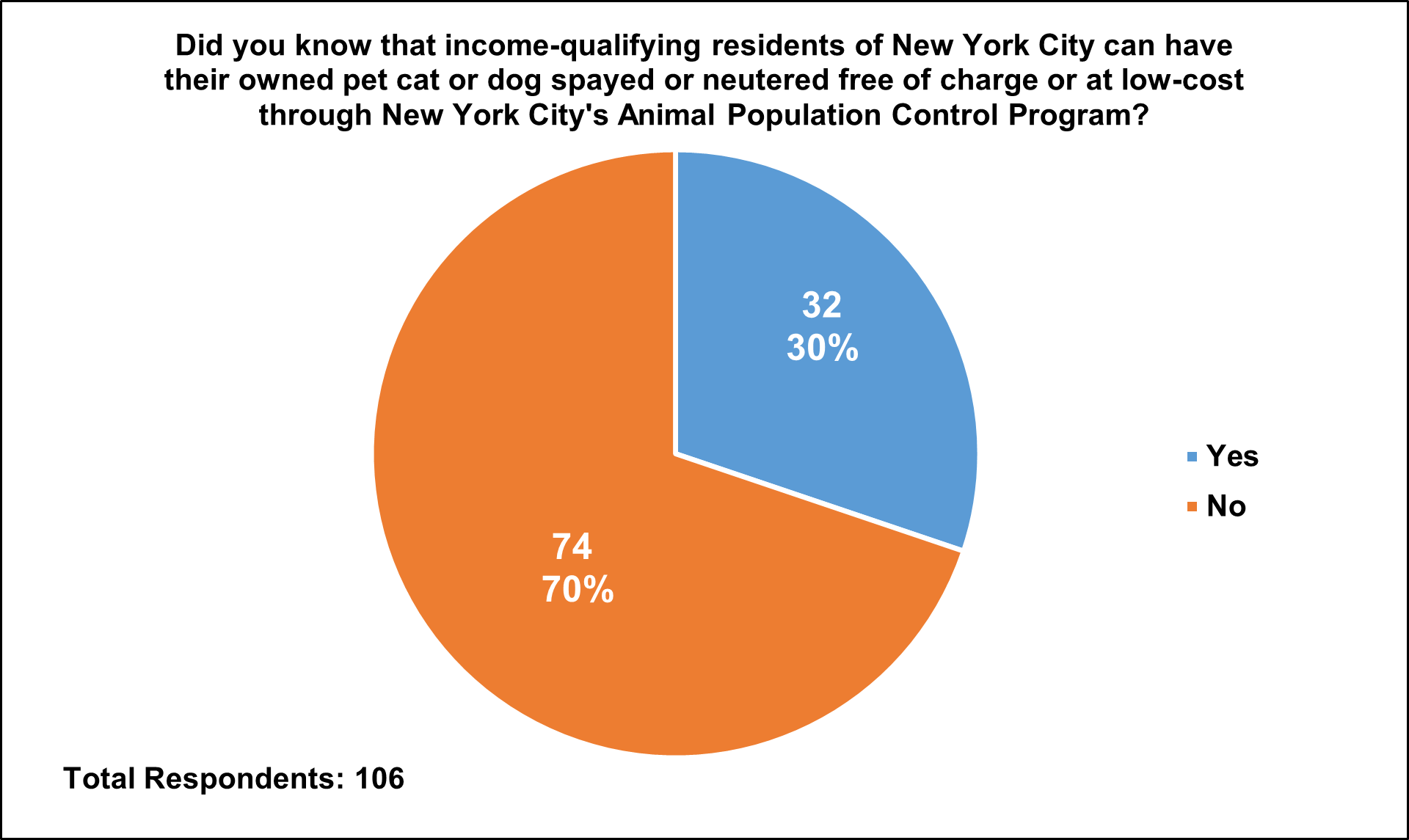
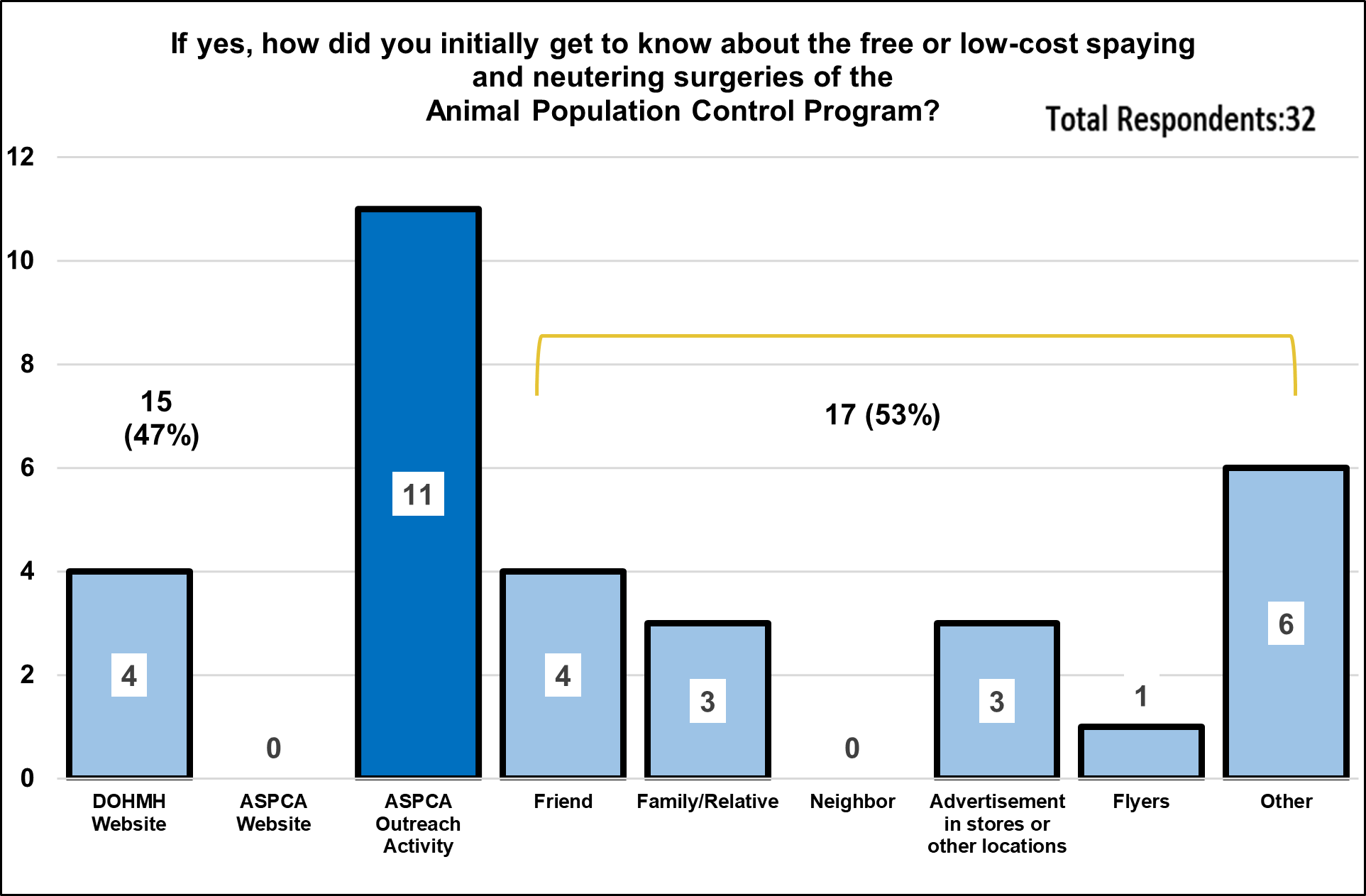
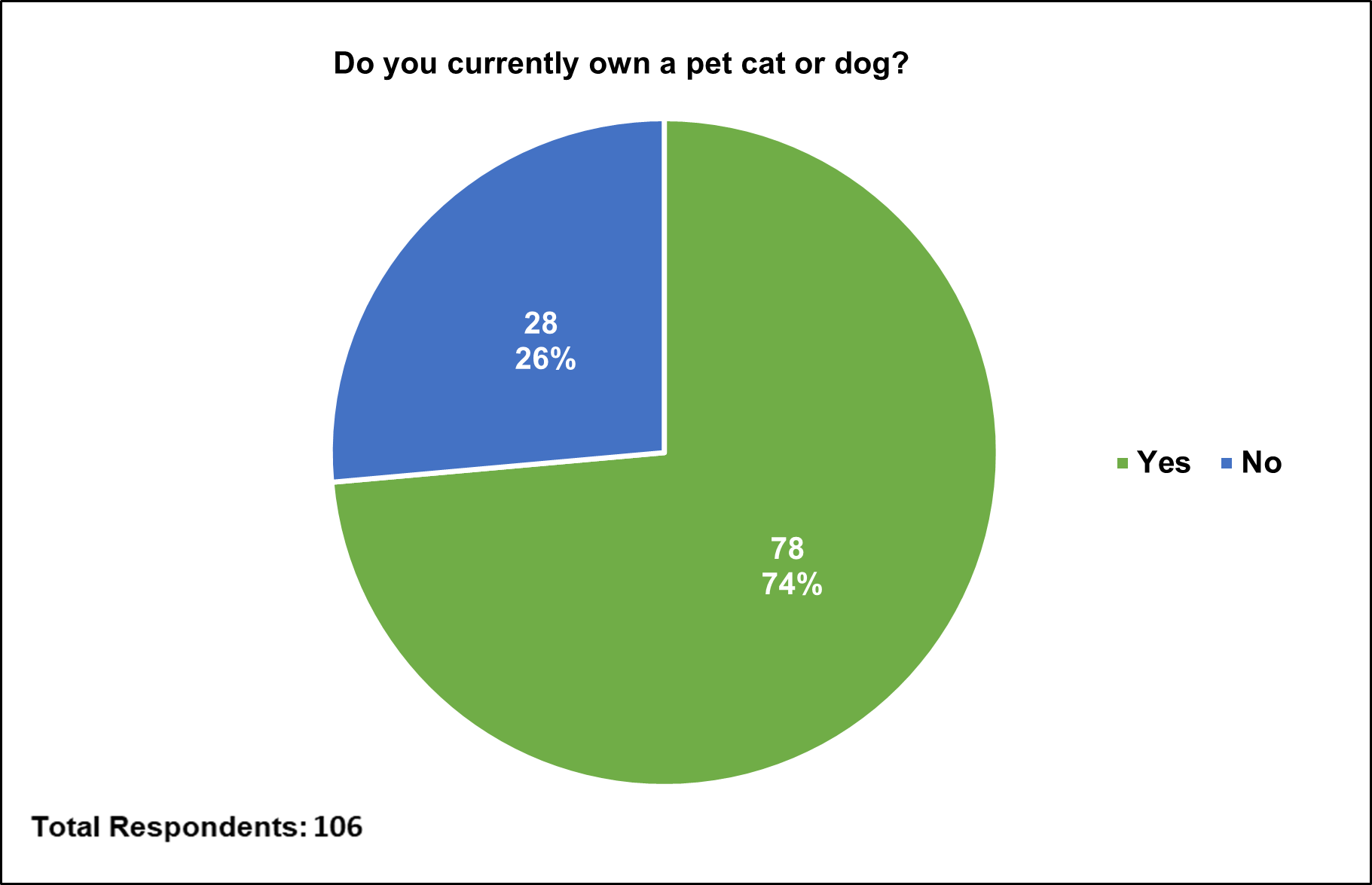
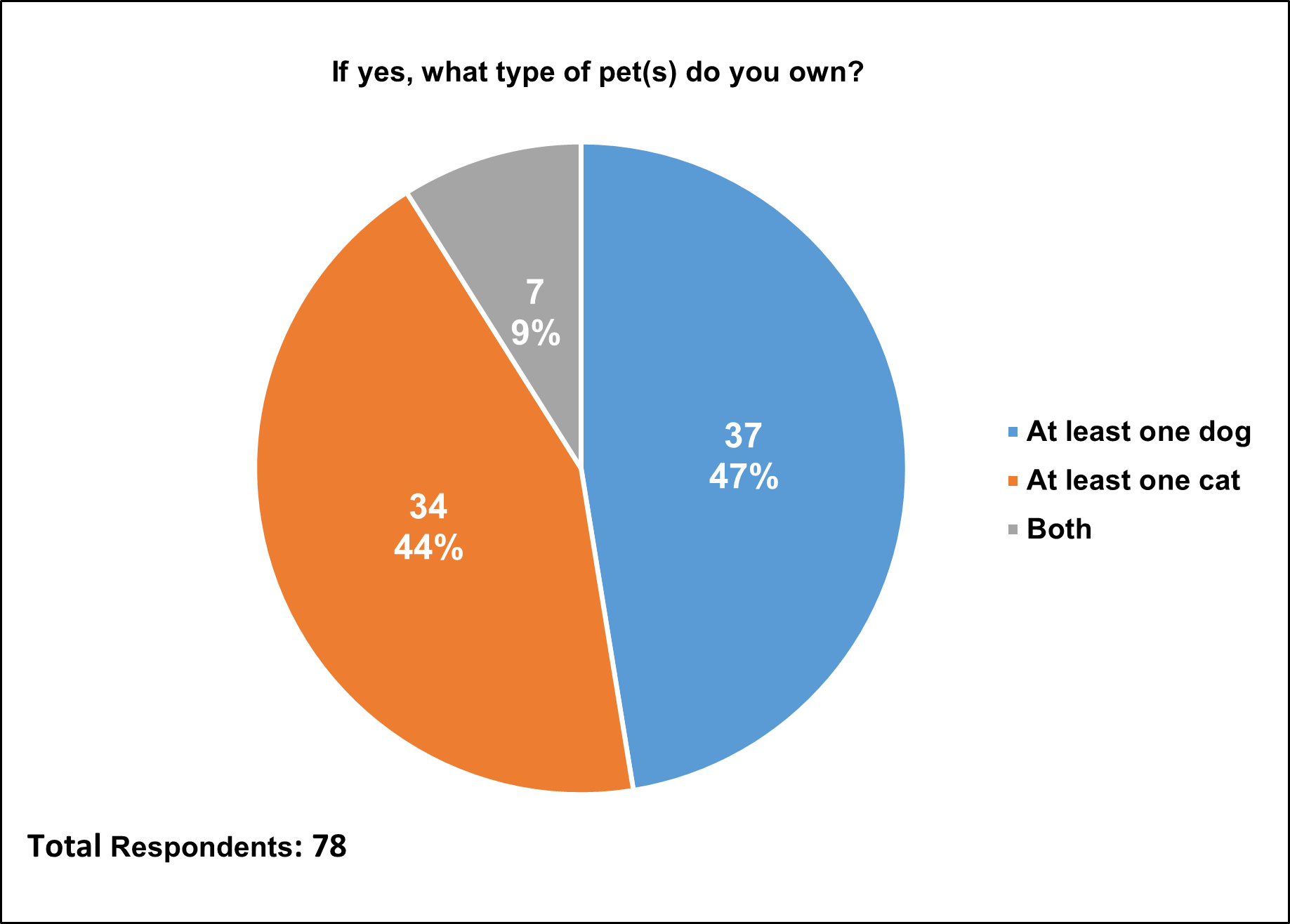
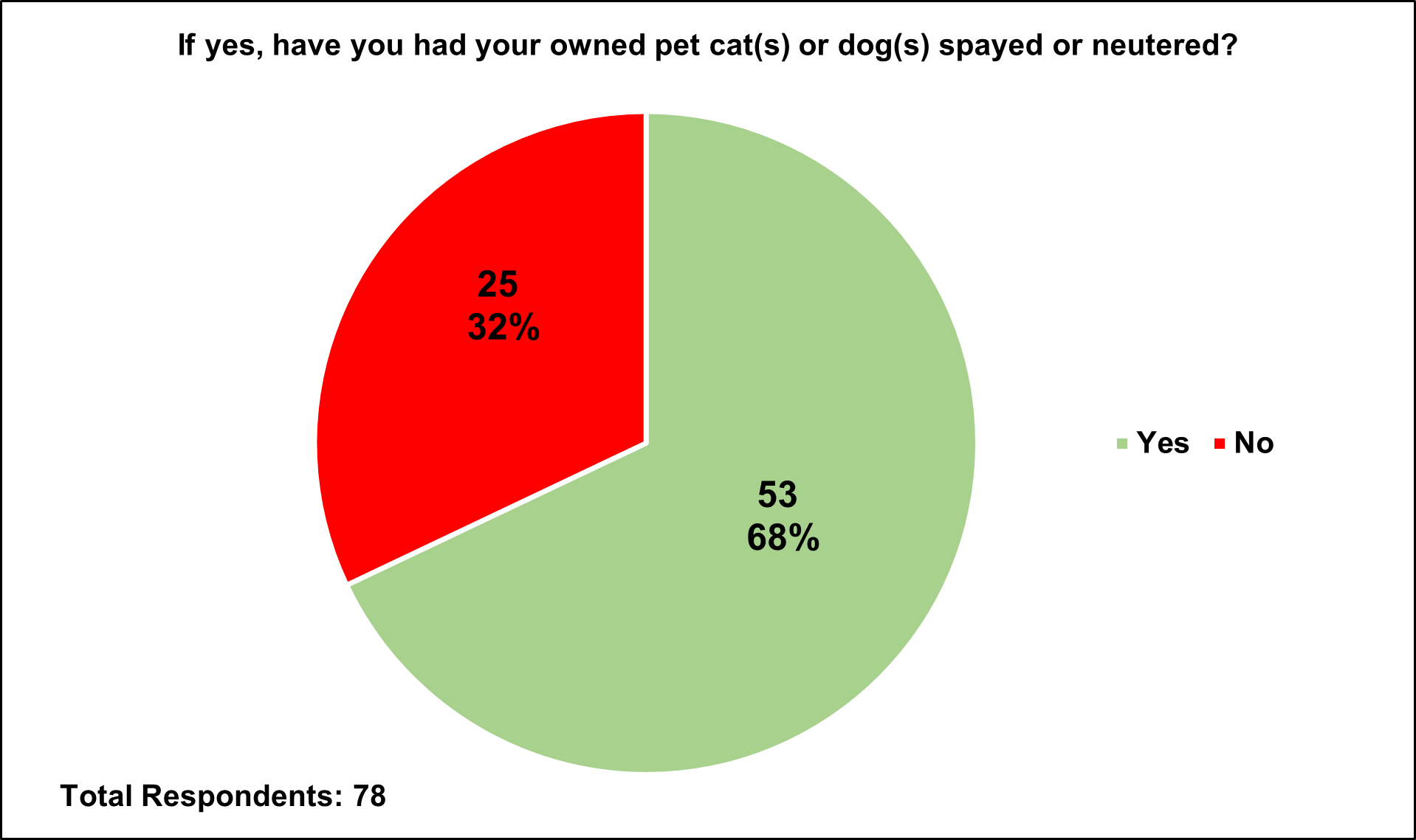
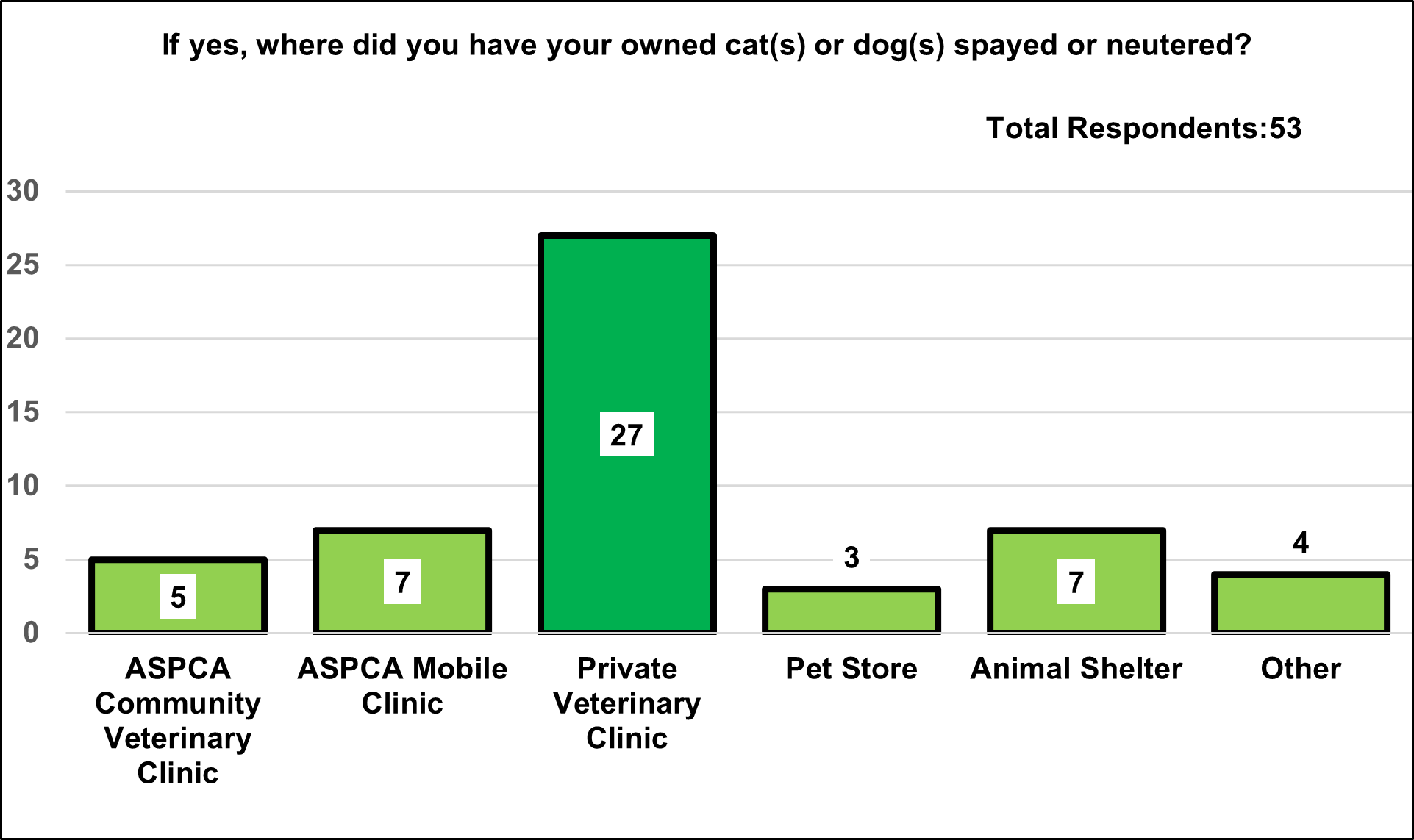
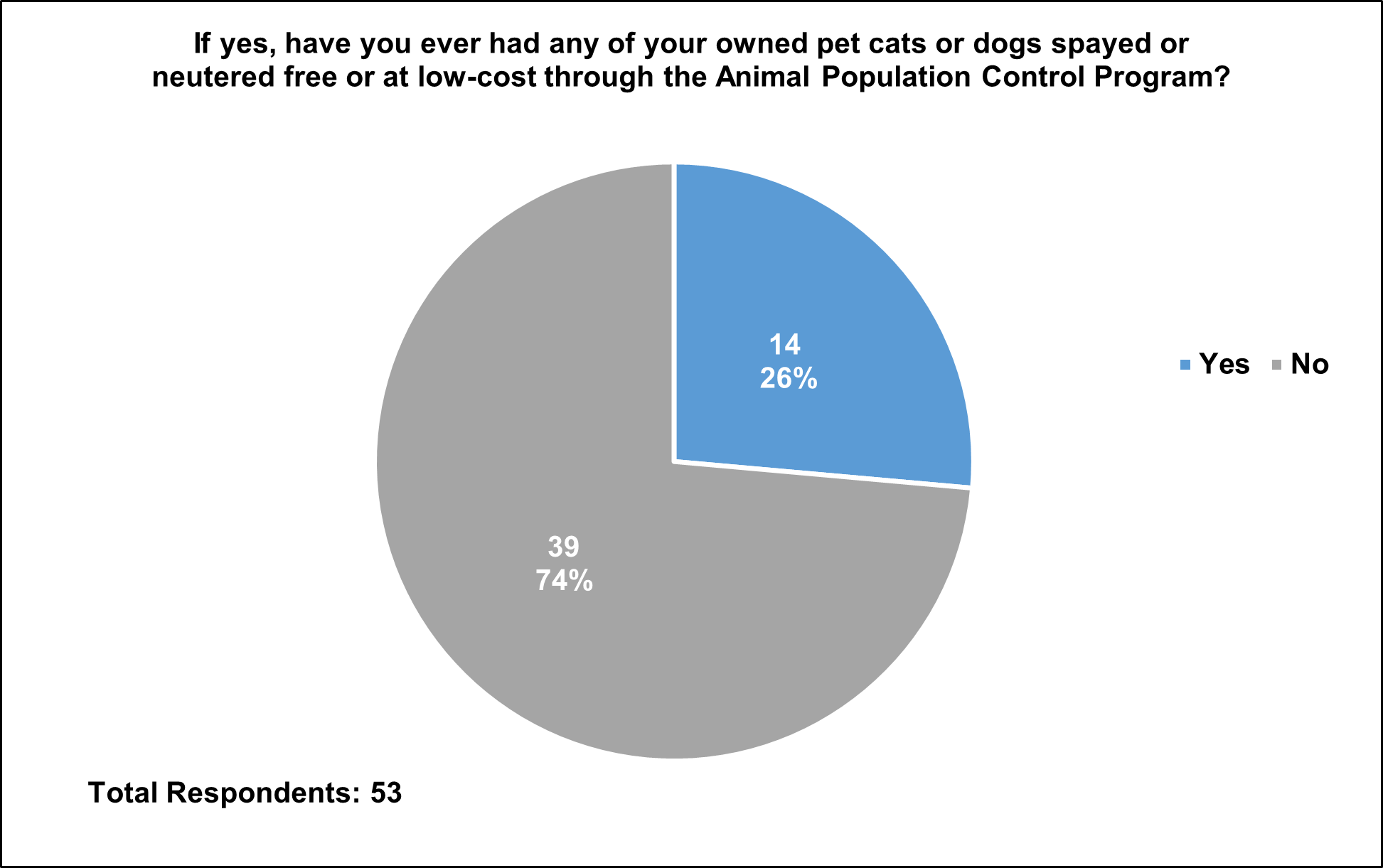
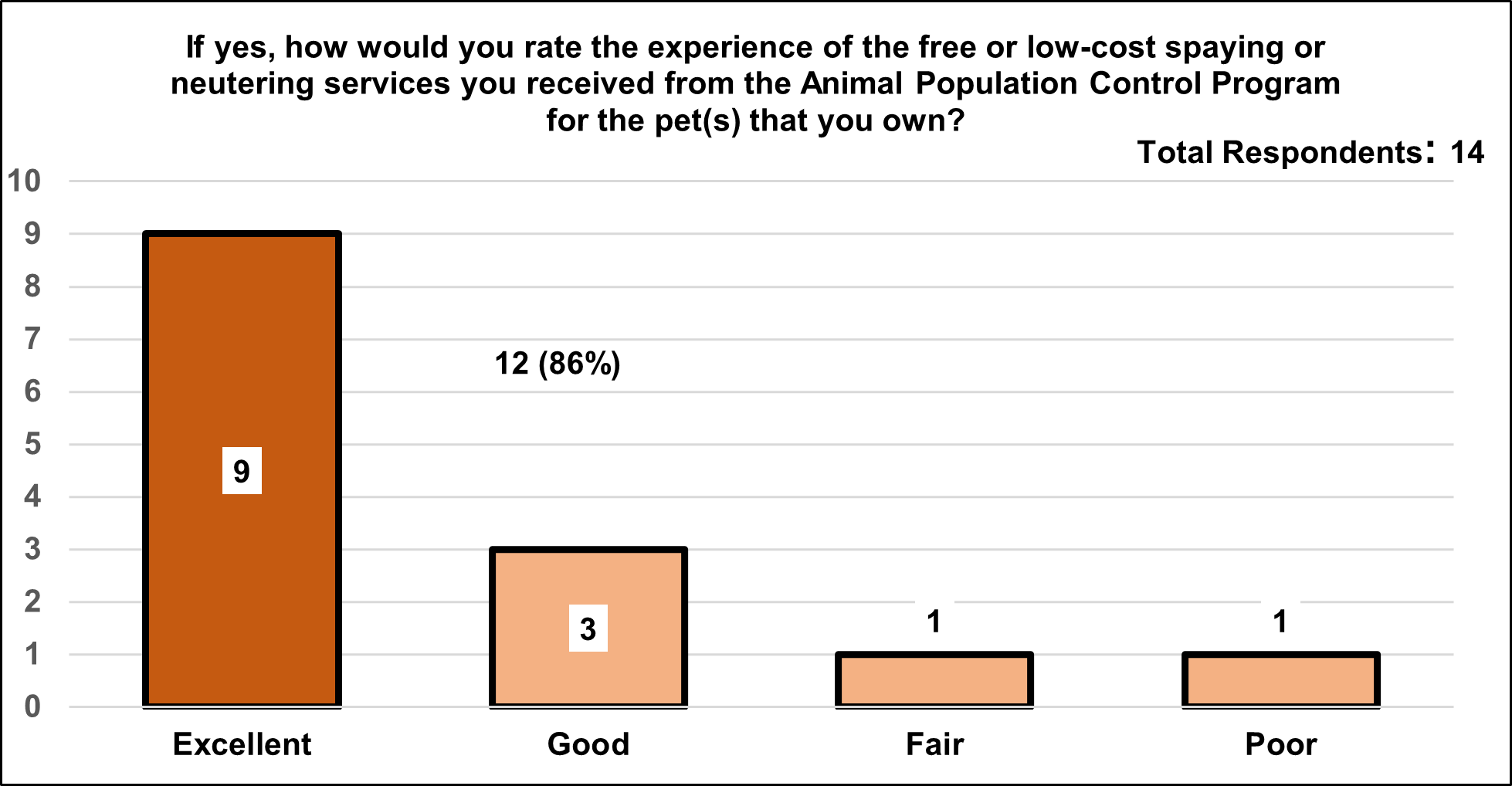
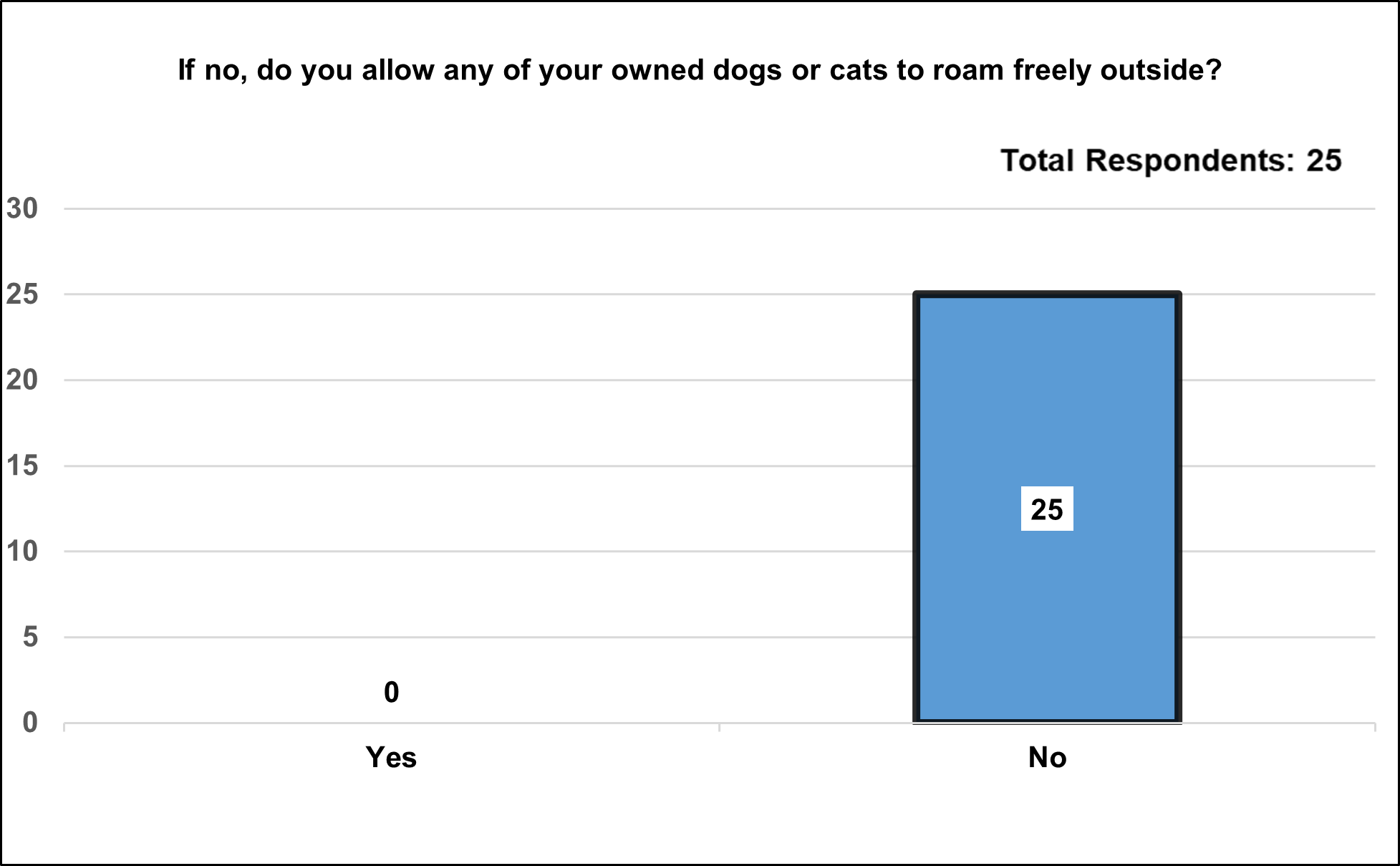
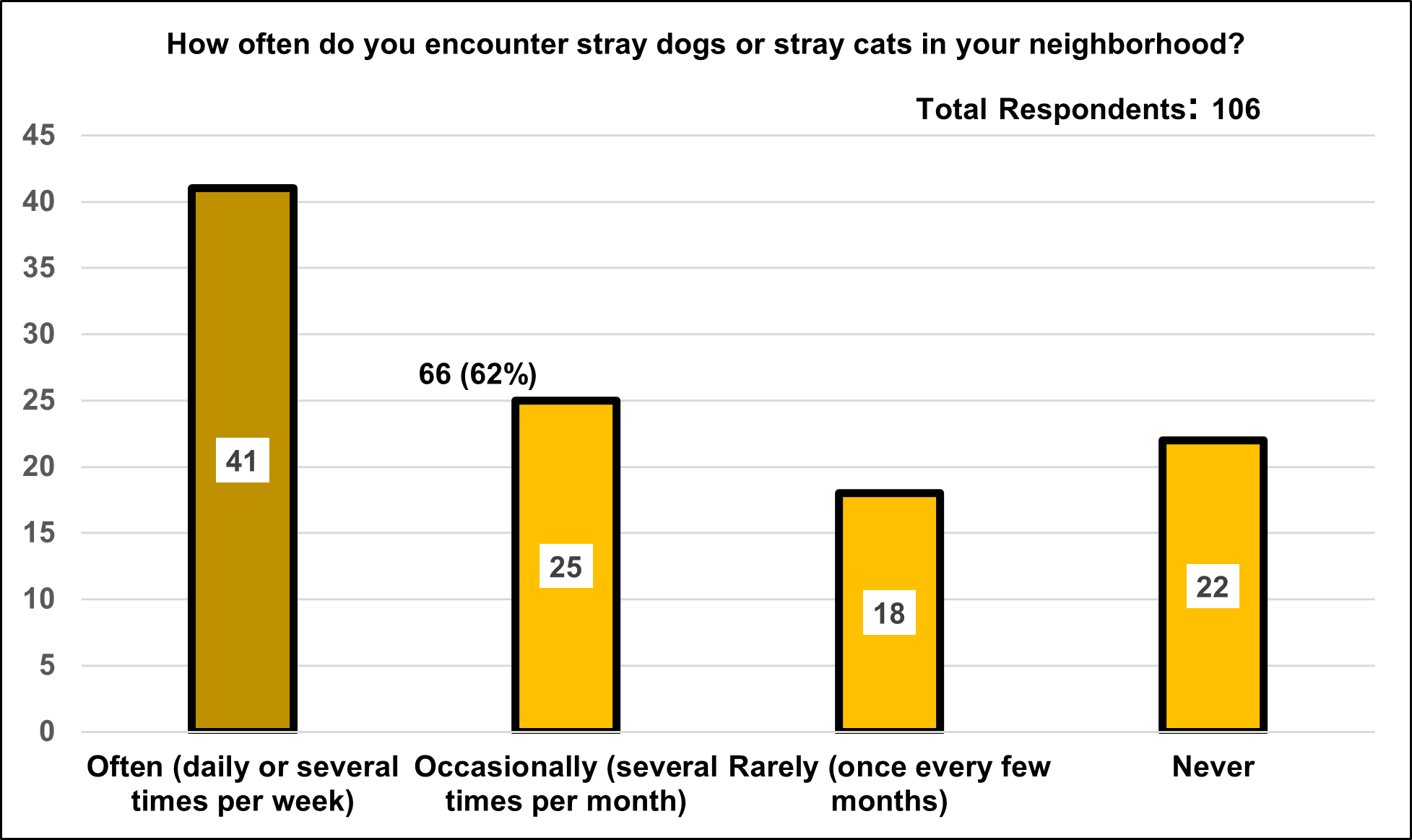
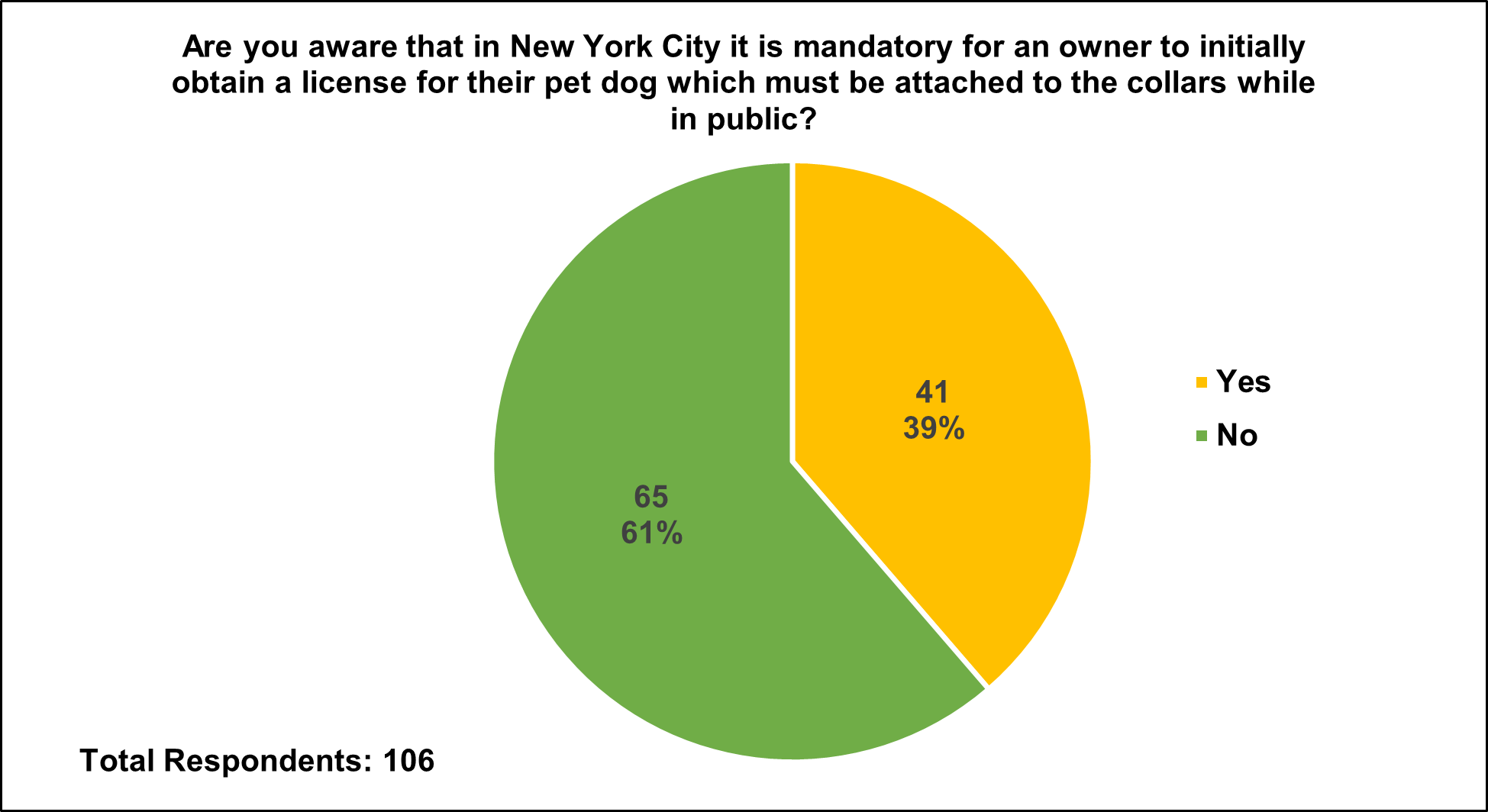
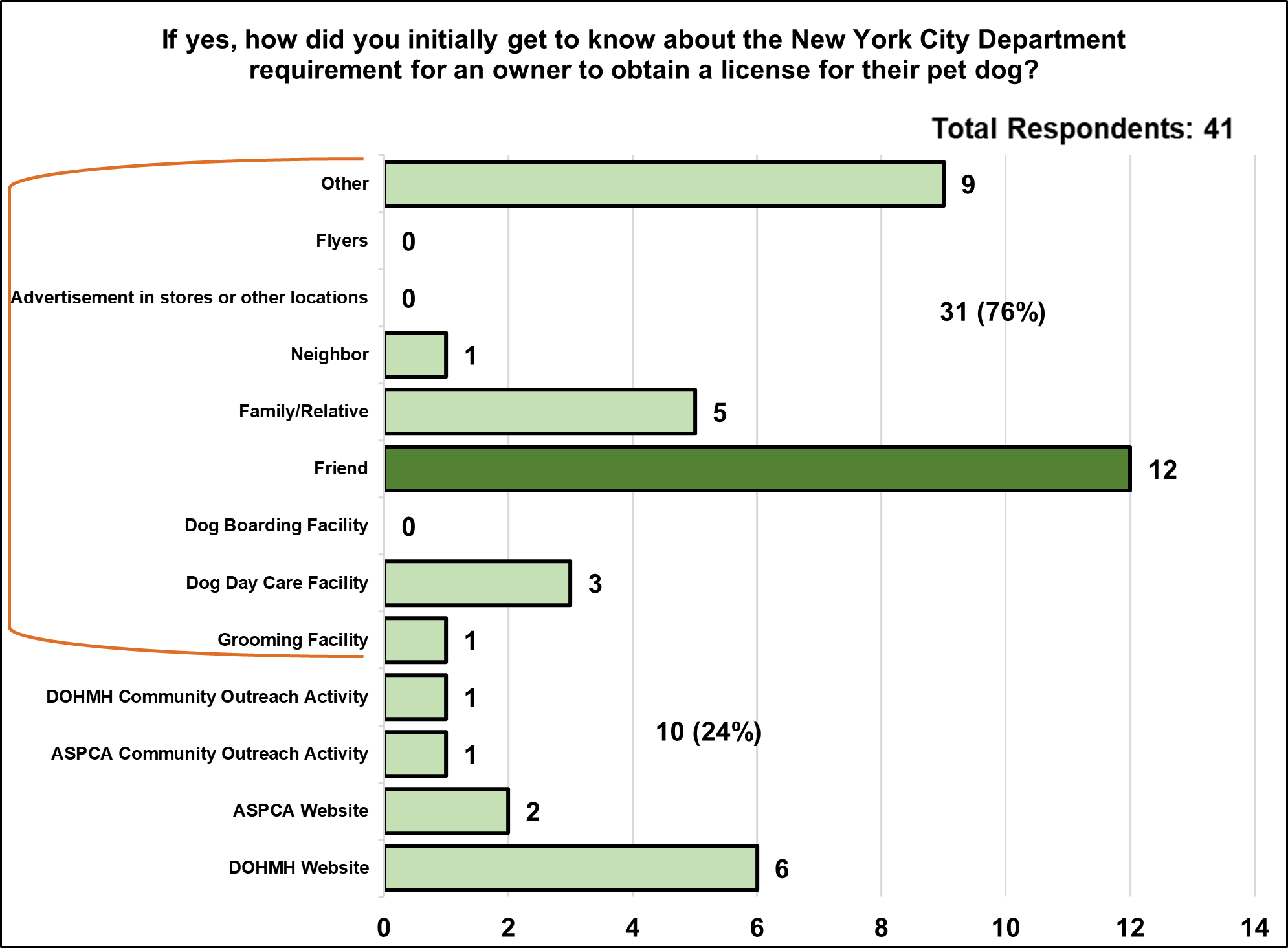
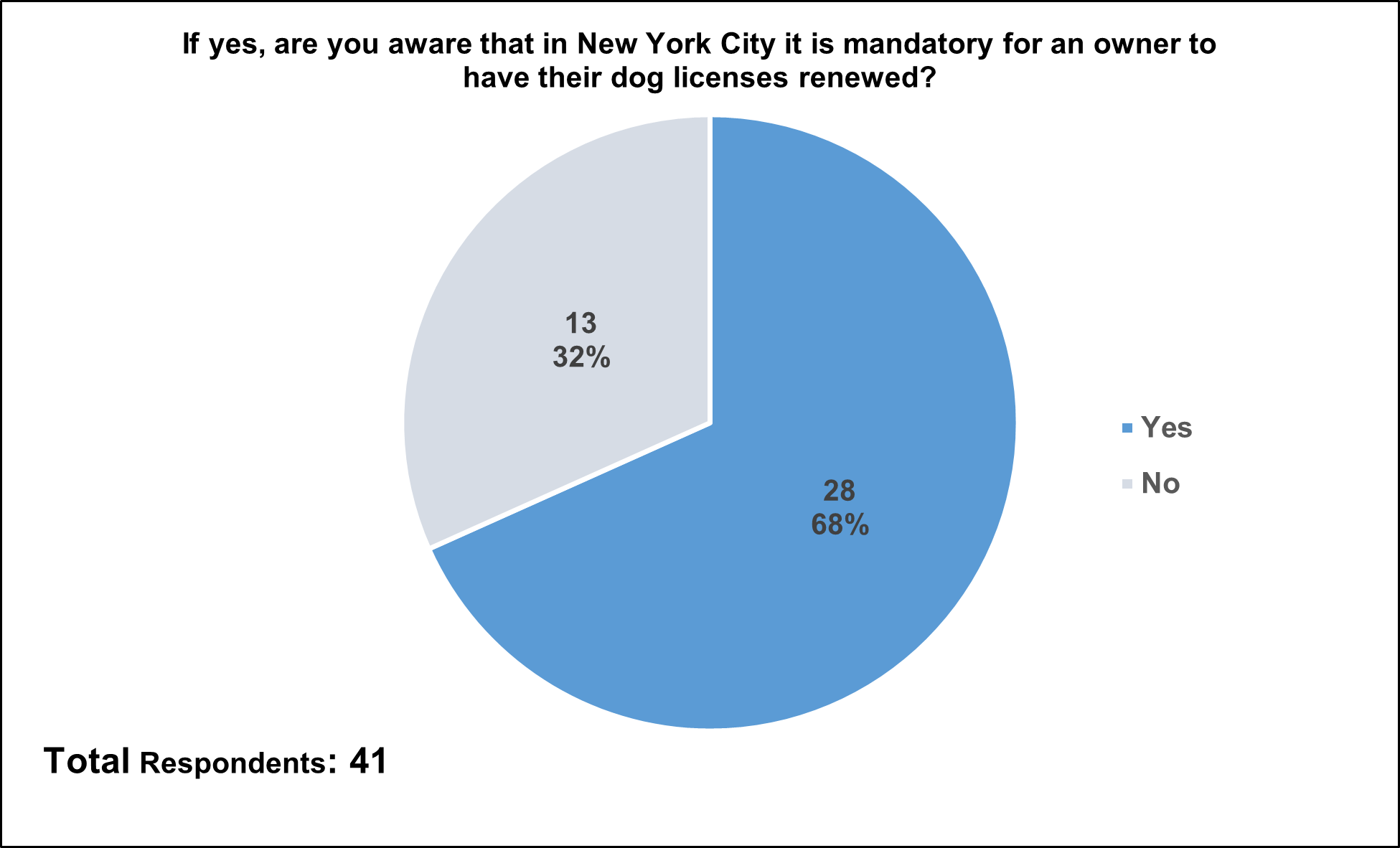
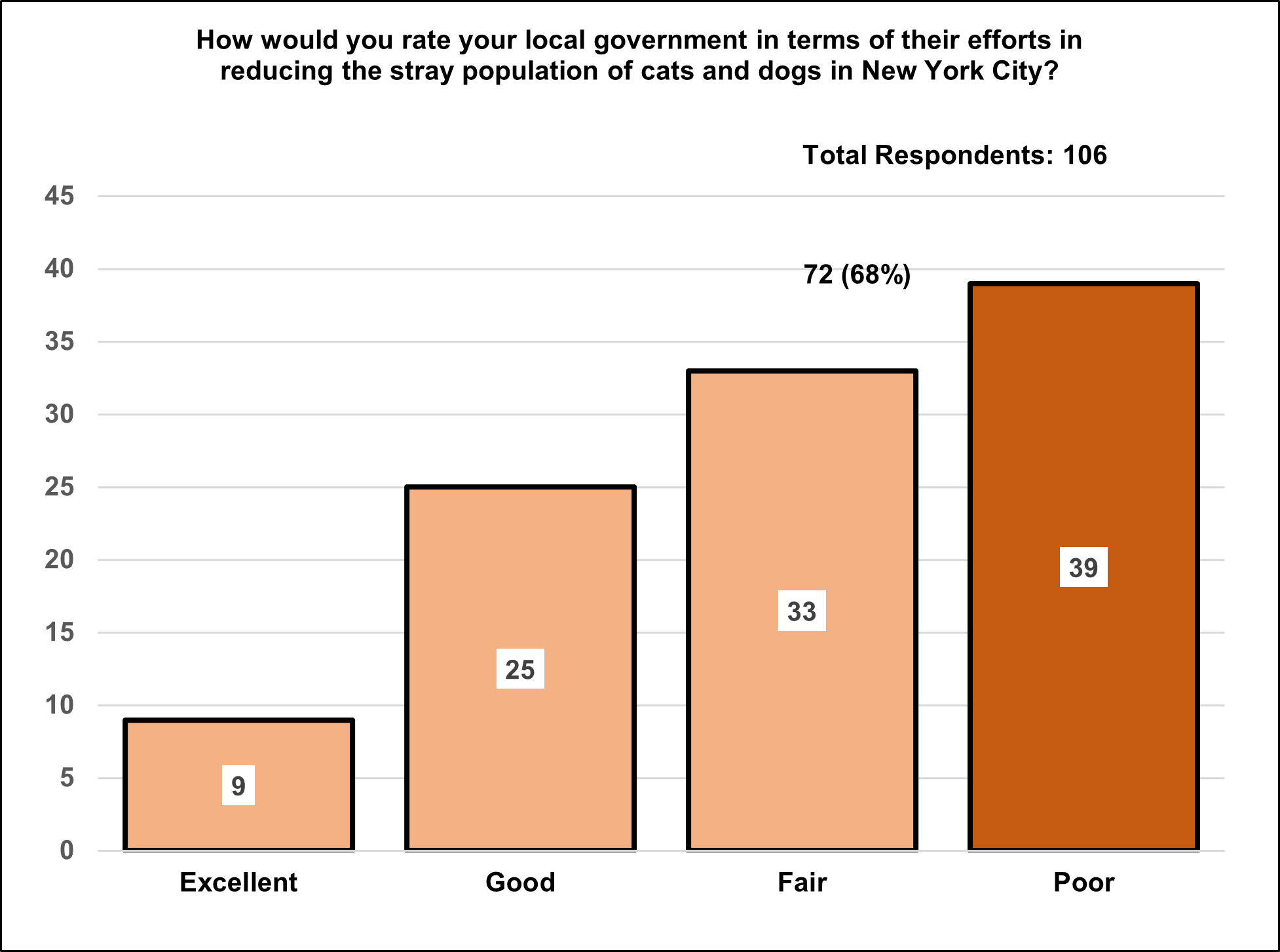
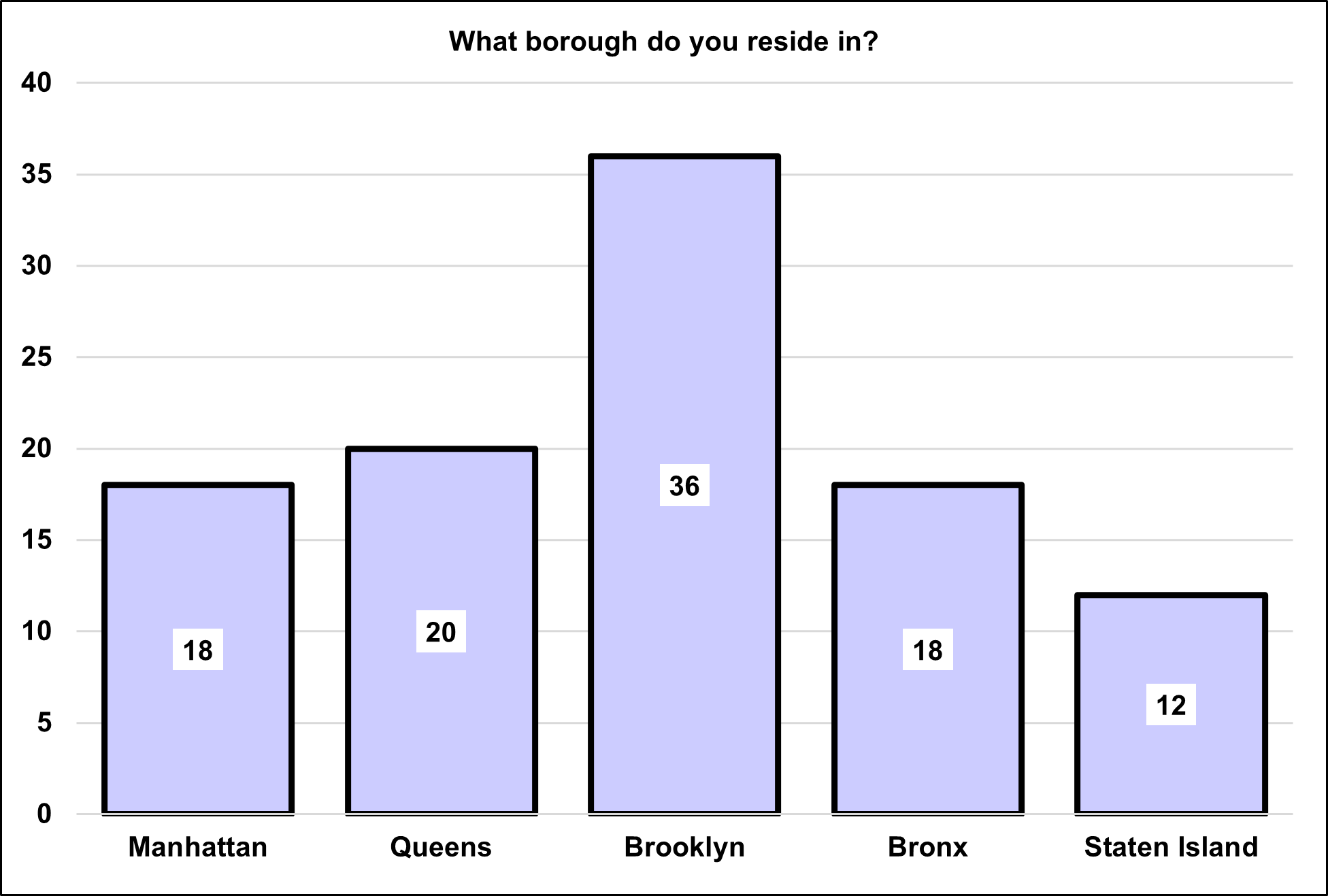
Endnotes
[1] Cats are not required to be licensed.
[2] Eligible pet owners include seniors, individuals with disabilities, residents of public housing, and recipients of Section 8. Eligibility also extends to anyone receiving government assistance, such as Medicaid, Medicare, Social Security, Social Security Disability, Supplemental Security Income, Food Stamps, and Public Assistance.
[3] Spaying and neutering services are provided by a veterinarian licensed to practice veterinary medicine in the State of New York to alter dogs and cats by surgical methods, or by other methods approved by the U.S. Food and Drug Administration or U.S. Department of Agriculture. Such sterilization services prevent animals from reproducing and include all accessory or supportive veterinary services deemed necessary by the veterinarian, such as rabies and other vaccinations, and assessments of the general health of the animals receiving such services.
[4] Organizations primarily eligible to enter into a contract with DOHMH to provide free or low-cost sterilization surgeries include New York City-based 501(c) (3) non-profit animal welfare organizations and New York City municipal animal shelters. To the extent that funds are or become available, private veterinarians practicing in New York may also be eligible to enter a contract with DOHMH to perform such sterilization surgeries, but only in a secondary capacity.
[5] Based on revenue information provided by DOHMH, revenue collected from dog licensing fees during the period of August 25, 2021 through July 13, 2022 (the fiscal year prior to the current contract) totaled $326,476.50.
[6] Prior to the current contract, from May 1, 2018 through April 30, 2022, DOHMH had two separate four-year contracts with two different vendors as follows: (1) a contract totaling $1,599,360 with the ASPCA for the boroughs of Manhattan, Queens, and Staten Island; and (2) a contract totaling $299,640 with Toby Project, Inc. for the boroughs of Brooklyn and the Bronx.
[7] In its response to the Draft Report, DOHMH argues that the average cost per year for this contract is misrepresented because the contract includes “substantial” funding for the development of the Queens Animal Care Center. A review of DOHMH’s website revealed that the funding allocated for the Queens Animal Care Shelter is $75 million, approximately 4% of the total contract amount ($1.9 billion). The contract’s approximate average cost per year, minus this allocation, has been modified in this report.
[8] In its response to the Draft Report, DOHMH states that while the intake and outcome data are accurate in Table I, the reported “placement rate” includes died/lost outcomes, which it characterizes as contrary to industry standards. The review includes these outcomes to ensure a comprehensive accounting of all animal dispositions within the City’s care. While DOHMH suggests this deviates from certain industry metrics, the objective of this analysis is to present a transparent view of all outcomes for the total sheltered population.
[9] The review team initially met with the founder and executive director of Flatbush Cats, one of the animal rights groups, prior to the start and throughout the review to discuss the organization’s concerns with animal welfare and to obtain background information on the matter.
[10] “The State of Animal Welfare in New York City? Not Great, Advocates Say at City Council Hearing,” Brooklyn Paper, published on September 17, 2024.
[11] The review team has become aware that several volunteer organizations are carrying out sterilizations without funding from the City.
[12] DOHMH lacked the funding necessary to carry out the estimated 10,660 sterilizations it anticipated could be carried out under the project, and the ASPCA lacked the capacity to carry out all of the sterilizations the provided funding could cover. The purchase orders issued to the Toby Project, Inc. used available revenue from dog licensing surcharges to cover the gap in the ASCPA’s ability to cover surgeries.
[13] Conducted by the United States Census Bureau since 2005, the American Community Survey (ACS) is the source of detailed social, economic, housing, and demographic data collected from a sample of households across the 50 states, the District of Columbia, and Puerto Rico.
[14] In its response to the Draft Report, DOHMH states that they did not “misunderstand the question at the [September 2024 City Council] hearing” and that the review team’s “characterization and the implication are incorrect.” However, this contradicts the statement made by the agency to the review team in a September 2025 email in which they stated in writing that they thought the question referred only to free-roaming cats.
[15] The review team received two datasets from DOHMH containing revenue information from dog licensing surcharges. One dataset, provided on April 10, 2025, included information as of March 14, 2025, for Fiscal Years 2023 through part of 2025. A second dataset, provided on September 19, 2025, included information for Fiscal Year 2022. The revenue collection information in the datasets is based on the dates when transactions were entered in the Financial Management System rather than the actual dates of receipt.
[16] In its response to the Draft Report, DOHMH argues that the finding related to the inadequacy of the program’s funding is not supported, asserting that a shortage of veterinary staff, not revenues, limited surgical capacity. However, the funding shortage is a distinct matter. As shown in Table 2, the number of surgeries funded is only 7,607 over the three-year period, far short of the target of 12,000 surgeries set in the contract.
[17] The review team contacted three municipalities (Chicago, Illinois, Animal Care & Control Agency; City of San Antonio, Texas, Animal Care Services; and Jacksonville, Florida, Animal Care & Protective Services) and one state agency (State of New Jersey Department of Health) to inquire: (1) how they handle the stray animal population in their areas; (2) whether they have a similar Program for qualifying residents; and (3) whether they use rescuers who provide TNR services and, if so, whether these services are City/State funded or whether the rescuers pay “out of pocket.” Chicago, Illinois did not have an animal population control program aimed at reducing the number of stray cats and dogs.
[18] New York State Bill 2025-A3122 was introduced, and if passed, would increase funding for the City’s animal population control measures by redirecting City-generated fees for animal welfare purposes into the City’s Fund and would require a percentage (up to 15%) of such funding to support related population education.
[19] In its response to the Draft Report, DOHMH argues that the review does not account for the disparity between New York City’s dog license fees and those of other municipalities, asserting that the City’s comparatively low base fee is largely responsible for the Program’s current dog license fee structure being insufficient to fund the Program. DOHMH does not identify the sources for the data used in its comparative analysis, so the review team offers no opinion on its accuracy. Nonetheless, DOHMH’s argument reinforces the review’s finding that DOHMH should identify and utilize additional funding streams to supplement the Program.
[20] Title 24, Article 161, Sections 161.04 (Dog Licenses), 161.09 (Permits to Keep Certain Animals), and 161.15 (Keeping of Small Animals for Sale, Boarding, Grooming, or Training) of the Rules of the City of New York for DOHMH.
[21] In its response to the Draft Report, DOHMH disputes the effectiveness of licensing events to “materially move [C]itywide licensing numbers,” but provides no data to support the claim. The review team’s survey data reveals a critical awareness gap, as 61% of respondents were unaware of licensing requirements. This data suggests the potential value of community engagement events in addressing the lack of public awareness.
[22] “Animal Population Control Program – Spay/Neuter Program,” DOHMH internal procedures, effective July 1, 2024.
[23] ASPCA was not required to submit outreach deliverables to DOHMH for the period of July 2022 through October 2022, as this predates the current contract, which commenced in November 2022.
[24] The ASPCA would not disclose how many mobile units they operate throughout the five boroughs.
[25] Due to limited daily spots, the virtual list closes when full. If a resident does not get a spot on the “wait list,” they must reapply on the next available date as information does not roll over.
[26] The review team initially selected 25 invoices—10 invoices from the 29 for FY 2023, 10 from the 25 for FY 2024, and all five from FY 2025. Because six of the 25 invoices were reimbursement for spaying/neutering surgeries performed by Toby Project, Inc. (not part of the ASPCA contract), the review team eliminated them from their analysis and only reviewed the 19 ASPCA invoices and associated summary service reports.
[27] The 19 sampled invoices pertained to the following months of services: November and December 2022; January, February, and May through November 2023; & January, March, April, and July through November 2024.
[28] The 19 invoices covered 3,602 surgeries for eligible residents across 130 zip codes; however, there were two zip codes that for some reason were not associated in the City, so the review team eliminated them from their analysis. The 128 zip codes consisted of 38 in Brooklyn, 24 in the Bronx, 33 in Queens, 21 in Manhattan, and 12 in Staten Island.
[29] The Shelter Animals Count’s Altered Status Data Report is an independent dataset produced by Shelter Animals Count, a program of the ASPCA. Monthly shelter data is provided by ACC.
[30] The review team selected three Petco/PetSmart locations in each borough. During their visits (August 28 and 29, 2025, and September 2, 3, and 4, 2025), the review team remained outside each location for one to two hours and attempted to elicit survey participation from individuals by having them scan the survey questionnaire’s Quick Response (QR) code. The locations included the following: (1) Brooklyn – Sunset Park, Old Mill Basin, and Gateway; (2) Queens – Jackson Heights, Forest Hills, and Rego Park; (3) Manhattan – Union Square, Turtle Bay, and Upper East Side; (4) Bronx – Kingsbridge, Gun Hill, and Throggs Neck; and (5) Staten Island – Forest Avenue, Hylan Blvd, and Charleston.
[31] “Intended participants” refers to individuals who: (1) declined the review team’s request to participate; (2) scanned the QR code and completed the survey questionnaire “on the spot”; (3) scanned the QR code on their phones and indicated that they would complete the survey questionnaire at a later time; and (4) took a hard-copy of the QR code and indicated that they would scan the code and complete the survey questionnaire at a later time.
[32] Of the 106 respondents, 18 resided in Manhattan (East Harlem, Chelsea, Upper West Side, Inwood, and Tribeca); 20 resided in Queens ( Rego Park, Ridgewood, Forest Hills, Elmhurst, and Astoria); 36 resided in Brooklyn (East New York, East Flatbush, Brighton Beach, Midwood, and Borough Park); 18 resided in the Bronx (Castle Hill, Pelham Gardens, Williamsbridge, Bedford Park, and Kingsbridge); and 12 resided in Staten Island (Rossville, Tottenville, Bloomfield, Mariner’s Harbor, and Great Kills). Two respondents were not City residents.
[33] It should be noted that the review team does not know whether the 39 respondents who did not get their pets spayed or neutered through the Program were eligible.
[34] National Library of Medicine, https://pmc.ncbi.nlm.nih.gov/articles/PMC11394480/
[35] According to the Animal Law Committee of the New York City Bar Association—which addresses animal-related legal and policy issues at local, state, national and international levels—TNR is a widely recognized and successful practice for managing community cat populations and is being used in several cities.
[36] On October 2, 2025, the review team toured the organization’s Flatbush Veterinary Clinic to observe how low-cost spaying and neutering services are provided to pet owners and rescuers.
[37] The review team met with ASPCA officials throughout the review to gain an understanding of their responsibilities regarding the Program. Specifically, the review team met with the Senior Director of Government Relations/Municipal Affairs, the Vice President of Community Medicine, and the Senior Director of Corporate Counsel.
[38] The ASPCA does not charge TNR rescuers for sterilization services. Instead, they rely on private donations to fund these surgeries. The review team’s calculation of the amount spent by the ASPCA on the TNR surgeries is based on the $125 fee charged for pet owners who are not eligible for free sterilization services.
[39] It should be noted that the total number of registered TNR rescuers (2,381) may be an overstatement of unique rescuers, as some rescuers may be registered with multiple organizations.
[40] “Ask Governor Cuomo to Protect Community Cats”, ASPCA Blog, published on October 19, 2015.
[41] In its response to the Draft Report, DOHMH questioned the efficacy of formally assessing the viability of introducing City-funded TNR programs, citing the New York State Governor’s veto of the TNR bill. The review notes that the veto occurred over 10 years ago (in October 2015) and was based on information available at that time. A current formal assessment would allow DOHMH to utilize up-to-date information and more recent studies to evaluate the effectiveness of these programs, particularly in light of the City Council’s recent $500,000 allocation for a TNR pilot initiative.
[42] council.nyc.gov/press/2025/09/25/2979/
[43] www.24pet.com/blog/build-a-pet-retention-program
[44] Of the 106 respondents, 73 provided comprehensive suggestions, while the remaining 33 provided limited and inadequate suggestions.