Review of Schools’ Food Donation and Composting Efforts
Introduction
Background
New York City Public Schools (NYCPS) is the nation’s largest school system. NYCPS provides primary and secondary education to over one million students, from early childhood to grade 12. NYCPS employs over 76,000 teachers in over 1,600 schools in 32 school districts. NYCPS offers free breakfast, lunch, and after school meals to all NYCPS students during the school year. On average, NYCPS serves approximately 940,000 meals daily.[1] In FY2025, the agency spent $600 million (12%) of its $4.9 billion operations budget on food. There are two lines of service at NYCPS that are responsible for preventing food waste: Office of Food and Nutrition Services (OFNS) and Office of Energy and Sustainability (OES). Each of these units has a very specific structure and is responsible for very different aspects of combating food waste.
Structure, Responsibilities, and Operations of OFNS
OFNS, which falls under NYCPS’ Senior Executive Director of Operations, manages all aspects of purchasing, cooking, and serving food to students. The agency offers free breakfast, lunch, and after school meals at all NYC public schools, charter schools, and other non-NYCPS schools that choose to participate in the lunch program during the school year. According to NYCPS, in FY2025, OFNS served 153,283,016 meals in 1,319 school buildings.
Chart 1. Total Meals Served FYs 2022–2025 in All Participating Schools
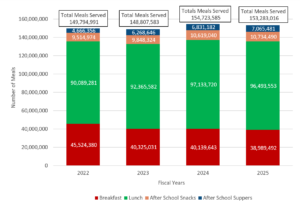
In FY2025, NYCPS served an average of 935,055 meals a day to students. This breaks down to 818,952 meals (88%) served in district schools and 116,103 (12%) in charter schools, non-public schools, and specialized schools.[2]
OFNS plans school menus on a five-day-per-week schedule, following a three-week cycle that resets after the third week. The menus are updated four times a year to reflect seasonal changes. Menus are centrally developed to ensure consistency and equity across all locations in the City. Once menus are approved and distributed, they must be followed. These menus guide ordering and service at each site.
While most meals are prepared and served onsite at NYCPS schools, charter schools, or non-public schools, some locations lack the infrastructure for onsite cooking. Meals for sites lacking full on-site kitchen infrastructure are prepared at designated school kitchen locations.
OFNS officials explained that to prevent over-purchasing, managers consult with the cook-in-charge and place orders based on the actual number of meals served, not on student enrollment. They use past service data to guide quantities. Orders are placed in advance, with the flexibility to adjust as needed.
Structure, Responsibilities, and Operations of OES
OES is responsible for increasing building efficiency and integrating sustainability into the daily operations of NYC schools. With cooperation from the Division of School Facilities, OES is tasked with providing schools with resources and technology to improve school buildings by reducing greenhouse gas emissions; providing resources and support to reduce and manage waste; offering climate leadership programs for educators, students, and facilities staff; and promoting access to school gardens and outdoor learning. For this review, the team concentrated on OES’ role in reducing food waste and waste management.
The functions of OES were performed under the Division of School Facilities until the middle of FY2025, when a new division was created under the management of the Chief Sustainability and Decarbonization Officer (CSDO), who reports directly to the Deputy Chancellor of Operations. The daily operations throughout the five boroughs are overseen by the citywide waste operations managers.
OES’ goal is to serve as a bridge to develop networks and connections between the New York City Department of Sanitation (DSNY), OFNS, schools, and students. OES officials stated that they partner with OFNS to minimize food waste and prevent it from ending up in landfills. To achieve this, OES provides advisory services and training to educate school staff, including custodians, kitchen staff, serving staff, teachers, principals, and students. While OES does not directly manage the procurement, it provides advisory support on compostable products, vendor certifications, and sustainability best practices. A notable collaboration involved the transition to compostable plates and utensils, where OFNS sought guidance from OES on product selection and environmental standards.
Zero Waste Schools Initiative
In February 2016, the mayor launched a Zero Waste Challenge across the City with the goal of eliminating all landfill waste by 2030. As part of this challenge, DSNY and NYCPS launched the Zero Waste Schools initiative and collaborative program, the aim of which is to divert all recyclable and compostable waste from approximately 100 Zero Waste Schools in five years. [3] By FY2024, the Zero Waste Schools initiative was expanded to all schools, which are now all required to separate compostable waste from regular garbage.
All schools are required to follow recycling and composting rules established by DSNY. The responsibility of core roles in school-related food waste programs is as follows:
- Custodians – ensure waste and recycling items are collected per schedule and rules set up by DSNY. They are not responsible for sorting out waste, recycling, or composting once they are in the bins.
- Sustainability Coordinators – serve as liaisons between the school, OFNS, and OES teams and are responsible for promoting correct recycling procedures among staff and students. Principals are mandated to appoint one coordinator at the beginning of each school year. This role may be assigned to any school staff member other than custodial engineers and principals. It does not provide additional compensation.
- Principals – oversee the operation of the school and by default are responsible for upholding all food waste programs to students and teachers.
Laws Governing NYCPS’ Food Waste Prevention Efforts
Local Law 41 of 2010 (LL41) requires OES to conduct a survey of sustainability coordinators once a year. This survey covers five topics: (a) sustainability and education, (b) communication and outreach, (c) energy conservations, (d) waste reduction, and (e) general category, such as school garden/wellness/health. There are about five or six questions per topic. The purpose of this survey is to collect information, understand areas of concern, and assess the satisfaction level of participation in these programs. OES uses the results of this survey to learn whether schools utilize the resources to improve sustainability in the building and assess what support can be offered to further advance sustainability efforts.
The same law requires the Chancellor to report to DSNY by January 1 of each year concerning compliance with the survey provisions in the preceding fiscal year. This information is included in NYCPS’ Sustainability Annual Report.
The New York State Education Law was amended, effective March 2018, to permit and encourage schools to establish means for donating unused school food that cannot be saved for future school meals to food assistance programs.
Mechanisms Established to Reduce Food Waste
To combat food waste, NYCPS employs several strategies:
Streamlining Kitchen Operations
According to NYCPS’ food prevention plan, combating food waste starts in the kitchen, specifically by food inventory management that allows for just the right amount needed to feed the students, to avoid throwing out the excess and ensuring that all food is properly stored, inspected, and rotated to prevent expiration. Additionally, NYCPS instructs kitchen staff to cook food in batches throughout the day, as opposed to larger quantities at the beginning of mealtime, which helps to prevent leftovers that may need to be discarded. Cafeteria staff are also encouraged to utilize the “offer vs. serve” method, which allows the students to select only some of the offered food items.[4]
Resources, Training, and Education
NYCPS has a sustainability section on its website that serves as an information hub for all school administrators, sustainability coordinators, and all others involved or interested in sustainability efforts. The website contains information about climate actions, energy use in public schools and related projects, and waste reduction and recycling requirements and related programs, and lists ideas for school engagement and funding sources.
According to NYCPS, school principals can receive dedicated sustainability training at the beginning of each school year, including through engagement with their school’s Sustainability Coordinator. School food managers and sustainability coordinators (each school is required to appoint one employee to the sustainability coordinator role) are required to undergo training that may include waste-related topics. Food managers are responsible for training kitchen staff, while sustainability coordinators are responsible for focusing on internal communication and student engagement. OES conducts sustainability training as a component of OFNS’ annual training program.
NYCPS stated that OES encourages students to participate in various food waste prevention programs offered in schools through assemblies, Green Team support, and citywide climate leadership events. Additionally, OES is responsible for training school staff and students to implement new practices designed to make each school more sustainable. Examples of engagement include organizing youth summit climate workshops and maintaining close communication with teachers and parent coordinators. During School Year 2024–25, NYCPS held four climate action days—November 19, 2024; February 5, 2025; April 9, 2025; and May 21, 2025. There is already a plan for the same program to be held in the current 2025–26 school year. NYCPS stated that OES liaises with DSNY on collection issues and operational challenges.
Food Sharing Tables and Other Food Donations
OES works with OFNS to support waste reduction efforts by developing guidelines and policies for food sharing tables and food donations to organizations and individuals outside schools.
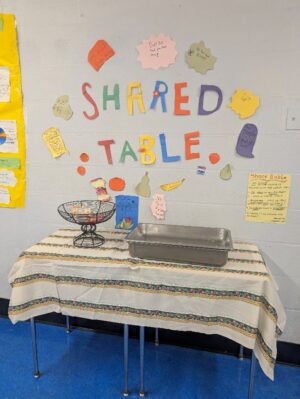
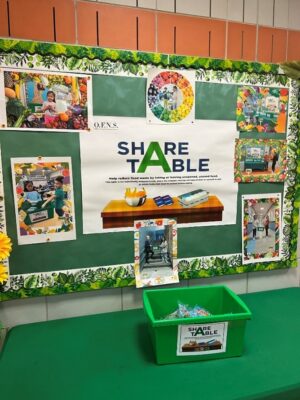
Once food is served to students, it cannot be repurposed. Only prepackaged and unopened items (for example, milk, prepacked sliced apples, containers of cereal, and unpeeled oranges) can be repurposed. OFNS offers a Share Table Program that allows kitchen staff to work with school administration to set up a designated table in the cafeteria during meal periods where students can place unopened, uneaten food or drinks instead of throwing them away. Food that is not used from the share tables, as well as food that has not been served to students and cannot be served the following day, may be donated to school families and staff or to outside organizations.
At the beginning of each school year, OFNS provides guidance for the Share Table Program in the Principal’s Guide. Kitchen managers are asked to review it with school leadership annually; this is because supervising cafeterias is the school administrators’ responsibility. OFNS created signage to clearly mark share tables to ensure students know how to use them. School staff monitor tables throughout the meal service to ensure food safety guidelines. According to information received from NYCPS for FY2025, food share tables were set up in 1,396 of the 1,675 (83%) buildings in which school food was served.
Photos 1 and 2. Samples of Food Sharing Tables
“Green Teams”
As discussed further below, survey respondents cited lack of student engagement as a challenge to schools’ ability to effectively implement composting and recycling protocols.
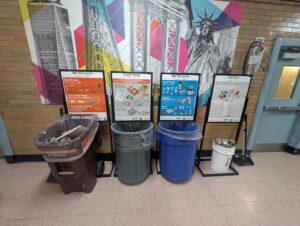
As part of the composting initiative, sustainability coordinators’ training of schools in waste management practices has led to the establishment of student-led “Green Teams” which assist with cafeteria waste sorting. According to the NYC Guide to Clean & Green Schools, published by NYCPS and DSNY, schools are required by law to set up waste, recycling, and composting bins in school cafeterias. Each school should be equipped with sorting stations that follow a standardized four-step process outlined in the Green Guide: disposing of liquids, sorting recyclables, separating compostable items, and discarding non-recyclable waste. This system serves as the universal waste management protocol across all school buildings. At some schools, a “Green Team” is stationed in the school cafeteria next to the waste sorting station, to oversee the proper sorting and disposal of waste. Examples are shown in Photo 3 below.
Photo 3. Required Waste, Recycling, and Composting Bins in School Cafeterias
Food Waste Audits
NYCPS stated that some schools have also conducted voluntary food waste audits in collaboration with certain non-profit organizations, such as Cafeteria Culture, a New York City-based national non-profit whose mission is to transform school cafeterias into youth action hubs. The organization addresses food waste and plastic pollution and promotes local composting. Cafeteria Culture works with youth to design and implement pilot projects that are replicated and scaled nationally. One such project is the food waste audit.
During these audits, equipment is used to sort, weigh, and document food waste through photographs. In its Impact Report for School Year 2024–2025, Cafeteria Culture stated that it conducted 11 detailed cafeteria waste audits and provided data to OFNS and policymakers to help guide more climate-smart cafeteria practices and waste reduction strategies. Additionally, during an observation at P.S. 029 in Brooklyn, the review team learned that the school’s Green Team students conduct random food waste audits to ensure proper waste segregation.
While NYCPS stated that it encourages schools to work with non-profits, such engagements are monitored at the local level. NYCPS does not track these efforts centrally. NYCPS does not know how many schools are currently working with Cafeteria Culture (and other non-profits) or how many of these food audits were conducted, or the results of these audits.
Plastic Free Lunches
Though not targeted to reduce food waste, NYCPS has participated in an initiative designed to reduce non-recyclable trash. In partnership with Cafeteria Culture, OFNS launched the first citywide NYCPS Plastic Free Lunch Day held on May 16, 2022. Over 750 elementary schools prepared and served lunch that day without any plastic.
According to NYCPS’ sustainability report for FY2022, the original Plastic Free Lunch “raised awareness about plastic packaging and the volume of waste it creates, laying the groundwork for the creation of monthly Plastic Free Lunch Days throughout FY23.” In FY2023 NYCPS held six such days citywide. In its annual sustainability report for FY2023, NYCPS wrote that P.S. 15 in Red Hook, Brooklyn, reduced plastic waste from 694 pieces to 28 in a single day. In FY2024, NYCPS ran 14 Plastic Free Lunch days—one every three weeks. This practice has been continued for FYs 2025 and 2026.
Students’ Concerns
On June 5, 2024, NYCPS District 2 students presented to the Comptroller’s Office their ideas regarding the food share program and subsequently shared their concerns with the Audit Bureau. The students indicated that although NYCPS has implemented a pilot program to combat food waste, the program was not well supported or advertised by NYCPS Central or by school staff. They also raised concerns that the donation rate was lower than it should have been and stated that the beneficiaries of food donations were unclear.
Objectives
The objectives of this review were:
- To determine whether NYCPS compiles metrics and other data relating to its donation and composting programs and, if so, ascertain the following:
- the percentage of food purchased by schools that has been (1) donated, (2) composted, and (3) discarded.
- the food assistance organizations that have been the recipients of school food.
- To identify NYCPS’ efforts to educate and promote its school food donation and composting programs.
- To obtain school administrators’ feedback relating to participation in NYCPS’ food donation and composting programs.
Discussion of Review Results with NYCPS
The matters covered in this report were discussed with NYCPS officials during and at the conclusion of this review. On March 12, 2026, we submitted a Draft Report to NYCPS with a request for written comments. We received a written response from NYCPS on March 26, 2026.
In its response, NYCPS agreed with recommendation #5, partially agreed with recommendation #4, and disagreed with recommendations #1, #2, and #3.
NYCPS’ written response has been fully considered and, where relevant, changes and comments have been added to the report. [5]
The full text of NYCPS’ response is included as an addendum to this report.
Key Takeaways
Although NYCPS has established mechanisms to help schools comply with food donations and composting regulations, and has created initiatives to support reduced food waste and increased food donation in schools, participation in voluntary activities remains low; contamination rates of compostable materials are very high; and NYCPS has no mechanisms for assessing the effectiveness of its overall efforts to ensure only the number of meals actually needed are prepared. This is a missed opportunity with fiscal and environmental implications. During FY2025, NYCPS served close to a million meals and spent $600 million on food, at a time when over 1.2 million City residents experienced food insecurity.[6]
According to NYCPS’ data, only 4% of schools donated unused food to outside organizations in FY2025. NYCPS does not centrally maintain records of organizations receiving food donations from schools and does not know what percentage of food prepared at schools is donated.
As of FY2024, NYCPS reported that all 1,715 schools have the capacity to collect compost and that the amount of school waste captured for composting increased from 6,278 tons in 2017 to 24,477 tons in 2024. However, while the volume of compost collected in schools has dramatically increased since FY2017, it remains a fraction of the total food waste generated in schools.
According to data reported by DSNY in its 2023 NYC Waste Characterization Study, food scraps made up 32% of all waste generated by NYCPS schools in FY2023, but only 37% of food scraps generated by schools were captured for composting. Additionally, an analysis of the compostable materials (food scraps, food soiled paper and compostable packaging, and yard waste) collected from schools for composting reveals a contamination rate of 28%, far exceeding the City’s overall organics contamination rate of 4%.
According to NYCPS, an annual sustainability survey is sent to all general education public schools. In its survey for School Year 2025, NYCPS asked schools to answer questions about six activities related to their food waste prevention programs. The results of the survey revealed that 15% of all schools engaged in none of the six activities, and most schools—87% in total—engaged in no more than three of the six activities.
To obtain school administrators’ feedback concerning participation in NYCPS’ food donation and composting programs, the review team sent surveys to school administrators. Results from the survey include the following:
- 86% of respondents who answered the question stated that their schools participated in the citywide composting and recycling program.
- Only 33% of respondents who answered the question stated that their schools donated unused food to school families, staff, or outside organizations.
- Only 59% of respondents who answered the question stated that their schools had a food sharing table.
- Only 45% of respondents who answered the question stated that their schools provided food waste prevention and sustainability training to both students and staff.
For those respondents who stated that their schools did not participate in voluntary initiatives, the primary reason stated was lack of funding.
NYCPS could and should do more to increase participation in voluntary food waste initiatives and should significantly reduce its organics contamination rate, encourage the collection and donation of unused food, and establish ways to measure its effectiveness in achieving these goals on a central as well as school-by-school basis.
NYCPS Does Not Track Data Necessary to Evaluate Food Waste Reduction Efforts
Success Rate of Minimizing Food Waste Unknown
According to NYCPS officials, the emphasis at schools is to limit food waste by preparing only the amount needed. To determine how many meals should be cooked each day, managers call school administrators after 9:30 am to confirm the day’s attendance and then cross-reference that with the number of meals served on similar days. Managers are expected to maintain regular communication with school administrators and refer to the school calendar to stay informed about upcoming events, like school trips, half days, holidays or other schedule changes, to incorporate and adjust the quantities to be prepared.
The review team asked NYCPS to provide information on how the data regarding the number of meals prepared and served is recorded by each school and how NYCPS compiles this data centrally. NYCPS provided a sample of the food production record used by each school to note, among other things, the number of meals prepared, served, and discarded. In addition, NYCPS provided a report summarizing the total number of meals served to students in each school by meal type. However, NYCPS does not maintain centralized data detailing the number of meals prepared and the number discarded. Although requested, this was not provided. NYCPS contends that food production recordkeeping requirements established by the United States Department of Agriculture (USDA) and administered by USDA Food and Nutrition Service (FNS) under the National School Lunch Act require this information to be kept at schools.[7] However, this would not prevent NYCPS from maintaining and tracking this information centrally as well.
NYCPS claims that food purchases and utilization are reviewed by School Food regional managers and supervisors and by independent monitors that audit individual school kitchens and asserts that it analyzes the effectiveness for food waste prevention efforts at the school level. However, NYCPS does not collect or analyze schools’ effectiveness at minimizing food waste on an aggregate level. Therefore, NYCPS has no idea how successful its overall efforts to prevent food waste are.
Only 4% of Schools Donated Unused Food to Outside Organizations
If items from share tables go unused, schools can participate in a food donation plan. OFNS officials explained that schools can set up food pantries in the school for school families in need or donate food to local organizations. The school administration is tasked with educating students regarding the share table, as well as identifying families in need and coordinating logistics with local food pantries. Schools are required to follow guidelines of the New York City Department of Health and Mental Hygiene when administering these food donation programs. According to data received from NYCPS, in FY2025 only 67 (4%) of NYCPS’ 1,319 school buildings donated food to outside organizations.[8]
Although NYCPS central management stressed that they play a role as mentor and information provider to schools, OFNS and OES officials were very adamant that it is each school’s responsibility to maintain relationships with the organizations and individuals who are recipients of the food donations and to keep their own records of these donations. NYCPS central management does not compile data related to the food donations made by the individual schools.
NYCPS Composting Efforts Need Improvement
Although the volume of compost collected in schools has dramatically increased since FY2017, it still represents a fraction of what could be collected, and the contamination rate far exceeds that of the City as a whole. This renders much of the material collected unsuitable for composting.
Schools’ Participation and Volume of Compostable Waste Collected Have Increased Significantly since 2017
The review team analyzed NYCPS’ sustainability reports from FY2017 through FY2024 and found that NYCPS dramatically increased its sustainability efforts following the implementation of the Zero Waste Schools pilot program.
OES publishes an annual sustainability report that includes data from DSNY on measurable participation in waste collection services. Following the implementation of the above-mentioned pilot program, originally in 100 schools, NYCPS reported that it steadily expanded the composting program, with the number of participating schools more than doubling during the period from FY2017 to FY2024—from 725 schools in FY2017 to all 1,715 schools in FY2024. During that same period, the amount of compostable material collected from NYCPS schools increased almost four-fold (390%)—from 6,278 tons collected in FY2017 to 24,477 tons in FY2024. The yearly numbers are shown in Chart 2 below.
Chart 2. Number of Schools Reportedly Participating in the Composting/Recycling Program versus Tons of Compostable Material Collected (FY2017 through FY2024)
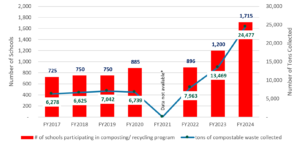
*Due to COVID-19 restrictions and guidance for school operation, schools were closed some of the time during the school year, and NYCPS adopted blended learning model (part time in person and part time online instructions) for part of the year. For those reasons, data was not systematically collected.
As shown in Chart 2, the number of schools that NYCPS reported as participating in the program has increased significantly since FY2022, from 896 to 1,715, a 91% jump. However, based on the results of a survey that the review team distributed to school administrators, only 86% of respondents stated that their schools are participating in the citywide recycling and composting program.
During this span, the amount of compostable waste also increased significantly in FY2023 and again in FY2024, showing increases of 69% and 82% respectively. The average tons collected per school participating in the recycling program is shown in Table 1 below.
Table 1. Average Number of Tons of Compostable Materials Collected per Participating School
| Fiscal Year | # of Schools Reportedly Participating in Composting/ Recycling Program | Tons of Compostable Waste Collected | Average Tons Collected per School |
| 2017 |
725 |
6,278 |
8.66 |
| 2018 |
750 |
6,625 |
8.83 |
| 2019 |
750 |
7,042 |
9.39 |
| 2020 |
885 |
6,739 |
7.61 |
| 2021 |
—– |
—– |
—– |
| 2022 |
896 |
7,963 |
8.89 |
| 2023 |
1,200 |
13,469 |
11.22 |
| 2024 |
1,715 |
24,477 |
14.27 |
As shown in Table 1, the average tons collected per school fluctuated from FY2017 through FY2022 (excluding FY2021), with a low of less than eight tons per school collected in FY2020. This may be due in large part to schools switching to remote learning in March 2020 because of the COVID-19 pandemic. Since FY2022, the average tonnage collected per participating school has increased significantly, going from 8.89 tons in FY2022 to 14.27 tons in FY2024, a 61% increase.
The review team attempted to obtain from NYCPS the total waste collected, to calculate the diversion rate for organic materials. Officials stated that it does not track diversion data; all such data would be collected by DSNY. Officials added that on an annual basis, DSNY provides NYCPS with the aggregated weight collected by DSNY trucks at transfer stations, but these figures include materials from other sources. The review team reached out to DSNY for those figures. In its response, DSNY stated that “schools are serviced by both dedicated school collection trucks that only collect waste from schools, as well as by trucks assigned to the residential route a given school is located on. For this reason, it is not possible to determine true diversion rates for school waste collected.”
Only 37% of School Food Waste is Captured for Composting and 28% of Compost Collected is Contaminated
DSNY data shows that most of the food waste collected from NYCPS schools in FY2023 was not captured for composting purposes, and the contamination rate for the NYCPS organic waste that was captured far exceeded the citywide contamination rate.
As part of its 2023 NYC Waste Characterization Study (WCS), DSNY examined samples of the waste collected from schools that participated in curbside composting collections. (According to the study, almost 70% of NYCPS’ schools participated.) That study found that 32.2% of waste collected from these schools was comprised of food scraps collected for composting. (These figures are shown in the chart below.) Overall, food waste accounted for 66% of the organics collected at schools for composting; food-soiled paper and compostable packaging (31%) and yard waste (3%) make up the remaining components.
Although food scraps account for almost a third of all school waste, most of the food waste is not captured for composting. The 2023 WCS found that only 37.1% of the food waste generated at schools was captured for composting; the remaining 63% was either incorrectly collected for recycling (paper or metal, glass, and plastic) or discarded as refuse. Further, of the organics that were diverted for composting, the rate of contamination (inclusion of materials unsuitable for composting, such as paper and plastics) far exceeded the citywide rate. The study found that 28% of the organics collected from schools were contaminated, well above the citywide organics contamination rate of 4%. Based on these figures, it appears that more work is needed to improve organics collections.
Figure 1
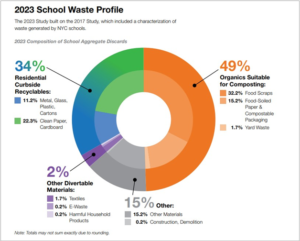
Source: 2023 NYC Waste Characterization Study
Based on the review team’s observations and interviews with faculty and staff at five schools, as well as data generated from survey responses, student engagement appears to be a contributing factor in the success of composting and recycling programs at schools. In one of the high schools that the review team visited, the school’s sustainability coordinator stated that, initially, students volunteered at the waste sorting station in the cafeteria, but the volunteering team was discontinued due to consistently low student participation. In that school, the review team also observed that students were throwing away their leftovers as well as the soiled containers with no regard for the purpose of each bin. The review team observed that all three bins had types of refuse that did not belong there. In response to the survey the review team sent, school administrators said one of the biggest challenges identified in administering the program was training students in the proper disposal of waste.
Surveys Indicate Need for Improved Engagement, Participation, and Best Practices Designed to Reduce Food Waste
NYCPS is required to conduct annual sustainability surveys with the schools. The results show low participation of schools in the activities noted in the survey. The review team conducting this review also surveyed schools to assess individual school adherence to best practices established to reduce food waste.
School Participation Rates in Recycling and Composting Activities are Limited
OES conducts annual sustainability surveys. Each survey covers five topics: (a) sustainability and education, (b) communication and outreach, (c) energy conservations, (d) waste reduction, and (e) general category, such as school garden/wellness/health.
OES directed their most recent survey to 1,182 public schools to collect information related to the 2024–25 school year.[9] OES asked 47 questions pertaining to these five areas. According to NYCPS, there were four questions relating to six activities that pertained to schools’ sustainability coordinators and food waste prevention programs. NYCPS provided the review team with responses from the survey, which show that no schools engaged in all activities covered in the report, and only one activity—Activity #2a, as shown in Table 2 below—achieved a better than 50% participation rate. The engagement rate for most activities ranged from 11% to 37%.[10]
Survey results varied considerably by school, as shown in Table 3 below. Only 12 schools (1%) reportedly engaged in all six activities, and 179 schools (15%) reported engaging in none of the activities. Most schools (1,023, or 87%) reportedly engaged in no more than three of the six activities. NYCPS did not provide an explanation for the low engagement rate. However, as discussed later in this report, schools identified insufficient staffing and challenges in training students as significant obstacles to engaging in recycling and composting efforts at schools.[11]
Table 2. Results of NYCPS’ Survey Sent to 1,182 Schools Regarding Sustainability Coordinators’ Composting and Recycling Efforts
| Activity | Number of Schools | |
| 1. | Waste & recycling: | |
|
a. |
Speaks to OFNS staff about launching or continuing the offer vs serve method* of serving meals to students |
348 (29%) |
|
b. |
Speaks to the principal and OFNS staff about participating in a food donation program |
228 (19%) |
| 2. | Health, wellness & green space: | |
|
a. |
Educates students about the connections between how our food is produced, what we choose to eat, sustainability, and personal health |
790 (67%) |
|
b. |
Partners with community organizations to address food insecurity and access to healthy food for all students |
301 (25%) |
| 3. | Works with the district’s Sustainability Specialist on: Participating in Food Waste Reduction Programs, including Offer Vs Serve, Shared Table, Food Donation Program, and/or Plastic Free Lunch Days |
126 (11%) |
| 4. |
Incorporates topic “only take what you will eat” into one of the Waste Climate Action Day |
443 (37%) |
* Offer versus Serve (OVS) is a provision that allows students to decline some of the food items offered on the service line when served without jeopardizing the federal funding requirements. One of the goals of OVS is to reduce food waste.
Table 3. Breakdown of Number of Questions Addressed by Schools in the Sustainability Survey
| Number of Activities Related to Food Waste Prevention Reportedly Engaged | Number of Schools |
|
0 |
179 (15%) |
|
1 |
361 (31%) |
|
2 |
280 (24%) |
|
3 |
203 (17%) |
| 4 |
101 (9%) |
| 5 |
46 (4%) |
| 6 |
12 (1%) |
| Grand Total | 1,182 (100%) |
Adherence to NYCPS’ Food Waste Best Practices is Inconsistent
The review team distributed a survey to 1,536 school administrators to learn about the ways schools follow the best practices set forth by OFNS and OES to prevent food waste. The review team received 288 completed responses.
The review acknowledges that the school administrators who responded to the survey represent only 19% of schools that were sent the survey.
The number of questions answered varied among respondents. (The results of the survey are shown in the Appendix.) Some of the key findings from the survey are as follows:
- 97% of respondents who answered the question stated that their schools have an appointed sustainability coordinator.
- 45% of respondents who answered the question stated that their schools provide training related to food waste prevention and sustainability to their students, staff, and faculty. 32% provide this training to students only and 11% to faculty and staff only. 11% do not provide any training.
- 59% of respondents who answered the question stated that their school set up a food sharing table, while 41% did not. The most frequent reason given for not implementing the food sharing tables (some schools gave more than one) was lack of staffing (38%), and the second was lack of interest from staff and faculty in participating (27%). Twenty-one percent responded that they did not have enough information to implement this program.
- 86% of respondents who answered the question stated that their schools participate in the citywide composting and recycling program, and 14% of schools do not. The most frequent reasons given for not implementing composting included lack of funding and resources (34%) and insufficient training for staff and faculty (31%). Ninety percent of the schools that stated that they participate in the composting and recycling programs have been doing it for over a year, including 28% that entered this program over three years ago.
- 33% of respondents who answered the question stated that their schools donate packaged and uneaten leftovers to either school families, school staff, or outside organizations. On the other hand, 59% of the schools do not donate the food and discard it with composting or regular garbage, while 8% of schools did not know what happens with the leftover food.
Recommendations
To improve its food waste prevention efforts, the reviewers propose that NYCPS:
- Establish NYCPS-wide targets for participation in composting, food donation, and other programs established to reduce food waste.
- Compile NYCPS-wide data to support the assessment of progress against such targets.
NYCPS Response: NYCPS disagreed with recommendations 1 and 2, stating that it is in compliance with the City Agency Food Waste Prevention Plan, Local Law 57, noting that only a limited number of schools participate in food donation programs, and asserting that their strategy to minimize excessive food production is appropriate.
Review Team Comment: Establishing agency-wide targets would facilitate NYCPS’ ability to measure its success in its food waste reduction efforts. While attempting to ensure excess food is not produced is a good strategy, it does not eliminate food waste caused, for example, by students choosing not to eat prepared food. The sheer bulk of compost generated by schools suggests that significant waste remains. Reducing food waste effectively across the board should be supported by agency-wide goals and data collection, particularly given the food insecurity experienced by New Yorkers. Without compiling this data system-wide, NYCPS is unable to assess the effectiveness of its strategies.
- Conduct and publish the results of a centralized assessment of progress—by school and by program—identify barriers to progress and develop strategies for improvement.
NYCPS Response: NYCPS disagreed with this recommendation. USDA guidelines require OFNS to provide reimbursable meals that meet specific meal pattern requirements. OFNS must order and prepare food with the goal of providing one meal per child at each meal service.
Review Team Comments: Ensuring that meals are provided to students in accordance with the USDA guidelines does not conflict with doing so in a manner that minimizes food waste.
- Develop NYCPS-wide training and outreach programs to:
- Increase participation in all NYCPS food waste reduction programs;
- Encourage information and idea sharing, and create opportunities for collaboration, amongst sustainability coordinators across the school system;
- Improve the percentage of food waste that is captured as potential compost; and
- Reduce contamination to ensure that what is captured is compostable.
- Conduct on-site visits to schools to verify that they comply with the composting and recycling requirements by having recycling and composting bins properly placed in cafeterias and classrooms.
NYCPS Response: NYCPS stated that it partially agrees with this recommendation and that it will continue to encourage all school principals to participate in the food donation programs, implement share tables and develop and foster partnership opportunities for sustainability coordinators and other school stakeholders to network, share information, and exchange ideas. NYCPS stated that its primary goal is to have minimal food waste and ensure proper composting, and that it will continue to provide support to schools through educational training and visits from OES staff.
Review Team Comments: NYCPS does not identify the portion of the recommendation with which it disagrees. Its response suggests agreement with the recommendation.
- Identify schools that do not have appointed sustainability coordinators and ensure these positions are filled and provide strong support to the new coordinators.
NYCPS Response: NYCPS agreed with this recommendation.
Recommendations Follow-up
Follow-up will be conducted periodically to determine the implementation status of each recommendation contained in this report. Agency reported status updates are included in the Audit Recommendations Tracker available at: https://comptroller.nyc.gov/services/for-the-public/audit/audit-recommendations-tracker/
Scope and Methodology
This review was conducted in accordance with the responsibilities of the City Comptroller as set forth in Chapter 5, §93, of the New York City Charter.
The scope of this review was from February 2016 through December 2025.
To obtain an understanding of the policies, procedures, and regulations governing NYCPS’ efforts to prevent food waste, the review team reviewed:
- NYC Local Law 41 of 2010, which amended the administrative code of NYC in relation to recycling in public and private schools.
- NYC Local Law 77 of 2013, which amended the administrative code of NYC in relation to collection of food waste.
- Chancellor’s Regulation A-850 Sustainability, issued on January 17, 2013.
- The New York State Education Law section 305, Subdivision 32, effective March 2018, which authorizes the commissioner of education, in cooperation with the commissioner of agriculture and markets, to establish voluntary guidelines to provide for the donation of excess, unused food from school, university, or other educational institutions’ meal programs to voluntary food assistance programs.
- Local Law 57 of 2021, which amends the administrative code of NYC in relation to city agency food waste prevention plans.
- Local Law 65 of 2021, which amends the administrative code of NYC in relation to school food waste prevention plans.
- NYC Guide to Clean & Green Schools published by the NYCPS and DSNY.
- NYCPS’ Policy on Food Donation Program.
- NYCPS’ Food Production Record Form.
Additionally, to obtain information about the responsibilities and operations of OFNS, the review team conducted a walkthrough with the Senior Executive Director, the Executive Director of Operations, Chief of Staff, and Senior Advisor for Special Projects. To learn about responsibilities and operations of OES, the review team conducted a walkthrough with the Chief Sustainability & Decarbonization Officer and Deputy Director of Sustainability. To understand how OES and OFNS processes are executed in the daily operation of the school, the review team visited five schools that NYCPS pointed out as exemplary: three elementary schools, one middle school, and one high school. During these observations, the project team interviewed OES regional representatives, OFNS regional directors, principals, assistant principals, teachers, kitchen managers, sustainability coordinators, and students and staff representing the Green Teams.
To determine NYCPS’ current efforts in educating faculty and students in the topics related to food waste prevention, including but not limited to food donations and composting, the review team conducted a detailed review of the information posted on NYCPS’ Sustainability Hub related to these topics. To quantify the number of students receiving lunch, the review team reviewed School Food Reports published on NYCPS’ website from FY2018 through FY2025. Further, during observations, the review team reviewed various educational material given to school staff regarding best practices to ensure proper amounts of food preparations and best practices to compost and recycle.
To establish the population for the participatory survey to schools, the review team requested from NYCPS a list of active schools, for which NYCPS provided the interim School Food Report for FY2025 (as of December 2024).
The review team requested data from NYCPS that showed whether schools participated in the food sharing tables and/or community organization food donations and determined the schools’ participation rate in these documents. To collect statistics and information regarding NYCPS’ efforts related to food donations, composting and recycling, the review team reviewed DSNY’s 2023 NYC Waste Characterization Study and NYCPS’ sustainability reports from FY2017 through FY2024, obtained from NYCPS results of the annual sustainability survey NYCPS sent to the sustainability coordinators in FY2024, and conducted research of not-for-profit organizations that provide support to schools in the efforts to combat food waste.
Lastly, to learn how schools implement NYCPS’ efforts to combat food waste, especially in the areas of donating excess food and composting discarded food, the review team conducted a participatory survey sent to 1,536 schools and received 288 valid responses.
Appendix
The following is a breakdown of the responses provided by 288 general education public schools in response to a food waste prevention survey the review team administered between June 6 and July 1, 2025.
The subscript notations (i, ii, iii etc.) used in this document reference the associated survey item numbers and identify the components that continue or connect into the following questions.
Food Waste Prevention – Sustainability Related Matters
| Do you have an appointed sustainability coordinator? | ||
|
Yes |
278 | 97% |
| No | 10i |
3% |
| Total | 288 |
100% |
| iWhat are the reasons for not having a sustainability coordinator? | ||
| In process of appointing |
3 |
30% |
| Unaware/Do not know |
2 |
20% |
| Lack of interest from faculty and staff |
1 |
10% |
| Lack of training and resources |
1 |
10% |
| Sustainability Coordinator on Maternity Leave |
1 |
10% |
| New principal |
1 |
10% |
| Hub site[12] |
1 |
10% |
| Total |
10 |
100% |
| Does your school provide any type of education (workshop) to students and faculty about recycling and composting? | ||
| Yes – all students, faculties and staff |
131 |
45% |
| Yes – faculty and staff only |
33 |
11% |
| Yes – students only |
92 |
32% |
| No education is provided for anyone in the school |
32 |
11% |
| Total |
288 |
100% |
| Is your school currently participating in recycling and composting programs? | ||
| Yes | 247ii | 86% |
| No | 41iii | 14% |
| Total | 288 | 100% |
| iiHow long has your school been participating in these programs? | ||
| Less than 1 year |
25 |
10% |
| 1 year |
60 |
24% |
| 2 years |
70 |
28% |
| 3 years |
23 |
9% |
| More than 3 years |
69 |
28% |
| Total |
247 |
100% |
| iiHow would you rate the success of these programs in diverting trash from your school’s garbage? | ||
| Somewhat successful |
111 |
45% |
| Neutral |
63 |
26% |
| Very successful |
42 |
17% |
| Somewhat unsuccessful |
18 |
7% |
| Unsuccessful |
13 |
5% |
| Total |
247 |
100% |
| iiWhat types of waste are included in your recycling / composting program? (Check all that apply) | ||
| Types of Waste |
# of Schools |
% of Schools |
| Food scraps for composting |
224 |
91% |
| Paper / Cardboard |
220 |
89% |
| Plastic / Metal/Glass |
205 |
83% |
| Total |
247 |
|
| iiiWhat are the reasons your school is not participating in recycling and composting programs? (Check all that apply) | ||
| Reasons provided | # of Schools | % of Schools |
|
Insufficient resources or funding |
23 | 56% |
| Staff not sufficiently trained |
21 |
51% |
| Lack of awareness about the program |
17 |
41% |
| Facilities and Sanitation Operational Challenges |
3 |
7% |
|
Participate in recycling, not composting |
2 |
5% |
|
In process of integrating |
1 |
2% |
|
Total |
41 | |
| What challenges, if any, does your school face in adhering to the requirements of these programs? (Check all that apply) | ||
| Challenges mentioned | # of Schools | % of Schools |
| Staffing | 136 | 47.22% |
| Training students in proper disposal of waste | 134 | 46.53% |
| Training of staff and faculty in proper disposal of waste | 124 | 43.06% |
| Funding | 103 | 35.76% |
| None | 13 | 4.51% |
| Lack of Cooperation – custodians | 8 | 2.78% |
| Oversight Constraints | 7 | 2.43% |
| Complaint about DSNY practices | 6 | 2.08% |
| Time constrains | 4 | 1.39% |
| Lack of supplies/bins | 3 | 1.04% |
| Lack of signage | 3 | 1.04% |
| Process too demanding for the school environment | 2 | 0.69% |
| Lack of Space | 2 | 0.69% |
| Lack of information | 1 | 0.35% |
| Students not cooperating | 1 | 0.35% |
| Total | 288 | |
Food Waste Prevention – Donation Program
| Does your school have a food sharing table? | ||
| Yes | 171 | 59% |
| No | iv117 | 41% |
| Total | 288 | 100% |
| ivPlease provide a reason why your school does not have a food sharing table. (Check All That Apply) | ||
| Reasons Provided | # of Schools | % of Schools |
| Lack of Staffing | 45 | 38% |
| Lack of interest in faculty and staff in participating | 32 | 27% |
| Lack of Funding | 26 | 22% |
| Lack of information | 24 | 21% |
| Difficult to follow the program’s rules | 21 | 18% |
| Students do not follow the program’s rules | 15 | 13% |
| Food Allergy/Safety Concerns | 2 | 2% |
| Total | 117 | |
| What is done with the leftover food that has not been taken from the food sharing table and/or the food that has been cooked, not served to the students and can’t be served in subsequent days? (Check all that apply) | ||
| Responses | # of Schools | % of Schools |
| Donated to families of students attending the school | 86 | 29.9% |
| Donated to organizations | 7 | 2.4% |
| Donated – Shared with students and staff | 6 | 2.1% |
| Discarded with composting | 135 | 46.9% |
| Discarded with trash | 121 | 42.0% |
| Unknown | 23 | 8.0% |
| Policy Issues | 1 | 0.3% |
| Total | 288 | |
| If food is donated to organizations, which ones? | ||
| No Donations to organizations | 267 | 92.7% |
| Donated to organization with specific name | 6 | 2.1% |
| Donated to Local church / shelter / community group / food pantry | 6 | 2.1% |
| No donation allowed due to policy | 4 | 1.4% |
| Lack of information on donation policies | 3 | 1.0% |
| In process of integrating | 1 | 0.3% |
| Not sure which organization | 1 | 0.3% |
| Total | 288 | 100% |
OES Team Outreach & Engagement
| Did you ever contact the Office of Energy and Sustainability (OES) team for questions or concerns? | ||
| No, we never had a need to contact the team. | 118 | 41% |
| No, we never contacted the team because we did not know one existed. | 66 | 23% |
| No, we never contacted the team because we don’t know how to contact the team. | 23 | 8% |
| Yes, we have contacted the team. | 81v | 28% |
| Total | 288 | 59% |
| vHow would you describe your interaction with the OES team? | ||
| The team responded promptly and was very helpful. | 71 | 88% |
| Team responded but did not satisfactorily address the question/concern. | 5 | 6% |
| The team was not quick to respond but was able to satisfactorily address the question/concern. | 3 | 4% |
| Did not receive a response. | 2 | 2% |
| Total | 81 | 100% |
Endnotes
[1] Based on a four-year average of meals served to all participating schools in NYC from Fiscal Years 2022 to 2025.
[2] Our review concentrates only on the food served at NYCPS public district schools. In our analysis, we excluded all schools under the governance of districts for special and alternative education (districts 75, 79, 84 and 88) if they operate in a stand-alone building. If a building housed both, a school governed by one of the above-mentioned districts and a public district school, that building remained in our review.
[3] In its response, NYCPS states that ‘The Report refers to the City’s 2016 initiative as a “Zero Waste Challenge.” The correct name of the program is the Zero Waste Schools initiative.’ It should be noted that the 2016 citywide Zero Waste Challenge and NYCPS’ Zero Waste Schools are two distinctive initiatives and the report refers to both.
[4] The offer vs. serve method allows students to pick three of five lunch items or three of four breakfast items.
[5] In its response to the Draft Report, NYCPS claimed that the report had “produced several inaccuracies and mischaracterizations that, taken together, present an incomplete and at times misleading depiction of NYCPS operations and programs.” All matters covered in this report were discussed with NYCPS officials during the review and a written summary of findings was presented to NYCPS. After a careful review of the records and information provided, the review team concluded that no changes to the review’s findings were warranted.
[6] NYC Mayor’s Office of Food Policy report titled January 2025 Food by the Numbers.
[7] Federal Regulation 7CFR section 210.10(a)(3)
[8] Several school buildings may house more than one school, and one school may be housed in more than one building. Generally, there is one kitchen per building.
[9] In its response to the Draft Report, NYCPS stated that the 1,182 public schools to which the survey was distributed included District 75 schools.
[10] Activity #2a was described as: “Educates students about the connections between how our food is produced, what we choose to eat, sustainability, and personal health”— 790 schools indicated this was done.
[11] In its response to the Draft Report, NYCPS argued that the review’s analysis of this subset does not accurately reflect overall school engagement in sustainability programs. The review team notes that the full sustainability survey was requested from NYCPS, but this was not provided. Officials provided only those sections that they determined to be related to food waste. The report accurately reflects what was provided to the review team.
[12] This is not a regular school building. This is a STEAM Center that offers 12 pathways across five sectors under the Career & Technical Education program model for students from different high schools who are in grades 11 and 12.