The Law requires that construction employees on an eligible site with 100 units or more be paid a minimum hourly rate, with higher rates for sites with 150 or more units in areas that have been designated as Zone A or Zone B, as set forth in more detail below. These hourly wage rates are subject to an annual escalator of 2.5%. The Applicant for ANNY benefits must post a Worker Notice Poster in a prominent and accessible place for construction employees at the worksite and comply with all relevant record-keeping requirements. The Comptroller’s Regulations implementing the construction wage requirements of § 485-x are available here. All building service employees employed at a site with 30 or more units must be paid prevailing wages and benefits for the duration of the applicable benefit period. The Applicant must submit an annual certification to the Office of the Comptroller.
485-X Construction Wage Rates
| Applicable Date | 100 Units or More | 150 Units or More, Zone A | 150 Units or More, Zone B |
|---|---|---|---|
| 7/1/2024 | $40.00 per hour | The lesser of $72.45 per hour or 65% of the greatest prevailing wage within a classification | The lesser of $63.00 per hour or 60% of the greatest prevailing wage within a classification |
| 7/1/2025 | $41.00 per hour | The lesser of $74.26 per hour or 65% of the greatest prevailing wage within a classification | The lesser of $64.58 per hour or 60% of the greatest prevailing wage within a classification |
| 7/1/2026 | $42.03 per hour | The lesser of $76.12 per hour or 65% of the greatest prevailing wage within a classification | The lesser of $66.19 per hour or 60% of the greatest prevailing wage within a classification |
Notices to the Comptroller
To submit the required Commencement Notice to the Comptroller, or to notify the Comptroller that Construction Work on the site is not subject to the wage requirement because the work is covered by a Project Labor Agreement, Collective Bargaining Agreement, or Jobsite Agreement, please use this form. The Comptroller will also accept notices submitted via email at laborlaw@comptroller.nyc.gov.
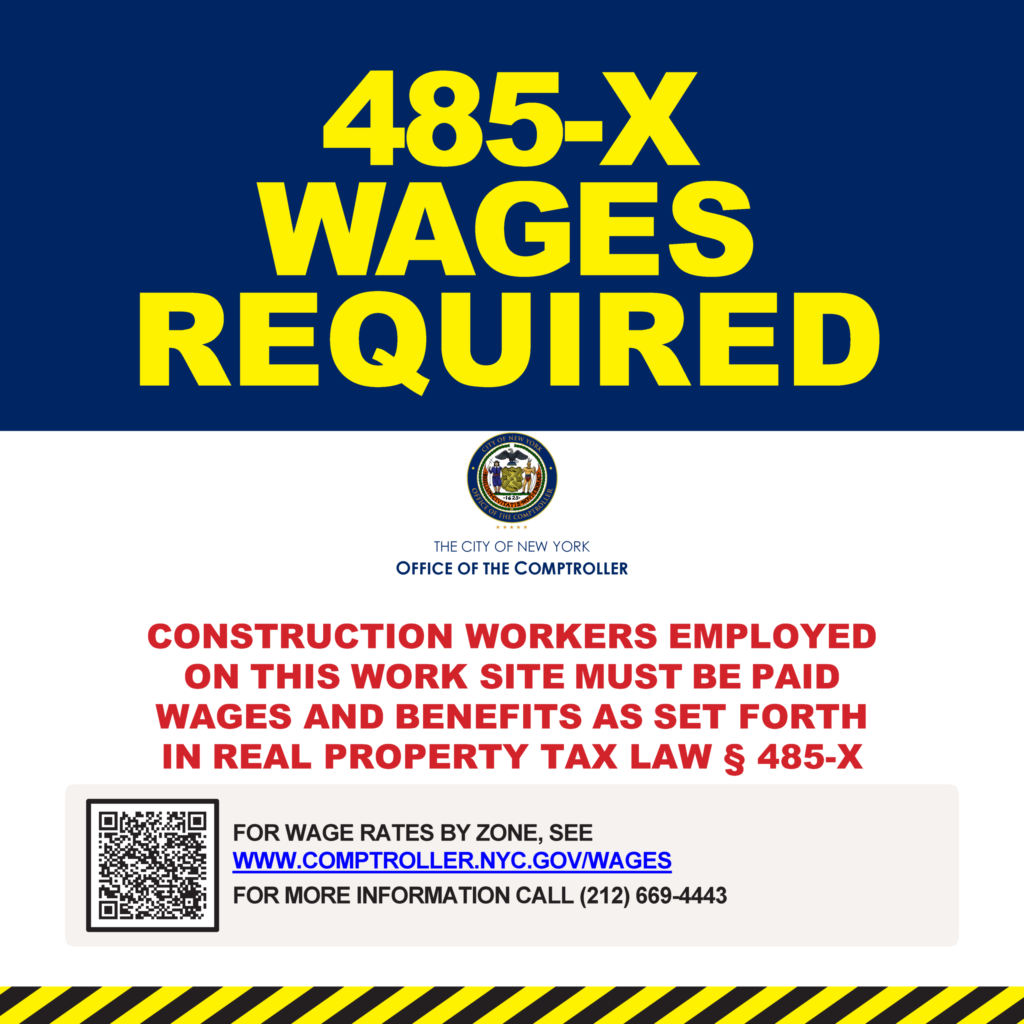
Worker Notice Poster
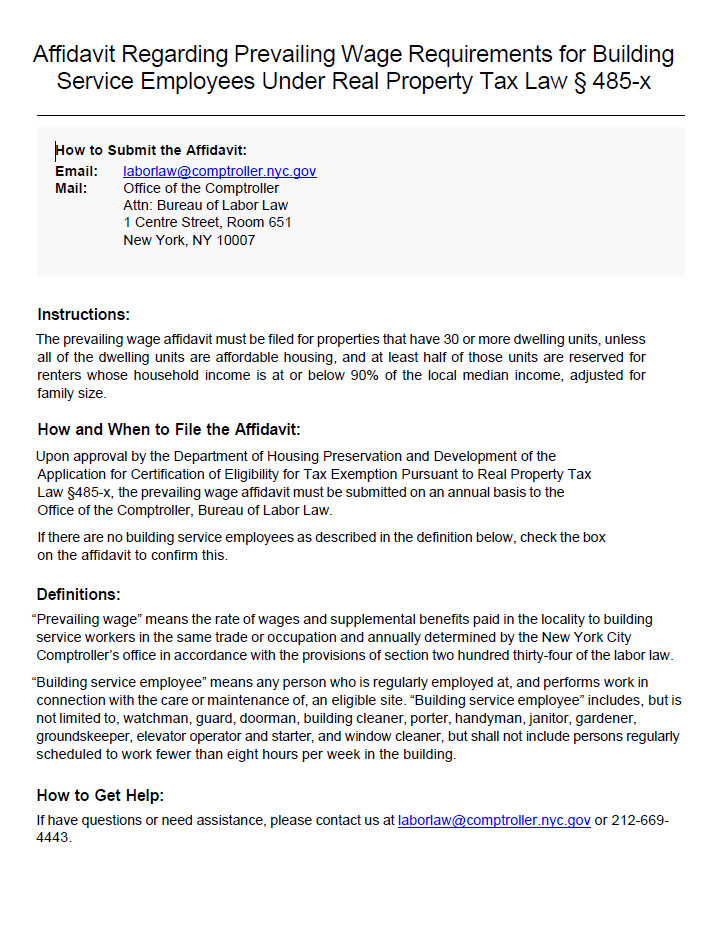
485-x Prevailing Wage Affidavit
485-x FAQs:
What is Real Property Tax Law § 485-x?
Real Property Tax Law § 485-x, also known as the Affordable Neighborhoods for New Yorkers (ANNY) tax incentive program, provides an exemption from real property taxes to housing developments that meet certain affordability requirements. The law also creates wage requirements for construction and building service employees on covered sites. In this FAQ, the terms “§ 485-x,” “the law,” or “the statute,” may be used interchangeably to refer to this program.
What is the purpose of this FAQ?
This FAQ is intended to assist compliance by supplementing the information provided in the Comptroller’s § 485-x Regulations regarding wages for employees performing construction work on a covered site. For information about prevailing wage requirements for building service employees, see the § 485-x Regulations issued by the Department of Housing Preservation and Development, available at 28 RCNY Chapter 63.
This FAQ is not intended to be legal advice or to substitute for a legal opinion. You should seek independent legal counsel for assistance with your specific situation.
What is the “construction wage requirement”?
As used in the Comptroller’s § 485-x Regulations, the term “construction wage requirement” refers to the wage obligations set forth in Real Property Tax Law § 485-x(3) with respect to employees performing construction work on a covered site.
The following section explains the construction wage requirement under § 485-x.
Who is responsible for ensuring compliance with the construction wage requirement on a covered site?
The Applicant, including the Applicant’s agents or successors, the Owner, and the employer of construction employees shall be jointly liable for violations of the construction wage requirement, regardless of whether the construction employees were directly employed by the Applicant or Owner.
What are “wages and supplements”?
“Wages and supplements” refer to the rate of pay and supplemental benefits set forth for each classification in the Comptroller’s prevailing wage schedules.
What is the “greatest prevailing rate of wages and supplements within a classification”?
This term, which is used in § 485-x, refers to the highest rate of wages and supplements listed for a specific job classification in the Comptroller’s Construction Worker Schedule or Apprentice Construction Schedule, whichever is applicable.
Some classifications have varying rates of wages and supplements based on the number of years of a worker’s employment in the industry. In this situation, the highest rate of pay must be used, regardless of a particular worker’s actual years of experience in the industry.
However, where the Comptroller’s Schedules list only one rate of wages and supplements, then that rate shall be considered the “greatest prevailing rate of wages and supplements within a classification.”
Below are a few examples to illustrate the issue:
Example 1: The Core Driller Helper classification in the Construction Worker Schedule provides four different rates for employees with one, two, three, and more than three years of employment in the industry.
For this particular classification, the “greatest prevailing rate of wages and supplements within a classification” is the rate for workers with more than three years of employment in the industry, regardless of a particular employee’s actual years of experience in the industry.
Example 2: The Driver: Truck title contains three classifications: Driver–Dump Truck; Driver–Tractor Trailer; and Driver–Euclid & Turnapull Operator.
Although all three classifications fall under the title of Driver: Truck, they are independent classifications reflecting different work duties. An employee working as a Driver–Dump Truck must be paid based on the rates listed in the Driver–Dump Truck classification. In this scenario, the rates for the Driver–Tractor Trailer and Driver–Euclid & Turnapull Operator classifications would not be apply.
Example 3: The Cement and Concrete Worker title in the Construction Apprentice Schedule has varying rates for the first 1333 hours, second 1333 hours, and last 1334 hours of work performed in that classification. The rate for an Apprentice performing such work must be calculated based on the rate of wages and supplements for the last 1334 hours of work performed in that title, regardless of the actual number of Cement and Concrete work hours completed by the individual apprentice.
The law says that I must pay the lesser of a specific dollar amount, or a percentage of the greatest prevailing rate of wages and supplements within a classification. How do I know which one applies?
This correct rate will be calculated based on the wage and supplement rates that appear in the Comptroller’s Prevailing Wage Schedules. Below are a few examples to illustrate the issue:
Example 1: A construction employee is performing work as a Glazier at a site with 150 units in Zone A in October 2025. The hourly rate applicable to such a site in Zone A in October 2025 is the lesser of $74.26 or 65% of the greatest prevailing rate of wages and supplements in a classification.
Based on the Comptroller’s Construction Worker Schedule, the Glazier’s wage rate in October 2025 is $49.20 per hour and the supplemental benefit rate is $57.22 per hour. The combined wage and supplement rate for the Glazier classification is $106.42 per hour. Sixty-five percent of this total rate is $69.17. The employee only needs to be paid the lesser of $74.26 or 65% of their hourly wages and supplements, so $69.17 is the minimum required construction wage.
Example 2: A construction employee is performing regular/day shift work on the same Zone A site as “Electrician A.” In October 2025, this classification has a wage rate of $62.00 per hour and a supplemental benefit rate of $66.90 per hour in the Comptroller’s Construction Worker Schedule. The combined hourly rate of wages and supplements for this classification is $128.90. Sixty-five percent of the Electrician’s total hourly rate is $83.79. Because the employee only needs to be paid the lesser of $74.26 or 65% of their hourly wages and supplements, $74.26 is the required minimum in this scenario.
I hired a third party to process my application for § 485-x tax benefits. Is the third party liable for wage violations?
No, the definition of Applicant does not include a person or entity that is retained solely for the purpose of submitting an application and corresponding materials.
Instead of paying supplements as cash wages, can I meet my obligations by providing other types of employee benefits?
Yes, the supplemental benefit requirement may be met through premiums or contributions made into plans or funds that provide health, welfare, non-occupational disability coverage (i.e., coverage that is not workers’ compensation), retirement, vacation benefits, holiday pay, life insurance and apprenticeship training. Paid leave, as required by federal, state, or local law, will count towards the supplemental benefit requirement.
Can payments made for New York State unemployment insurance, New York State disability insurance, metropolitan commuter transportation mobility tax, federal unemployment insurance, or pursuant to the Federal Insurance Contributions Act or any other payroll tax count towards my wage or supplemental benefit obligation?
No, these payments do not count towards the wage or supplemental benefit obligation.
What proportion of an employee’s hourly wage rate can be provided as employee benefits instead of cash wages?
Up to 50% of the employee’s wages can be provided as supplemental benefits, regardless of whether the employee is paid a flat hourly rate or a percentage of the greatest rate of prevailing wage and supplements within a classification.
How are overtime, weekend, and holiday pay calculated?
Each construction employee’s rate of pay for overtime, weekend, and holiday hours must be based on the overtime rules set forth in the Comptroller’s Construction Worker Schedule or Construction Apprentice Schedule for that classification.
Example: The Comptroller’s Construction Worker Schedule indicates that the Glazier classification must be paid double the hourly rate on holidays. A Glazier working on the site on New Year’s Day would be entitled to double their hourly rate of pay.
The Comptroller’s Construction Worker Schedule also requires the Glazier to be paid one and a half times their regular hourly rate when the employee works more than 8 hours in a workday. Thus, the Glazier would be eligible for overtime after 8 hours by multiplying the hourly wage rate by 1.5.
Is there a prohibition on overtime hours in § 485-x?
There is no prohibition on overtime hours, provided the employee is paid the correct overtime, weekend, or holiday rate, as described above.
Does § 485-x dictate apprentice ratio requirements?
No, § 485-x does not set forth such requirements, but apprentices must be paid the required construction wage for their classifications, as noted above.
During the construction phase, what kind of work is subject to the § 485-x construction wage requirement?
Section 485-x covers construction work performed on the site from the commencement date to the completion of construction on the site. Construction is defined broadly as the process whereby “materials and constituent parts are combined to initially form, make or build an eligible multiple dwelling, including without limitation, painting, or providing of material, articles, supplies or equipment in the eligible multiple dwelling, but excluding security personnel and work related to the fit-out of commercial spaces.”
Is demolition work covered?
Work that takes place prior to the commencement date, which is defined in the statute as “the date upon which excavation and construction of initial footings and foundations lawfully begins in good faith,” is not covered by the construction wage requirement.
What does it mean to provide material, articles, supplies, or equipment? Is delivery/truck driving work covered?
To determine whether delivery work is covered, the Comptroller’s office evaluates factors including the length of time spent on site by the driver, the extent and nature of the role of the driver, the extent of the driver’s involvement with the overall construction project, the location of the delivery, whether this is a single or multiple delivery, and the type of material or fixture delivered. Only time actually spent on the worksite is covered.
Example 1: A truck driver makes a single delivery of bathroom fixtures to the covered site, leaving the fixtures at the entry of the site and spending less than ten minutes on the site. Such work would not be covered by the construction wage requirement because the time spent and level of involvement are limited, and the fixtures are not part of the “initial forming, making or building” that is, the construction, of the dwelling.
Example 2: A truck driver delivers cement to the covered site to be used to form parts of the building, spending approximately one hour on the site pouring the cement. Such work would be covered by the construction wage requirement because the driver spent a substantial amount of time on the site and the cement is part of the “initial forming, making or building” of the dwelling.
Example 3: A crew is hired to remove soil as part of the excavation process, spending several hours on the covered site. Such work would be covered by the construction wage requirement because excavation is part of the “initial forming, making, or building” of the dwelling.
Are building service employees covered by § 485-x?
Building service employees must be paid prevailing wages and supplements as set forth in the Comptroller’s Building Service Employee Schedule. These wages must be paid for the duration of the tax benefit period, regardless of whether such benefits are ultimately revoked or terminated. For more information, see the § 485-x Regulations issued by the Department of Housing Preservation and Development, available at 28 RCNY Chapter 63.
In addition, the Applicant must submit an annual certification to the Comptroller that its building service employees are being paid the prevailing wage.
Note that security personnel during the construction phase are excluded.
What notice must be provided to the Comptroller under § 485-x?
At least three (3) months prior to the Commencement Date, the Owner must submit the following information to the Comptroller:
(1) the location of the Eligible Multiple Dwelling,
(2) the anticipated Commencement Date,
(3) the anticipated Completion Date, and
(4) the existence of any Project Labor Agreement regulating Construction Work on the Covered Site.
What happens if I don’t submit this notice?
Failure to comply with the Law’s notice requirements subjects the Owner to a fine of up to $5,000 per day. If construction begins prior to providing the required notice, the Owner forfeits the tax abatements and exemptions provided under § 485-x.
I wasn’t aware of the notice requirement until the Comptroller published its regulations, which was after construction commenced on my project. Am I subject to a fine?
Owners will have 30 days from the effective date of the Comptroller’s § 485-x Regulations to submit any required notices for projects that commenced prior to the effective date of the regulations.
What if the site is covered by a Project Labor Agreement?
A site covered by a Project Labor Agreement is excluded from the construction wage and notice requirements of § 485-x, provided the PLA expressly waives the provisions of § 485-x(3)(a), (b), (c) and (d). However, the Owner must notify the Comptroller of the exclusion by submitting the following information:
(a) the location of the Eligible Multiple Dwelling,
(b) the anticipated Commencement Date,
(c) the anticipated Completion Date, and
(d) the existence of any Project Labor Agreement regulating Construction Work on the Covered Site.
What if some of the work is covered by a Collective Bargaining Agreement or Jobsite Agreement?
Work covered by a Collective Bargaining Agreement or Jobsite Agreement that expressly waives the provisions of § 485-x(3)(a), (b), (c) and (d) is excluded from the construction wage and notice requirements of § 485-x.
For example, if the carpenters performing work on the site are covered by a Collective Bargaining Agreement with an express waiver, the contractor and Owner are excluded from the wage and notice requirements with respect to those workers only.
The Owner or contractor must notify the Comptroller of the exclusion by submitting the following information:
(a) the location of the Eligible Multiple Dwelling,
(b) the anticipated Commencement Date,
(c) the anticipated Completion Date, and
(d) the existence of Collective Bargaining Agreement or Jobsite Agreement regulating Construction Work on the Covered Site.
How do I submit the required information to the Comptroller?
Submit your information using this form. The Comptroller will also accept notices that are submitted via email to laborlaw@comptroller.nyc.gov.
What recordkeeping is required by § 485-x?
Every Owner of a Covered Site is required to maintain Certified Payroll Reports.
In addition, an Owner whose site is not excluded from the wage requirements of § 485-x must also maintain the following records:
- Contracts and subcontracts for construction work on the covered site;
- List of all construction employees and their last known addresses, telephone numbers, and, where available, e-mail addresses;
- Daily Sign-In Logs for construction employees;
- Weekly payroll records, registers or journals as required by Labor Law 195;
- All documents concerning the cost of supplemental benefits provided to construction employees, including, but not limited to, invoices, account statements, benefits remittance reports and benefits plan descriptions.
The Owner is responsible for maintaining records for a period of six years after the completion date of the eligible multiple dwelling. Even if the Owner delegates recordkeeping responsibilities to the general contractor on the site, the Owner remains jointly and severally liable.
Each contractor performing work on the site is also required to maintain, for all construction employees, all federal and state employment tax returns and filings, including, but not limited to, quarterly combined withholding, wage reporting, and unemployment insurance form NYS-45 returns; employers’ quarterly Federal tax form 941 returns; wage and tax form W-2 statements; and miscellaneous income form 1099 statements.
The regulations reference a Worker Notice Poster that must be posted at the worksite. Where do I obtain this?
The Worker Notice Poster is a 2’ x 2’ poster that must be placed in a prominent and accessible place for construction employees at the worksite. Posters may be requested from the Comptroller’s office free of charge by contacting the Bureau of Labor Law at (212) 669-4443 or via email at laborlaw@comptroller.nyc.gov, or you may produce your own poster using the template available on the Comptroller’s website.
Can I use electronic certified payroll reporting?
Yes, provided that the electronic certified payroll report sets forth the names, addresses and trade classifications for all construction employees employed on a particular project or contract on the covered site, as well as the hours and days of construction work, the hourly wages and supplement rates, and the weekly gross and net pay amounts for each construction employee. It must be signed digitally and affirmed to be true under penalty of perjury by an officer or principal of the Owner or a contractor authorized by the Owner.
Can I use electronic daily sign-in logs?
An Owner may use electronic daily sign-in logs with verified electronic signatures only with the Bureau of Labor Law’s written approval. The Bureau will evaluate whether each construction employee has a unique identifier, the timekeeping program’s procedures for clocking in and out, and whether the program accurately records each employee’s actual start and end times. The Bureau will not approve a program that automatically defaults to a standard work day (e.g. 8 hours) as opposed to tracking actual hours and minutes worked by each construction employee.
I’m a construction employee who hasn’t been paid the correct wages or benefits. What can I do?
Any construction employee who believes they have not been paid the wages or benefits required by § 485-x may file a complaint directly with the Comptroller’s office using our Online Complaint Form. The Bureau of Labor Law will open an investigation into the matter.
Can an employee be fired, demoted, or subject to other adverse employment action for filing a complaint with the Comptroller’s Office?
No. This is considered interference with the Comptroller’s investigation. The Comptroller is entitled to seek back pay, interest, and penalties on behalf of the affected employee.
What happens during an investigation?
The Comptroller’s Office issues an administrative subpoena to collect documents and records from the parties under investigation. After all documents are collected, the Comptroller’s Office will determine whether a violation has occurred and will calculate the underpayment of wages, along with any interest or penalty amounts.
Once the Comptroller’s Office calculates any underpayment and interest, the Owner will be provided an opportunity to settle the matter. If no settlement is reached, the matter will proceed to a hearing before the New York City Office of Administrative Trials and Hearings (OATH).
If the parties enter into a settlement agreement, or the Comptroller’s Office is successful in its OATH litigation, payments will be issued to all workers who were found to have been underpaid.
Who may be held responsible for the underpayment of § 485-x’s construction wage requirement? What are the penalties for violating § 485-x?
Failure to comply with the requirements of § 485-x may subject the Applicant, Owner, general contractor and construction employer to an investigation, litigation, back wages, interest, fines, liquidated damages, and under certain circumstances may result in the termination, revocation, or recapture of tax benefits.
Under what circumstances can my tax benefits be revoked?
The Comptroller may begin proceedings to terminate or recapture ANNY program benefits where an Applicant has committed three uncured violations of the construction wage requirement within a five-year period.
I still have questions about § 485-x. Who can I contact?
You may reach the Comptroller’s Bureau of Labor Law at (212) 669-4443 or via email at laborlaw@comptroller.nyc.gov.